Tehran / Washington — In a disclosure that has sent shockwaves through diplomatic and intelligence circles worldwide, Iranian officials have confirmed that Mojtaba Khamenei the reclusive, powerful son of Supreme Leader Ali Khamenei and the figure most widely considered his likely successor was physically affected by a U.S. strike, claiming he was knocked from a staircase by the force of a nearby blast but is now “recovering well.” The admission, extraordinary in its rarity given Iran’s culture of absolute silence around the Khamenei family’s personal security, has immediately intensified scrutiny of the US-Iran war’s escalating trajectory and raised profound questions about what Washington may or may not have known about who was inside the targeted facility.
What Iran Said and How It Said It
The disclosure came not through a formal government press conference but through a carefully worded statement attributed to a senior Iranian official speaking to state-affiliated media a deliberate communications choice that allowed Tehran to control the narrative without triggering a full-scale official response that would demand a matching official reaction from Washington.
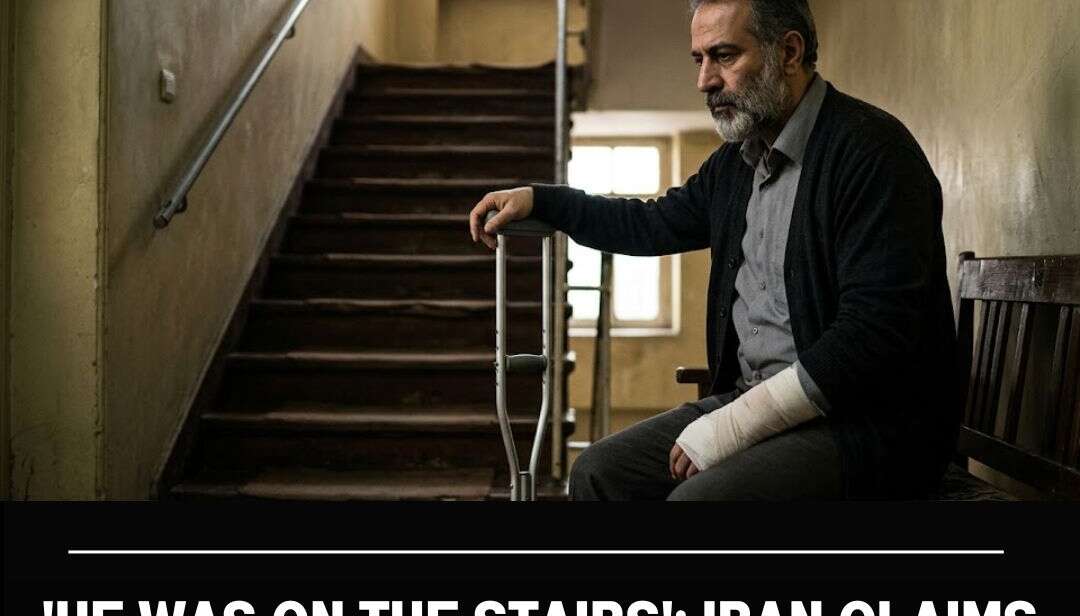
According to the Iranian account, Mojtaba Khamenei was present at a location struck by a U.S. munition and was on a staircase when the blast’s concussive force knocked him down. He sustained no life-threatening injuries, the statement said, and was “recovering well under medical supervision.” No photographs, video, or independent verification of his condition has been made available.
The phrase “he was on the stairs” specific, almost cinematic in its detail was almost certainly chosen deliberately. It humanises the near-miss without confirming a deliberate targeting operation. It signals danger without declaring war. And it communicates to domestic Iranian audiences that the Supreme Leader’s inner circle has been touched by American violence a powerful rallying narrative without providing Washington with confirmation of a high-value targeting success it could publicly claim.
Who Is Mojtaba Khamenei
To understand why this disclosure carries such extraordinary weight, it is essential to understand who Mojtaba Khamenei is within the architecture of Iranian power.
Now in his mid-fifties, Mojtaba has operated almost entirely in the shadows of his father’s supreme authority but those shadows are vast. He is widely believed to exercise significant informal influence over the Islamic Revolutionary Guard Corps (IRGC), particularly its intelligence apparatus. Iranian dissident sources and Western intelligence assessments have long identified him as a key node in the network that manages Iran’s most sensitive security and succession planning.
More critically, in a system that officially prohibits dynastic succession but has increasingly organised itself around exactly that possibility, Mojtaba is the consensus candidate among hardline clerical and IRGC factions to inherit the supreme leadership when his 85-year-old father’s tenure ends. His safety is, in a very real sense, a matter of Iranian state continuity.
Washington’s Response: Silence Wrapped in Ambiguity
The U.S. response to the Iranian disclosure has been a masterclass in strategic ambiguity. The Pentagon declined to comment on “specific targeting decisions or outcomes.” The State Department said it was “aware of the Iranian statement” and would not “confirm or deny operational details.” The National Security Council did not respond to requests for comment.
That silence is itself a message. If the proximity of Mojtaba Khamenei to the strike was genuinely accidental an unintended consequence of targeting a nearby military or logistics facility the administration would have strong incentives to say so clearly, defusing a potential escalation trigger. The decision not to do so preserves deliberate ambiguity: Tehran cannot be certain whether Washington targeted the location knowing he was present, stumbled into it through intelligence that identified the facility but not its occupants, or had no idea he was there at all.
Each of those possibilities carries radically different implications for Iran’s response calculus — and Washington appears content to let all three exist simultaneously in Tehran’s threat assessment.
The Succession Dimension
Beyond the immediate military and diplomatic stakes, the incident has cracked open a conversation about Iranian succession that the Islamic Republic has always treated as an existential taboo subject.
Supreme Leader Khamenei, whose health has been the subject of persistent speculation for years, has never publicly designated a successor. The formal mechanism for selecting a new supreme leader the Assembly of Experts — exists on paper but has never been tested in real time. The informal consensus around Mojtaba has always rested on the assumption of his physical safety and operational continuity.
An injured, potentially vulnerable Mojtaba — even one described as “recovering well” introduces a new variable into succession calculations that Iran’s hardline establishment will now be forced to address, however quietly. If Washington’s strike, whether intentional or not, has compromised the continuity planning of the Islamic Republic’s most sensitive internal process, the strategic implications extend far beyond the military balance of the current conflict.
Escalation Risk: The Red Line Question
The central question now dominating analysis of the US-Iran war is whether the proximity of a strike to the Supreme Leader’s son constitutes, in Tehran’s assessment, a red line that demands a qualitatively different response than previous exchanges.
Iranian hardliners are already framing the incident as proof that Washington is pursuing regime decapitation rather than military pressure a framing that, if it takes hold within the IRGC and the Supreme National Security Council, could justify retaliatory operations of a scale and directness that the conflict has not yet seen.
Pragmatist factions are pushing back, arguing that Iran cannot afford to allow an unverified account of a near-miss one that Tehran itself characterised as survivable to become the trigger for a full-scale escalation that would invite devastating U.S. military response.
The Supreme Leader himself has not spoken publicly since the disclosure. His silence, like Washington’s, is being read as meaningful a space being held open while decisions of enormous consequence are made in rooms the world cannot see.
What Comes Next
Intelligence agencies across Europe, the Gulf, and Asia are urgently reassessing their models of Iranian decision-making in light of the disclosure. The question they are all trying to answer is the same one keeping Washington’s Iran policy team awake: is this incident the kind of near-miss that both sides quietly file away as a warning and move past or is it the moment that rewrites the rules of the conflict entirely?
Mojtaba Khamenei is reportedly recovering. But the stability of the US-Iran war’s managed escalation framework may prove considerably harder to rehabilitate.