
Share This Article
For 75 days, India has watched its energy lifeline choke. The US Iran war’s closure of the Strait of Hormuz has slashed LPG imports by 53%, tightened LNG supplies, and exposed a vulnerability that 1.4 billion people cannot afford to ignore. Now, the Modi government is moving on a solution decades in the making: a Rs 40,000 crore deep-sea pipeline running 2,000 kilometres directly from Oman’s coast to Gujarat bypassing the Hormuz chokepoint entirely.
The Middle East-India Deep-water Pipeline (MEIDP), also known as the Oman-India pipeline, is not a new idea. It has been discussed in Indian energy policy circles for years. But the 2026 Strait of Hormuz crisis described by the International Energy Agency as the “largest supply disruption in the history of the global oil market” has transformed it from a strategic aspiration into an urgent national infrastructure priority.
What Is the Project?
The proposed pipeline would stretch 2,000 kilometres under the Arabian Sea, connecting Oman’s coastline directly to Gujarat on India’s western seaboard the energy hub that hosts Reliance Industries’ Jamnagar complex, India’s largest LNG terminals, and the country’s most critical petrochemical infrastructure.
At depths of up to 3,450 metres, the MEIDP would rank among the deepest undersea pipelines ever constructed in the world. It would carry 31 million standard cubic metres per day (mmscmd) of natural gas directly into India’s gas distribution network supplying homes, industry, and power plants with steady, competitively priced energy that does not depend on surface shipping through contested waters.
The total project cost is estimated at Rs 40,000 crore (approximately $4.8 billion), and construction is expected to take five to seven years from formal approval.
Here are Some Related Blogs to Read
- Get the full picture on where this war is headed – more Trump-era geopolitical coverage at DonaldTrump.Coach.
- Tuesday’s missiles didn’t come out of nowhere, Iran has been digging out hidden missile stockpiles after rejecting Trump’s peace offer
- Not everyone in Trump’s own camp agrees on strategy, JD Vance claims Hegseth has been misleading Trump on the Iran war
- This isn’t the only recent flashpoint at sea, a US Navy destroyer just fired on and seized an Iranian cargo ship
- The strikes haven’t ended Iran’s nuclear ambitions either, US intel says recent strikes did only limited damage to Iran’s nuclear program
- That brief pause before Tuesday’s attack wasn’t random, Trump had deliberately paused Hormuz operations to force Iran into a deal
- The missiles are only half the story, Iran and Israel’s spy war is heating up amid claims of stolen F-15 secrets
- Trump’s fights aren’t confined to Tehran, he’s now clashing with his own SCOTUS picks back home
- Global supply chains are already bracing for impact, Goyal’s courting 50 US leaders in New York over exactly that.
Why Now? India’s Hormuz Exposure
The numbers behind India’s vulnerability are stark.
India imports approximately 90% of its crude oil, with historically around 85% transiting through the Strait of Hormuz. The country meets roughly 60% of its LPG demand through imports, the vast majority sourced from Gulf suppliers through the same chokepoint. Before the Israel-Iran war began on February 28, India was importing approximately 2 million tonnes of LPG per month. By March, that figure had fallen to 1.1 million tonnes. By April, it had dropped further to just 0.95 million tonnes a collapse of over 50% in two months.
The human consequences are visible: booking gaps of up to 45 days for LPG cylinders, black-market prices reaching Rs 4,000–5,000 per cylinder, and a domestic LPG usage decline of 16% in April alone. India’s Oil Secretary acknowledged the urgency publicly: “We develop national infrastructure when disruptions force our hand.”
India currently holds approximately 60 days of crude oil reserves, 60 days of LNG, and 45 days of LPG rolling stock a buffer that narrows by the week as Hormuz shipping remains paralysed.
How the Pipeline Works
The MEIDP’s genius lies in its geometry. The Strait of Hormuz sits between Iran and Oman, at the Gulf’s exit. But Oman’s southern coastline on the Arabian Sea lies entirely outside the strait accessible without transiting the choke point at all.
A pipeline from Oman’s Arabian Sea coast to Gujarat would carry gas from multiple Gulf producers Oman, the UAE, Saudi Arabia, Qatar, and potentially Turkmenistan and Iran when geopolitics permit through a single undersea artery that bypasses not only Hormuz but also the contested Red Sea corridor that has seen its own security deterioration in recent years.
The pipeline would tap into an estimated 2,500 trillion cubic feet of Gulf gas reserves enough to supply India’s growing energy needs for generations.
Who Is Building It and What Stage Is It At?
The project has been championed by The South Asia Gas Enterprise (SAGE), a New Delhi-based private sector consortium that has already conducted a pre-feasibility study and taken the extraordinary step of laying 3,000 metres of test pipeline along the proposed seabed route at a cost of Rs 25 crore demonstrating both technical commitment and geological viability.
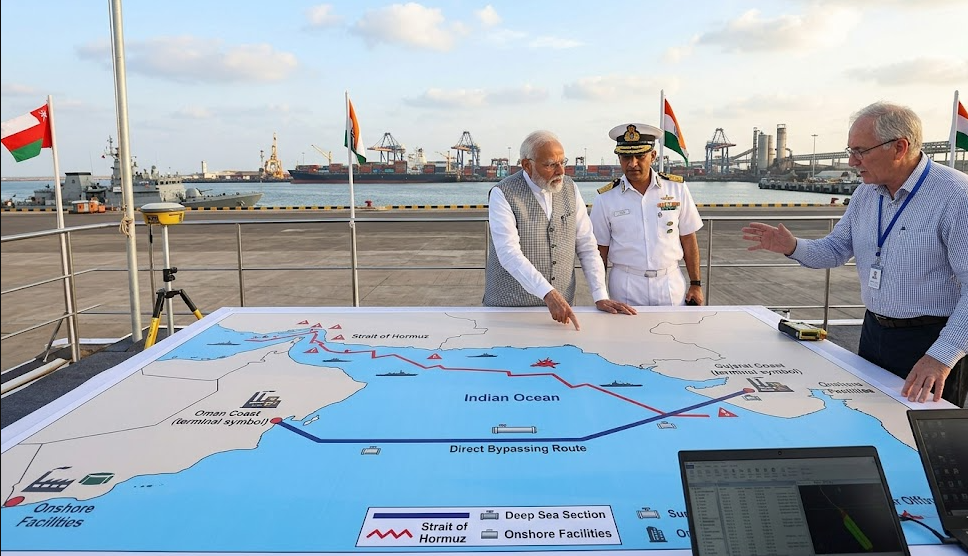
Building on SAGE’s work, India’s petroleum ministry is now directing three state-owned giants GAIL (Gas Authority of India Limited), Engineers India Limited (EIL), and Indian Oil Corporation (IOC) to prepare a detailed feasibility report. If the report confirms viability, formal diplomatic and commercial negotiations with Oman will follow.
The Oman government has previously been receptive to the concept. Oman sits outside the Hormuz closure zone, has significant gas production capacity, and has a long-standing energy partnership with India under the India-Oman Strategic Partnership framework.
The Challenges Ahead
The Deep-Sea Pipeline faces formidable engineering and geopolitical obstacles. Laying infrastructure at 3,450 metres of depth in the Arabian Sea is technically demanding only a handful of pipelines globally operate at comparable depths. The seabed between Oman and Gujarat involves complex geology, and repair operations at such depths require specialised vessels and technology.
Financing a $4.8 billion project over a 5–7 year construction window will require sustained political will, international lending institution support, and potentially sovereign guarantees. The US Iran war’s uncertainty also complicates long-term gas supply contracts with Gulf producers, some of whom are directly affected by the conflict.
India’s Strategic Imperative
The MEIDP is more than an infrastructure project. It is India’s answer to a question that 75 days of Hormuz chaos has made unavoidable: can the world’s most populous nation afford to have 90% of its crude oil dependent on a 21-mile-wide chokepoint controlled by a country at war?
The Rs 40,000 crore Deep-Sea Pipeline is expensive. It is technically challenging. It will take years to build. But for a country whose 330 million LPG connections, 256-gigawatt power demand, and $3.7 trillion economy all ultimately depend on energy that currently flows through the Strait of Hormuz, the more important question is: can India afford not to build it?

Oil & Energy Markets
A look at crude price swings, OPEC supply moves, and how energy markets react to geopolitical shocks.

Geopolitics & Conflict
Breaking down how wars, ceasefires, and diplomatic deals ripple through global trade and security.
US Foreign Policy
Coverage of Trump administration negotiations, sanctions, and strategic decisions shaping world events.
Economy & Inflation
Tracking how commodity prices, gas costs, and supply chains affect everyday consumers.