Share This Article
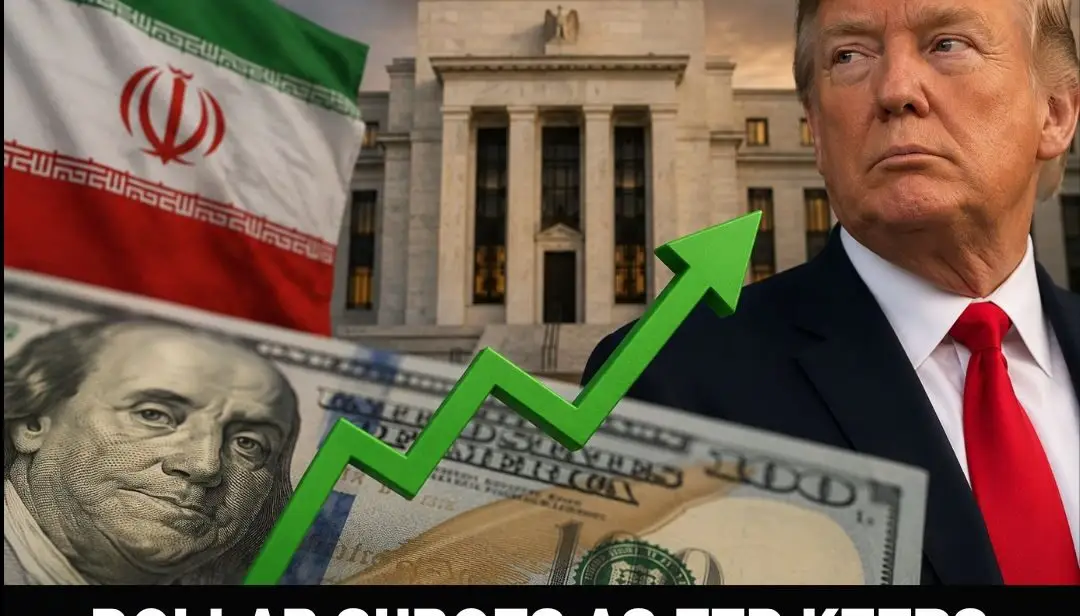
The U.S. dollar posted its best single-day performance in nearly a year on Wednesday after the Federal Reserve held its benchmark interest rate steady but signaled that a rate hike, not a cut, could be the central bank’s next move. The decision marked the first policy meeting under new Fed Chairman Kevin Warsh, and it landed at a uniquely volatile moment: just days after the United States and Iran finalized a framework agreement to end their war and reopen the Strait of Hormuz.
A Hawkish Surprise From a “Dovish” Pick
President Trump nominated Warsh in hopes the longtime Fed critic would aggressively cut rates. Instead, in his first appearance as chair, Warsh oversaw a unanimous vote to keep the federal funds rate in its current range of 3.5% to 3.75% and the committee’s updated quarterly projections sent an unmistakably hawkish signal. Nine of the Fed’s 18 policymakers indicated support for at least one rate hike before year-end, with six of those backing two separate quarter-point increases. That marks a dramatic reversal from March, when not a single committee member had penciled in a hike and the panel as a whole projected a rate cut for 2026.
The shift reflects a stark inflation picture. Consumer prices rose at a 4.2% annual rate in May the highest level in three years and more than double the Fed’s long-standing 2% target. Much of that pressure traces directly back to the now-concluding US-Iran conflict: energy costs spiked sharply after the war began on February 28, and the producer price index — a leading indicator of consumer inflation jumped 1.1% in May alone, up 6.5% year-over-year.
“Persistently high prices are a burden for the American people,” Warsh acknowledged at his post-meeting news conference, while also stressing the Fed’s continued commitment to its 2% inflation goal: “I see no reason until we have reestablished our commitment and ability to deliver on the 2% inflation objective to revisit that target.”
Markets React: Dollar Jumps, Stocks and Gold Slide
Financial markets moved swiftly. The U.S. dollar index rose roughly 1%, putting it on pace for its strongest day in nearly a year, as traders repriced expectations for “higher-for-longer” rates. Two-year Treasury yields jumped 16 basis points to 4.21% their highest level in over a year while the benchmark 10-year yield climbed toward 4.5%.
Equities sold off in response. The Dow fell more than 500 points (0.98%), the S&P 500 dropped 1.21%, and the Nasdaq Composite slid 1.34%. Gold, which typically underperforms when rates rise and the dollar strengthens, fell more than 2%.
The reaction wasn’t confined to broad indices retail and consumer-discretionary names felt the rate shock too, as higher-for-longer borrowing costs raise questions about discount retailers’ margins and consumer spending power heading into the back half of the year. Investors watching value-oriented retail names, including any Dollar Tree stock surge driven by recent bargain-shopping trends amid inflation, will be parsing how a more hawkish Fed reshapes consumer behavior in the months ahead.
Traders on the CME Group’s FedWatch tool dramatically repriced the odds of a near-term hike, pushing the probability of a September increase to 49% up from just 27% the day before with some estimates putting the chance of a hike by October above 60%.
Warsh’s Reform Agenda and a Notably Short Statement
Beyond the rate decision itself, Warsh used his debut press conference to outline an institutional shake-up. He announced the creation of five internal task forces tasked with reviewing the Fed’s communications strategy, its balance sheet, its reliance on existing economic data, productivity measurement, and its broader inflation framework. Each, he said, would “start with first principles, ask hard questions, examine current practice, consider alternatives, and ultimately propose next steps.”
Notably, Warsh declined to submit his own economic projection to the Fed’s dot plot a break from convention he defended by arguing that such forward guidance can “tie the central bank’s hands.” The Fed’s official statement was also unusually brief, dropping previous language that had hinted at a future rate cut. Analysts say the terser, more guarded tone is itself a deliberate signal of the new chairman’s preferred communication style.
Asked whether he had spoken with Trump since taking office, Warsh offered little: “I don’t have anything for you.” For his part, Trump downplayed the decision when asked by reporters in Paris, calling it “all right, whatever,” while adding of Warsh: “We have a very good guy over there now, so I’m guided by what he wants.”
The Iran Deal’s Shadow Over Monetary Policy
The Fed’s decision arrived just days after Washington and Tehran announced a framework agreement reported by NBC News and confirmed by multiple outlets to extend their ceasefire, reopen the Strait of Hormuz to toll-free shipping, and end hostilities in Lebanon. Trump declared on social media that he had “fully authorized the toll free opening of the Strait of Hormuz” alongside the removal of the U.S. naval blockade, a move markets initially cheered with a stock rally and a near-5% drop in oil prices.
But the Fed’s policymakers were notably cautious about pricing in those diplomatic gains. As the central bank’s statement put it, “economic activity is expanding at a solid pace despite elevated uncertainty that owes, in part, to the conflict in the Middle East.” With the US-Iran agreement still an interim memorandum not a final, binding deal and unresolved questions remaining over Iran’s nuclear program and the durability of the Strait of Hormuz reopening, the Fed opted to treat any relief on energy prices as provisional rather than assured.
For a detailed breakdown of what the U.S.-Iran framework actually commits both sides to, NPR’s full coverage of the agreement offers additional context.
What Comes Next
With inflation still running hot and the Strait of Hormuz reopening still unproven in practice, Warsh now faces a genuinely difficult balancing act: raising rates risks drawing the White House’s ire and could push up costs for mortgages and consumer credit ahead of the midterms, while holding steady risks letting inflation entrench further. As Man Group’s chief market strategist Kristina Hooper put it, “Markets were holding out hope that Chair Warsh would throw them some kernels of real dovishness that they obviously felt they didn’t get.”
Whether the Fed actually follows through on a 2026 hike or whether a durable peace dividend from the US-Iran deal cools inflation first will likely define the next several months of monetary policy.

Oil & Energy Markets
A look at crude price swings, OPEC supply moves, and how energy markets react to geopolitical shocks.

Geopolitics & Conflict
Breaking down how wars, ceasefires, and diplomatic deals ripple through global trade and security.
US Foreign Policy
Coverage of Trump administration negotiations, sanctions, and strategic decisions shaping world events.
Economy & Inflation
Tracking how commodity prices, gas costs, and supply chains affect everyday consumers.