Share This Article
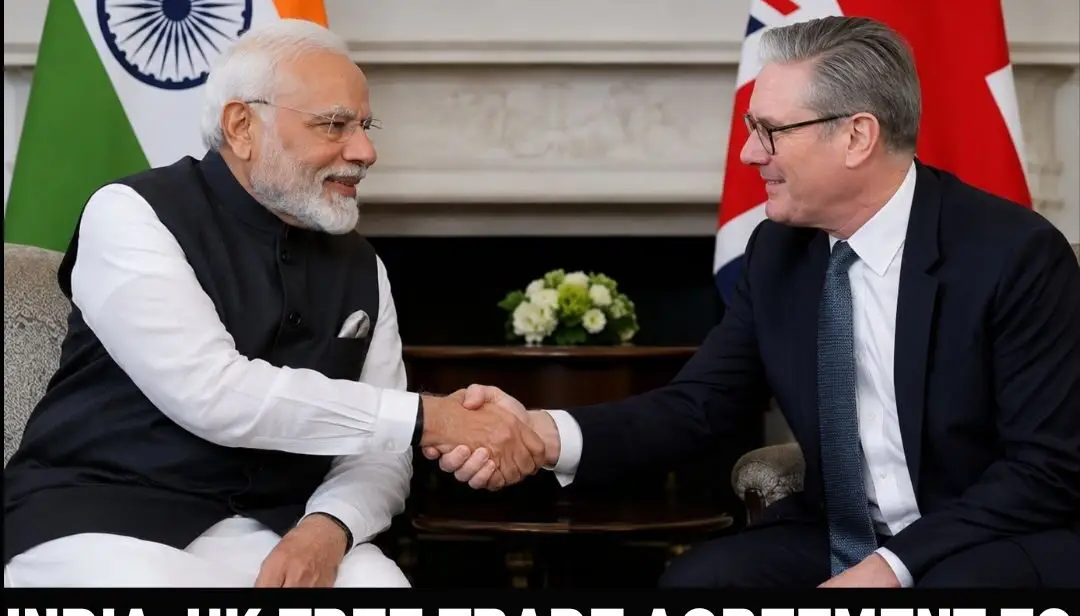
The India-UK Free Trade Agreement will officially come into force on July 15, 2026, marking what British officials are calling the quickest turnaround from signature to implementation of any trade deal in UK history. The announcement, confirmed jointly by New Delhi and London on June 17, gives businesses on both sides just 28 days to prepare before new tariff terms take effect.
The deal formally known as the Comprehensive Economic and Trade Agreement (CETA) was signed nearly a year ago, on July 24, 2025, during Prime Minister Narendra Modi’s visit to London. Officials say the rapid push from signing to enforcement reflects the political urgency both governments have placed on capturing economic momentum quickly, rather than letting the agreement languish through prolonged ratification.
A Historic Milestone, Confirmed at the G7
Prime Minister Modi made the announcement from Evian, France, where he was attending the G7 Summit alongside UK Prime Minister Keir Starmer. “A historic milestone for India-UK relations,” Modi wrote on X. “Delighted to note that the India-UK Comprehensive Economic and Trade Agreement will enter into force on 15th July 2026. This agreement will significantly boost our bilateral trade and investment.”
Modi added that the pact would support India’s long-term Viksit Bharat 2047 development vision and “unlock numerous opportunities for Indian farmers, workers, MSMEs, startups and innovators.”
British High Commissioner to India, Lindy Cameron, framed the moment similarly, posting: “The countdown begins! The UK and India have agreed that the Free Trade Agreement will come into effect on 15 July” calling it “an historic moment for the modern UK-India partnership, unlocking a new era of growth for both our economies.”
UK Business and Trade Secretary Peter Kyle was direct about the rationale behind the speed: “We are bringing our landmark trade deal with India into force as quickly as we can, because we want businesses and the public to feel the benefits immediately, including cuts to tariffs of £400 million within the first year alone.”
What Changes on July 15
The agreement delivers sweeping tariff reductions across multiple sectors. Among the headline changes:
India’s tariff on imported whisky will fall from 150% to 40% a major win for Scotch whisky producers seeking deeper access to one of the world’s largest spirits markets. Automotive tariffs will drop from 100% to 10%, though under a quota-based mechanism that limits volume eligible for the reduced rate.
In return, the United Kingdom will lower tariffs on Indian exports including clothing, footwear, and select food products. Within a decade, the broader agreement is expected to make 85% of British products sold in India tariff-free, while India secures zero-duty access for 99% of its exports into the UK market.
Cosmetics and several other product categories will see duties of up to 22% eliminated either immediately or phased out over a period of up to 10 years.
Alongside the FTA, the UK-India Double Contributions Convention will also take effect on July 15. This separate arrangement allows UK nationals working in India to continue building UK State Pension entitlement for up to 60 months up from the current 36 while paying National Insurance contributions rather than duplicate social security payments in India. The provision works reciprocally for Indian professionals in the UK using existing skilled-worker visa routes, mirroring arrangements the UK already has with Japan, South Korea, and Canada.
The Economic Stakes
According to UK government estimates, the deal is projected to boost bilateral trade by £25.5 billion annually over the long run, add £4.8 billion to UK GDP, and lift real wages by £2.2 billion. The World Economic Forum has separately estimated the agreement could increase bilateral trade by $34 billion a year by 2040.
The deal is being described in London as the most comprehensive trade agreement India has ever brought into force, and the most economically significant bilateral deal the UK has struck since leaving the European Union. For India the world’s fifth-largest economy and the UK, the sixth-largest, the agreement represents the culmination of more than three years of negotiation that began in January 2022.
Notably, the implementation date was finalized despite ongoing friction between the two governments over Britain’s forthcoming steel tariff regime a sign both sides were determined not to let secondary disputes delay the headline agreement.
What Businesses Need to Do Now
With just 28 days between confirmation and enforcement, British and Indian officials are urging companies to move quickly. Businesses seeking to benefit from reduced tariffs will need to register with HM Revenue & Customs to access preferential rates. The UK government has encouraged firms to use the coming weeks to review supply chains, customs documentation, and certification requirements ahead of the July 15 start date.
Further detail on the agreement’s full tariff schedules and business guidance is available via the UK government’s official trade portal
The Bigger Picture
The India-UK deal lands at a moment of considerable global economic uncertainty. Oil markets remain volatile amid the ongoing Strait of Hormuz crisis, with shipping traffic through the chokepoint still a fraction of pre-war levels following the U.S.-Iran conflict that began in February. As Washington and Tehran continue working toward a potential US-Iran agreement to end hostilities and reopen the waterway, global trade has faced elevated shipping costs and energy price pressure — making the certainty offered by the India-UK pact especially valuable to businesses on both sides looking for predictable, tariff-reduced trade routes.
For now, India and the UK have a four-week runway to prepare for a deal both governments hope will define the next decade of their economic relationship.

Oil & Energy Markets
A look at crude price swings, OPEC supply moves, and how energy markets react to geopolitical shocks.

Geopolitics & Conflict
Breaking down how wars, ceasefires, and diplomatic deals ripple through global trade and security.
US Foreign Policy
Coverage of Trump administration negotiations, sanctions, and strategic decisions shaping world events.
Economy & Inflation
Tracking how commodity prices, gas costs, and supply chains affect everyday consumers.