Share This Article
On Monday, Iranian Foreign Minister Abbas Araghchi arrived in St. Petersburg for a direct meeting with Russian President Vladimir Putin a visit that made explicit what Moscow has been signaling for weeks through diplomatic channels: Russia will not stand aside as the United States attempts to bludgeon Iran into submission through ultimatums, blockades, and threats of civilizational destruction.
The meeting between Putin and Araghchi came hours after Trump canceled his own delegation’s trip to Islamabad and posted on Truth Social that the U.S. “has all the cards.” From Moscow’s perspective, that framing American maximalism dressed up as negotiating leverage is precisely the problem.
Russia Names the Method: Blackmail
Russia’s messaging on the Iran conflict has grown progressively sharper. In the weeks since U.S.-Israeli strikes began on February 28, 2026, the Kremlin and its foreign ministry have moved from condemnation to direct instruction.
Russian Deputy Foreign Minister Sergei Ryabkov stated plainly that Washington’s approach constitutes something beyond hardball diplomacy. “Threats are indeed being heard, ultimatums are also being heard,” Ryabkov said, adding that Russia considers “such methods inappropriate” and condemns using them as a way “to impose its own will on the Iranian side.”
Foreign Minister Sergey Lavrov, speaking in Beijing, went further defending Iran’s right to enrich uranium for civilian purposes as “inalienable,” directly contradicting the Trump administration’s demand for zero enrichment. Lavrov framed Washington’s nuclear demands not as non-proliferation policy but as geopolitical coercion: an effort to strip a sovereign nation of capabilities it is legally entitled to under the Nuclear Non-Proliferation Treaty.
Russia’s formal condemnation of the strikes issued in the hours after the February offensive characterized the U.S.-Israeli campaign as “a preplanned and unprovoked act of armed aggression.” That language was deliberate. It mirrors the framing Russia has used to describe Western responses to its own actions in Ukraine, and it signals that Moscow views the Iran war not as a regional conflict but as a template one that could be applied anywhere, including to Russia itself.
Putin’s Strategic Position
Putin is not simply issuing warnings out of principle. Russia has emerged as one of the clearest beneficiaries of the Iran war, and the Kremlin is in no hurry for it to end on Washington’s terms.
The closure of the Strait of Hormuz has pushed global oil prices to levels that have replenished Russian energy revenues at a moment when Western sanctions were beginning to bite. Fertilizer demand a major Russian export has surged. And crucially, advanced U.S. air defense systems that might otherwise flow to Ukraine have been redirected toward the Middle East theater, providing Moscow tactical breathing room on the Ukrainian front.
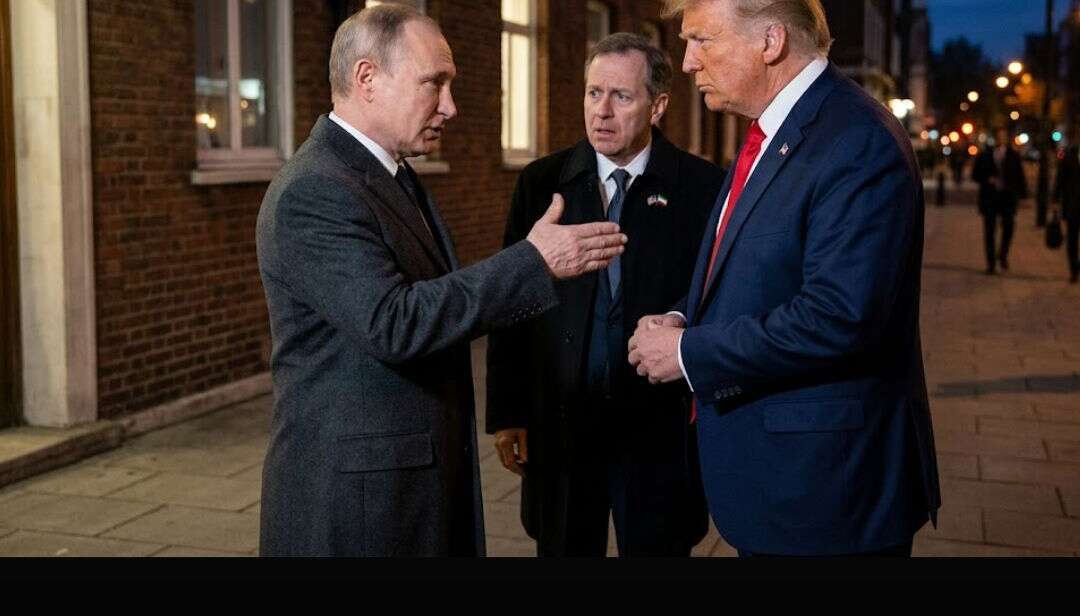
At the same time, Russia has not positioned itself as Iran’s unconditional patron. Trump and Putin spoke by phone in March, during which the Kremlin asserted that Russian officials were not sharing intelligence with Iran a pointed denial that Trump had publicly demanded. Reports in Politico further revealed that Russia had, at one point, offered to end any intelligence cooperation with Tehran entirely if Washington agreed to halt military support for Ukraine, a proposal that underscored how the Iran conflict has become deeply entangled with the Russia-Ukraine war in the Kremlin’s strategic calculations.
The Uranium Gambit
Russia has also repeatedly offered a mechanism that could theoretically resolve the US Iran nuclear deal impasse: accepting Iran’s stockpile of highly enriched uranium as part of a final settlement, storing it on Russian soil as a guarantee against weaponization. Kremlin spokesman Dmitry Peskov confirmed the offer remained open but acknowledged it was “not currently on the negotiating table,” with Washington showing no interest.
From Putin’s vantage point, U.S. disinterest in the Russian uranium offer is itself evidence of bad faith proof that Washington’s stated concern about Iranian nuclear capability is a pretext for regime change, not a genuine non-proliferation objective. If America truly wanted to prevent an Iranian bomb, the argument goes, it would take yes for an answer.
What Araghchi Carried to St. Petersburg
According to Iranian state media, Araghchi traveled to Moscow after a regional tour that included Pakistan and Oman, carrying a list of Tehran’s “red lines” including nuclear enrichment rights and Hormuz to be communicated to any potential intermediary. The visit to Russia was the capstone of that tour, signaling that Iran views Moscow not merely as a sympathizer but as an active diplomatic sponsor with the standing to deliver messages to Washington that Tehran cannot.
Russia’s warning to Trump is now embedded in that framework: so long as the U.S. insists on ultimatums over diplomacy, Moscow will amplify Iran’s position, expand its own regional influence, and treat every failed negotiation as vindication of its argument that American power is the destabilizing force in the equation.
Whether Trump reads that as a threat or an opportunity will shape the next phase of a war that neither Russia nor Iran appears in any rush to see end on American terms.

Oil & Energy Markets
A look at crude price swings, OPEC supply moves, and how energy markets react to geopolitical shocks.

Geopolitics & Conflict
Breaking down how wars, ceasefires, and diplomatic deals ripple through global trade and security.
US Foreign Policy
Coverage of Trump administration negotiations, sanctions, and strategic decisions shaping world events.
Economy & Inflation
Tracking how commodity prices, gas costs, and supply chains affect everyday consumers.