
Share This Article
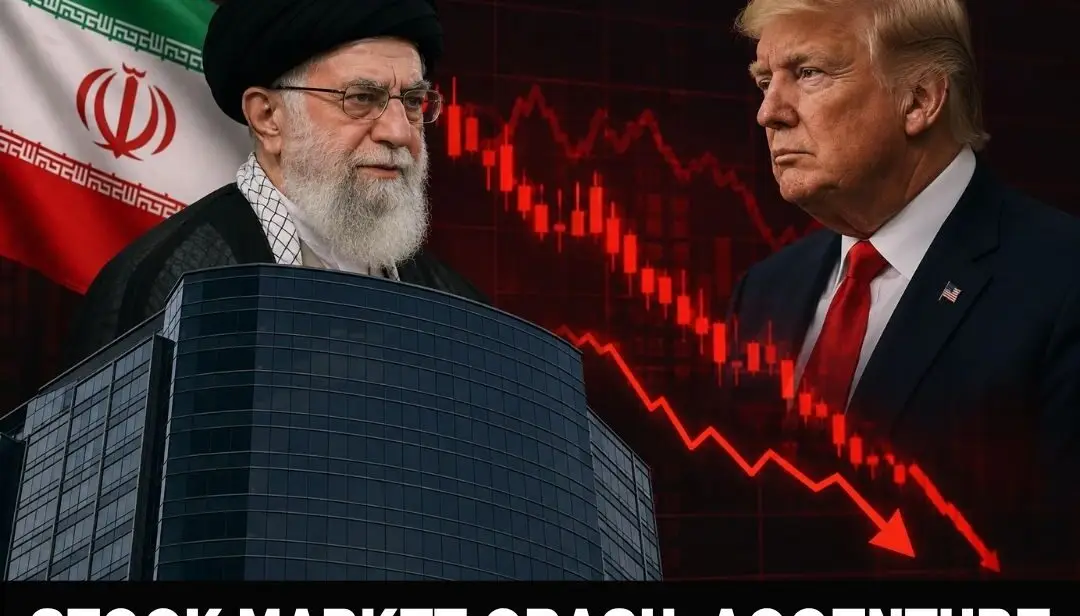
Indian equity markets witnessed a sharp and unexpected stock market crash on Friday, as a disappointing revenue forecast from global IT consulting giant Accenture triggered a broad-based sell-off across the technology sector, wiping out nearly ₹2 trillion in investor wealth within hours of trading.
The sell-off arrived on a day that should have otherwise been a celebratory one for global markets with news breaking just a day earlier that the United States and Iran had signed a landmark agreement to end their months-long conflict and reopen the Strait of Hormuz to commercial shipping. Yet even as oil prices fell and broader indices found relief from the US-Iran agreement, India’s IT sector moved in the opposite direction, dragged down entirely by one company’s earnings warning thousands of miles away.
What Triggered the Crash
The proximate cause was unambiguous: Accenture, the world’s largest IT services and consulting firm, trimmed the upper end of its full-year revenue growth guidance, citing continued caution among enterprise clients on discretionary technology spending. The company nudged its constant-currency revenue growth outlook down to 3–4% (from 3–5%) and its core commercial guidance to 4–5% (from 4–6%).
That single data point sent shockwaves through technology stocks globally. Because Indian IT majors derive a significant share of revenue from the same US and European client base that Accenture serves, the read-through was immediate and brutal.
The benchmark BSE Sensex fell sharply by 557.12 points, or 0.72%, opening at 76,852.86, before deepening losses saw it trade nearly 729 points lower by midday. The NSE Nifty 50 dropped 176.80 points (0.73%) to settle at 23,991.20 in early trade. The Nifty IT index bore the brunt, tumbling as much as 6% — by far the worst-performing sectoral gauge of the session.
Leading the rout was Infosys, down over 7.5%, followed closely by steep declines in TCS, HCLTech, Tech Mahindra, and Wipro. The damage extended overseas: American Depositary Receipts (ADRs) of Infosys and Wipro fell by at least 10% on the New York Stock Exchange, while Cognizant’s ADR slid more than 10% and IBM dropped over 5%.
Estimates of the total wealth erasure varied across analysts and outlets, ranging from roughly ₹1.35 trillion to ₹2 trillion, depending on the measurement window and the breadth of stocks included in the calculation.
A Sector Already Under Pressure
Friday’s stock market crash didn’t emerge in isolation. The IT sector had already been grappling with a difficult 2026, weighed down by fears of AI-led disruption to traditional consulting and outsourcing revenue, delayed client decision-making, and shrinking transformation budgets. Earlier in the week, signals from the US Federal Reserve suggesting interest rates could stay elevated for longer had already dampened sentiment toward global technology shares.
Shashwat Singh, a fundamental analyst at Bajaj Broking, characterized the move as a “direct reflex reaction” to Accenture’s guidance cut, noting that the update effectively confirmed what markets had feared that enterprise clients remain reluctant to commit big technology budgets even as AI adoption accelerates.
Foreign Institutional Investors (FIIs) added to the pressure, offloading equities worth over ₹1,000 crore on the day, reversing what had been five consecutive sessions of gains across domestic indices. Analysts cited by Reuters noted that Accenture’s commentary worsened an already fragile sentiment picture for the sector, reducing hopes of a near-term turnaround.
Notably, not every part of the market suffered. Investors rotated into defensive sectors such as pharmaceuticals and healthcare, helping cushion the broader index from a deeper rout.
The Hormuz Contrast
What made Friday’s session particularly striking was its timing. Just a day earlier, Pakistani Prime Minister Shehbaz Sharif — who mediated months of US-Iran negotiations announced that a memorandum of understanding between Washington and Tehran had entered into force “with immediate effect.” Under the deal, Iran agreed to “instantly reopen” the Strait of Hormuz, the critical chokepoint through which roughly a fifth of the world’s oil normally flows, while the US agreed to lift its naval blockade of Iranian ports.
Oil tankers reportedly began moving through the strait following the pact, and crude prices extended their decline, with Brent crude slipping toward $79 a barrel and US benchmark WTI falling near $76 both sharply lower from the highs seen earlier in the conflict. Markets in Asia and beyond had largely rallied on the news, pricing in relief from one of the most disruptive geopolitical shocks to the global energy supply in years, as reported by Al Jazeera.
Yet that optimism did little to insulate India’s IT-heavy indices. The sector-specific shock from Accenture overwhelmed any tailwind from easing geopolitical risk a reminder that even amid welcome de-escalation in the Strait of Hormuz, sector-specific earnings shocks can move Dalal Street just as forcefully as a global ceasefire.
What Comes Next
Analysts caution that the durability of Friday’s sell-off will depend heavily on upcoming earnings commentary from India’s own IT majors, who report quarterly results in the coming weeks. With AI-driven automation reshaping demand for traditional outsourcing work, and clients still cautious on discretionary spending, the sector’s path to recovery may not be straightforward even as broader markets cheer the resolution of the US-Iran standoff.
For now, traders are watching the upcoming Reliance Industries AGM and incoming global cues for the next signal on whether Friday’s stock market crash was a one-day reflex or the start of a deeper correction.

Oil & Energy Markets
A look at crude price swings, OPEC supply moves, and how energy markets react to geopolitical shocks.

Geopolitics & Conflict
Breaking down how wars, ceasefires, and diplomatic deals ripple through global trade and security.
US Foreign Policy
Coverage of Trump administration negotiations, sanctions, and strategic decisions shaping world events.
Economy & Inflation
Tracking how commodity prices, gas costs, and supply chains affect everyday consumers.