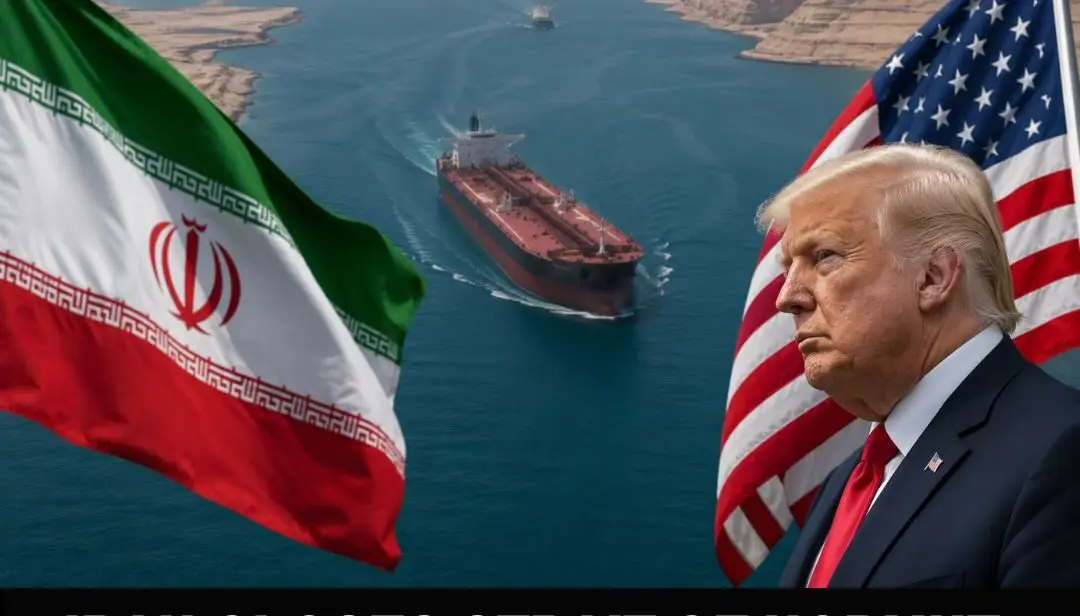
The world’s most critical oil corridor is shut — and global markets are feeling every hour of it.
Since late February 2026, the Strait of Hormuz has been at the center of the most dangerous geopolitical standoff in decades. Following U.S. and Israeli strikes on Iran beginning February 28, Iran moved to block the narrow 33-mile passage connecting the Persian Gulf to the Gulf of Oman — a waterway that, in normal times, handles roughly 20% of global petroleum and 20% of global liquefied natural gas (LNG) trade.
As of June 2026, the Iran-US war latest developments show no clear resolution in sight. Iran’s military has reimposed full closure of the strait, citing repeated “ceasefire violations” by the United States. Iranian Revolutionary Guard gunboats have fired on tankers, and the Persian Gulf Strait Authority has officially declared the waterway “closed until further notice.”
What Exactly Is the Strait of Hormuz — and Why Does It Matter So Much?
The Strait of Hormuz is a narrow maritime chokepoint between Iran to the north and Oman to the south. Before the conflict, roughly 3,000 vessels transited the strait every month, according to the UK House of Commons Library.
In 2024 alone, approximately 20 million barrels per day of oil moved through the passage — representing nearly 27% of all global maritime oil trade, per U.S. Congressional Research Service data. That includes crude from Iraq, Kuwait, Saudi Arabia, Qatar, and the UAE.
The key problem? Most of these producers have no practical alternative route. Iraq, Kuwait, and Qatar are almost entirely dependent on the strait for exports. Saudi Arabia has limited pipeline alternatives, but not nearly enough capacity to absorb a full closure.
The Human and Economic Toll Since Iran Closed the Strait
The consequences have been swift and severe.
Since Iran closed the Strait of Hormuz on March 4, 2026:
- Tanker traffic has plunged by 90%+, with WTO data showing a 95% reduction in crude oil shipping and a staggering 99% drop in LNG vessels through Persian Gulf ports.
- Brent crude surged past $120 per barrel immediately after closure, forcing QatarEnergy to declare force majeure on all exports.
- The Dallas Federal Reserve projects WTI oil reaching $98/barrel and global real GDP growth falling by an annualized 2.9 percentage points due to supply shock.
- Iraq and Kuwait began curtailing oil production in early March as storage filled up with no export route available.
- Global oil output is forecast to fall by 6.9 million barrels per day in Q2 2026 — the largest quarterly decline since the COVID-19 pandemic.
The International Energy Agency called it the “largest supply disruption in the history of the global oil market” — a label that echoes the 1973 Yom Kippur War oil embargo.
Beyond Oil: What Else Is Stuck in the Strait?
Energy headlines dominate, but oil is far from the only concern. According to the World Economic Forum:
- ~33% of global fertilizer trade transits the Strait of Hormuz, including massive nitrogen exports. Urea prices in the U.S. have already jumped from $475 to $680 per metric ton — a 43% spike at the worst possible time for the spring planting season in the American Midwest.
- Methanol — a key ingredient in plastics, resins, and paints — is seeing supply tighten globally, with China’s port inventories approaching “below warning thresholds.”
- Aluminum and sulfur supplies critical to manufacturing and green energy infrastructure are also at risk.
Supply chain experts warn that consumers will feel price impacts across grocery stores, fuel stations, and manufactured goods within four to six weeks of sustained closure.
Can the World Route Around the Problem?
Theoretically, yes. Practically, barely.
Saudi Arabia’s East-West Pipeline (Petroline) can redirect some crude to Red Sea export ports, bypassing the strait entirely. The UAE’s Abu Dhabi Crude Oil Pipeline also offers partial relief. But combined, these pipelines cover only a fraction of the volume normally flowing through Hormuz.
The Kiel Institute for the World Economy estimates that in a full closure scenario, blocking Gulf exports entirely could push global energy prices up by 10.8% and food prices by 5%, with developing nations facing the sharpest welfare losses.
Meanwhile, the IEA made the unprecedented move of releasing 400 million barrels from strategic reserves — an emergency buffer that buys time but doesn’t solve the underlying crisis.
Iran-US War Latest: Where Do Negotiations Stand?
The diplomatic picture remains deeply unstable.
A conditional ceasefire was extended for further talks, but Iran has since reimposed closure, accusing the U.S. of “breaches of trust.” As of early June 2026, Iran has halted negotiations entirely, demanding Israel’s full withdrawal from Lebanon and Gaza before any dialogue resumes.
The U.S. has responded with a counter-blockade on Iranian port access while the Treasury Department separately extended sanctions pauses on Russian oil — a sign of how badly the disruption has stressed Western energy supply chains.
[→ See Also: Iran-US War: Full Conflict Timeline and What Comes Next]
How Long Can the World Afford This?
Not much longer at this pace.
The World Bank forecasts Brent crude averaging between $95 and $115 per barrel for full-year 2026 — a 10% to 35% premium over pre-war levels. Global oil demand has already contracted by 0.8 million barrels per day, with advanced economies and Asia leading the pullback.
The stagflation risk is real. Higher energy costs are feeding directly into consumer prices, industrial costs, and supply chain disruptions simultaneously — a combination last seen during the 1970s energy crises.
For a world still heavily dependent on fossil fuels, the Strait of Hormuz closure is a live demonstration of just how fragile globalized energy security really is. Every week the strait stays closed, the economic damage compounds — and the political window for a negotiated resolution narrows.
The world can ill afford this standoff. The question now is whether the parties involved are willing to accept that fact before the damage becomes truly irreversible.