Share This Article
he moment US military strikes hit Iranian soil on February 28, 2026, Iran’s response was not a targeted counterstrike it was a regional war unleashed simultaneously across six countries. Within hours of Operation Epic Fury’s opening salvo, which killed Supreme Leader Ali Khamenei and destroyed Iran’s primary nuclear enrichment sites, the Islamic Revolutionary Guard Corps launched the largest coordinated missile and drone campaign ever directed at Gulf Arab states a retaliation so vast it strained every air defence system in the region to its breaking point.
Four months later, with a ceasefire declared and then repeatedly violated, the full scale of Iran retaliates is still being counted in damaged refineries, depleted interceptor stockpiles, and a Strait of Hormuz that remains effectively closed to global shipping.
Operation Epic Fury: What Triggered the Retaliation
Operation Epic Fury began at 09:05 UTC on February 28, 2026, with coordinated US and Israeli strikes targeting over 1,700 Iranian sites in the first 72 hours and more than 5,000 targets in the first ten days, according to US Department of Defense fact sheets. Key targets destroyed included Iran’s three main nuclear enrichment sites at Natanz, Fordow, and Isfahan, 29 ballistic missile launch sites, 4 key manufacturing facilities, and effectively the entire conventional Iranian Navy with 9 warships sunk on Day 1 alone and 150 warships destroyed across the campaign.
The US Department of State confirmed the legal framework in a formal release on Operation Epic Fury and International Law. The White House declared it a demonstration of “peace through strength.”
Tehran called it an act of war and responded accordingly.
The Retaliation: Numbers That Redefined Modern Warfare
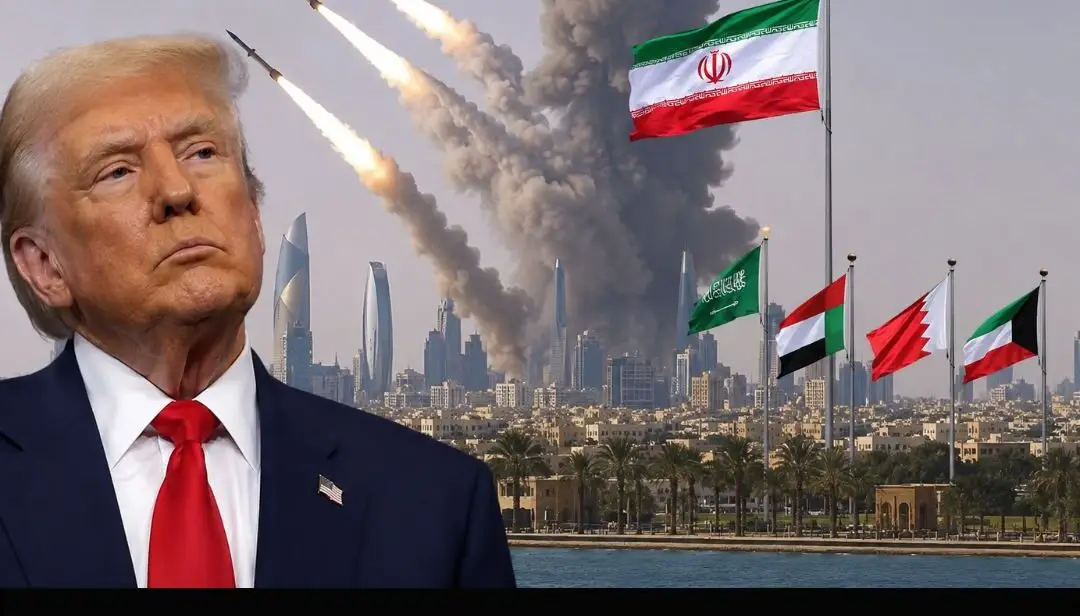
Iran retaliates with a scale of firepower that no regional air defence network was designed to absorb. For the first time in history, Iran simultaneously attacked all six GCC member states Saudi Arabia, UAE, Qatar, Bahrain, Kuwait, and Oman in a single coordinated strike package launched within hours of the first US bombs falling.
The cumulative toll of iran retaliation across the campaign, per Pentagon April 1 update and Wikipedia’s documented strike data:
- UAE: 438 ballistic missiles, 2,012 drones, 19 cruise missiles — 13 killed, 224 injured
- Saudi Arabia: At least 38 missiles, 435 drones — 2 killed, 12 injured
- Qatar: 66 missiles including a direct strike on Al Udeid Air Base — 16 injured
- Kuwait: 13 ballistic missiles and 17 drones in the June 3 barrage alone
- Region-wide total: Over 1,000 ballistic missiles and 3,000+ drones deployed
Iran’s arsenal deployed included the Sejjil (2,000 km range solid-fuel ballistic missile), Khorramshahr, Kheibar Shekan, Haj Qasem, and most alarmingly, the Fattah hypersonic missile — capable of traveling at over five times the speed of sound and maneuvering unpredictably mid-flight to defeat conventional interceptors.
Gulf Air Defences: Holding But Barely
The Gulf’s layered air defence architecture Patriot missile batteries, THAAD systems, Pantsir-S1, Barak-8, and SkyKnight performed at historically high interception rates. The UAE posted an extraordinary 96% interception rate, according to Breaking Defense. But interception rates only tell part of the story.
By late March, the UAE and Kuwait had expended approximately 75% of their Patriot interceptor stocks. Bahrain had burned through 87%. Qatar had depleted 40%. US interceptor stockpiles across the region — already stressed — are now expected to take years to rebuild, per Military Times reporting on the interceptor attrition race.
Iran’s strategy was deliberate: not necessarily to break through defences on every sortie, but to exhaust the interceptor magazines faster than they could be replenished — a war of attrition fought in the skies over the Gulf.
US Bases: The Hidden Damage
Sixteen US military installations across the Gulf were struck or threatened during the campaign. The damage, initially downplayed, was far more extensive than public statements suggested. NBC News investigation and satellite imagery analysis by ABC News confirmed destruction of runways, radar arrays, aircraft hangars, warehouses, and satellite communications terminals including at the US Navy Fifth Fleet Headquarters in Bahrain.
Total repair costs are estimated at up to $5 billion. Official US casualties stand at 13 fatalities and hundreds injured figures that independent analysts say are understated. The US military responded by dispersing personnel from fixed bases into hotels, office buildings, and remote facilities, abandoning the centralized base model that had defined Gulf force posture for decades.
The Strait of Hormuz: Iran’s Most Powerful Weapon
Beyond missiles and drones, Iran’s most strategically devastating act of iran retaliation was the closure of the Strait of Hormuz announced formally on March 4, 2026, after the IRGC began laying sea mines, boarding merchant vessels, and threatening any ship transiting the waterway. Vessel traffic collapsed to approximately 5% of pre-conflict levels, cutting off 20–25% of the world’s seaborne oil trade and triggering the global energy crisis that is still unresolved today.
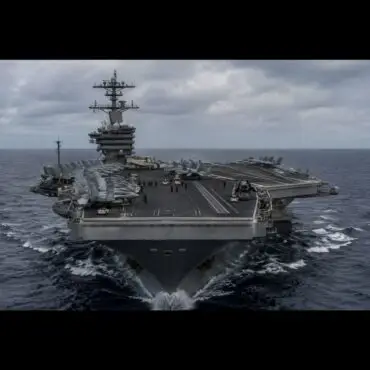
The US responded between April 13 and May 29 with a naval blockade of Iranian ports an extraordinary escalation that added economic strangulation to the existing military pressure. Iran threatened to “completely” close the strait in June and briefly halted all negotiating communications with Washington on June 1, according to CNBC’s live conflict coverage.
IRGC Signals: Restraint Is Over
In early June, the IRGC made its posture explicit. In a formal statement, the Guard declared: “Our self-restraint has come to an end,” warning Gulf states hosting US forces: “Until today, we have restrained ourselves for the sake of good neighbourliness… however, we are now lifting the immunity provided by our previous tolerance.”
The IRGC simultaneously threatened 18 major technology companies including Apple, Google, Meta, Microsoft, and Nvidia labelling them “legitimate targets” for their role in enabling US military communications infrastructure, as CNBC reported.
The ceasefire declared on April 8 has been violated repeatedly. US strikes on Iranian radar sites and a communications tower near Qeshm Island in late May triggered fresh IRGC retaliatory strikes on the Fifth Fleet headquarters. On June 21, the US struck Fordow, Natanz, and Isfahan once more. Trump declared a new ceasefire on June 24 the second of the conflict.
Whether this one holds depends entirely on whether US-Iran talks can finally translate a framework both sides claim is nearly done into a signed agreement and whether Tehran’s definition of the Strait of Hormuz as Iranian-managed water can be reconciled with Washington’s demand for unrestricted international passage.

Oil & Energy Markets
A look at crude price swings, OPEC supply moves, and how energy markets react to geopolitical shocks.

Geopolitics & Conflict
Breaking down how wars, ceasefires, and diplomatic deals ripple through global trade and security.
US Foreign Policy
Coverage of Trump administration negotiations, sanctions, and strategic decisions shaping world events.
Economy & Inflation
Tracking how commodity prices, gas costs, and supply chains affect everyday consumers.