Share This Article
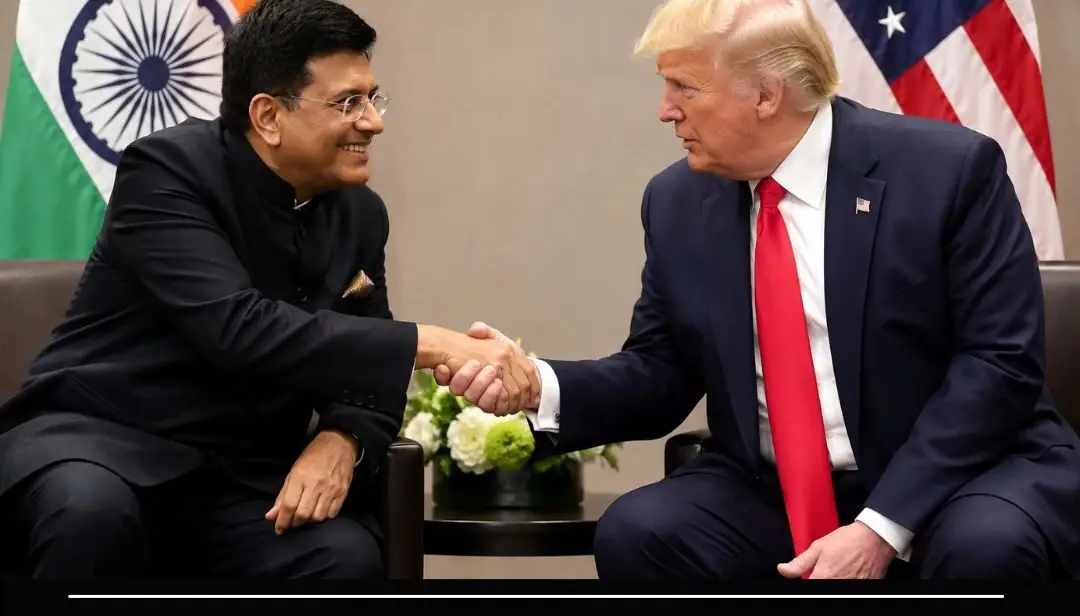
India’s Commerce and Industry Minister Piyush Goyal arrived in New York on May 29, 2026, for a closed-door roundtable with more than 50 of America’s most influential business executives and left with something more valuable than photo opportunities. He left with momentum.
The event, hosted by the Consulate General of India in collaboration with the US-India Strategic Partnership Forum (USISPF), brought together C-suite leadership from Morgan Stanley, Mastercard, Warburg Pincus, Amneal Pharmaceuticals, and dozens of other major US firms. The agenda covered trade expansion, supply chain resilience, digital commerce, advanced manufacturing, and clean technology. But the headline that will reverberate across both capitals is simpler: Goyal assured the assembled executives that an India-US interim trade agreement is close and that a US delegation is scheduled to arrive in New Delhi from June 1 to 4, 2026, to finalize its details.
Why New York, Why Now
The timing of Goyal’s visit is not incidental. With the Strait of Hormuz still effectively closed following US strikes on Iran and global supply chains in a state of acute disruption, American corporations are actively re-evaluating their manufacturing and sourcing dependencies. China remains a contested partner for US firms navigating export controls, technology transfer restrictions, and geopolitical risk. India is positioning itself as the credible alternative and Goyal’s New York offensive is designed to accelerate that repositioning at precisely the moment corporate boardrooms are most receptive.
Business Standard reported that USISPF confirmed Goyal’s assurance to industry that the interim agreement is “close,” framing the June 1–4 delegation visit as a near-final step rather than exploratory talks. For US executives weighing long-term supply chain investments, that signal matters enormously. Capital allocation decisions factories, logistics hubs, R&D centers require regulatory certainty, and a signed trade framework provides the foundation that informal bilateral goodwill cannot.
The Conversations That Counted
Among the most strategically significant bilateral meetings on the margins of the roundtable was Goyal’s session with Morgan Stanley Chairman and CEO Ted Pick, which focused on strengthening long-term institutional investment in India. Morgan Stanley’s positioning in Indian markets has grown substantially over the past decade, and Pick’s personal engagement with Goyal signals that Wall Street views the India growth story as durable even amid the global turbulence created by the Iran war and energy supply disruptions.
Mastercard CEO Michael Miebach met Goyal to discuss deepening collaboration in digital commerce, digital security, and next-generation payment solutions, with specific emphasis on India’s digital public infrastructure and its emergence as a global fintech hub. India’s Unified Payments Interface has already demonstrated at scale what a government-built digital payments backbone can achieve Mastercard’s interest reflects both a commercial opportunity and a recognition that India’s model is increasingly being studied for replication elsewhere.
Amneal Pharmaceuticals co-founder Chintu Patel engaged on R&D collaborations and investment in India’s pharmaceutical manufacturing sector a conversation that has taken on new urgency as American policymakers push to reduce dependence on Chinese API production and build Western-aligned pharmaceutical supply chains.
The $500 Billion Commitment
Underpinning all of these conversations is a headline number that Goyal has been deploying to maximum effect in Washington and New York: India intends to purchase $500 billion worth of US products over the next five years. The commitment covers US energy products, aircraft and aircraft parts, precious metals, technology goods, and coking coal. It is the kind of figure that transforms a bilateral relationship from strategic aspiration to contractual reality and it gives American companies a direct commercial stake in India’s success as a partner economy.
The White House joint statement released earlier this year framed the India-US relationship around exactly this kind of mutual economic dependency, emphasizing supply chain complementarity, technology cooperation, and alignment on inbound and outbound investment reviews.
Supply Chain Realignment in Real Time
What Goyal’s New York roundtable represents, at its core, is the supply chain realignment that economists have been predicting for years accelerated by the Iran crisis, the Hormuz blockade, and the broader decoupling of Western industrial networks from China. KPMG noted that deepening US-India trade ties now encompasses not just goods trade but cooperation on export controls, investment screening, and technology standards the full architecture of an economic security partnership rather than a simple bilateral trade deal.
Goyal’s own framing was direct. “India and America are working as natural partners,” he told the assembled executives. “There is complementarity and trust.” In a world where both of those qualities are in short supply, the message landed.
With a US trade delegation heading to Delhi in days and an interim agreement described as imminent, the supply chain partnership that American and Indian officials have been discussing for years is taking shape with unusual speed. The question is no longer whether it happens it is how much of the $500 billion commitment gets locked in before the geopolitical weather changes again.

Oil & Energy Markets
A look at crude price swings, OPEC supply moves, and how energy markets react to geopolitical shocks.

Geopolitics & Conflict
Breaking down how wars, ceasefires, and diplomatic deals ripple through global trade and security.
US Foreign Policy
Coverage of Trump administration negotiations, sanctions, and strategic decisions shaping world events.
Economy & Inflation
Tracking how commodity prices, gas costs, and supply chains affect everyday consumers.