Share This Article
The cracks inside the Republican Party were always there. Now, with the United States locked in a grinding military conflict against Iran and the Strait of Hormuz blockaded for nearly three months, those cracks have split wide open threatening to reshape the political landscape of the war and President Donald Trump’s grip on his own party.
What was once a cautious murmur of dissent has become an open rebellion. Congressional Republicans, long the most reliable wall shielding Trump from accountability, are now peering over that wall and some are climbing over it.
The War Nobody Voted For
On February 28, 2026, the United States and Israel launched coordinated airstrikes against Iran, targeting military installations, government infrastructure, and senior Iranian officials including Supreme Leader Ali Khamenei. The strikes were ordered without a formal declaration of war, and without explicit authorization from Congress.
Iran struck back hard. Missile and drone attacks were launched against Israel, U.S. military bases across West Asia, and U.S.-allied Arab nations. Most critically, Tehran closed the Strait of Hormuz the narrow waterway through which approximately 25% of the world’s seaborne oil and 20% of global LNG supplies flow daily. The economic consequences have been swift and severe: gas prices at home have surged, global shipping has been thrown into chaos, and the stalemate shows no sign of breaking.
Trump’s response to the Hormuz closure has been publicly firm: “We don’t want tolls. It’s international. It’s an international waterway,” he told reporters this week, urging that the strait remain “open” and “free.” But the administration has offered no clear timeline for forcing that opening.
The War Powers Countdown
Under the War Powers Resolution of 1973, a president may engage U.S. forces in hostilities for a maximum of 60 days without congressional authorization before lawmakers must either formally declare war or authorize the use of military force. That legal clock, by most congressional interpretations, has now expired.
A Senate resolution to compel Trump to withdraw U.S. forces from the Iran conflict made its way to the House floor this week and nearly passed. Three Republicans voted in favor of the measure, forcing a tie vote that exposed how thin GOP support for the war has become. House leaders, recognizing they lacked the numbers to defeat the resolution, quietly canceled the scheduled vote, kicking the matter to June.
The retreat was telling. It was, by multiple accounts, the tenth time Republicans have declined to formally rein in Trump over Iran but this time, the margin of safety had all but vanished.
The Defectors Speak
The most prominent Republican dissenter is Rep. Brian Fitzpatrick (R-PA), a moderate who has consistently argued that the president’s legal window to wage war without Congress has closed. On Wednesday, despite direct pressure from Trump who publicly called out Fitzpatrick’s opposition the Pennsylvania congressman told Axios he still intends to vote for the war powers resolution. Fitzpatrick was joined in earlier votes by Reps. Thomas Massie (R-KY), Warren Davidson, and Tom Barrett (R-MI).
“The 60-day clock has run,” Fitzpatrick said. “That’s not an opinion. That’s the law.”
Trump, for his part, has turned his characteristic pressure tactics onto wavering members, framing any challenge to his war authority as disloyalty even as GOP leaders privately scrambled to contain the fallout.
A Party at a Crossroads
The divide is not simply about US-Iran tensions or the legality of the war. It reflects a deeper fracture over what the Republican Party stands for in a post-MAGA era. Many Republicans were broadly supportive of Trump’s stated objective eliminating Iran’s nuclear capabilities but support for an open-ended, congressionally unauthorized conflict is a different proposition entirely.
As NPR reported, “patience with the war has worn thin as the stalemate in the Strait of Hormuz disrupts global shipping and elevates gas prices in the U.S.” The political math is no longer simple: backing Trump means owning a war without an exit strategy, a blockaded waterway, and rising costs at home.
PBS NewsHour noted the symbolic weight of what nearly happened this week: a war powers resolution passed by the Senate and nearly rubber-stamped by a Republican-controlled House against a Republican president.
What Comes Next
The vote has been delayed to June, but that only postpones the reckoning. If the Strait of Hormuz remains closed, gas prices continue to climb, and no military breakthrough materializes, the political pressure on rank-and-file Republicans will intensify with each passing week.
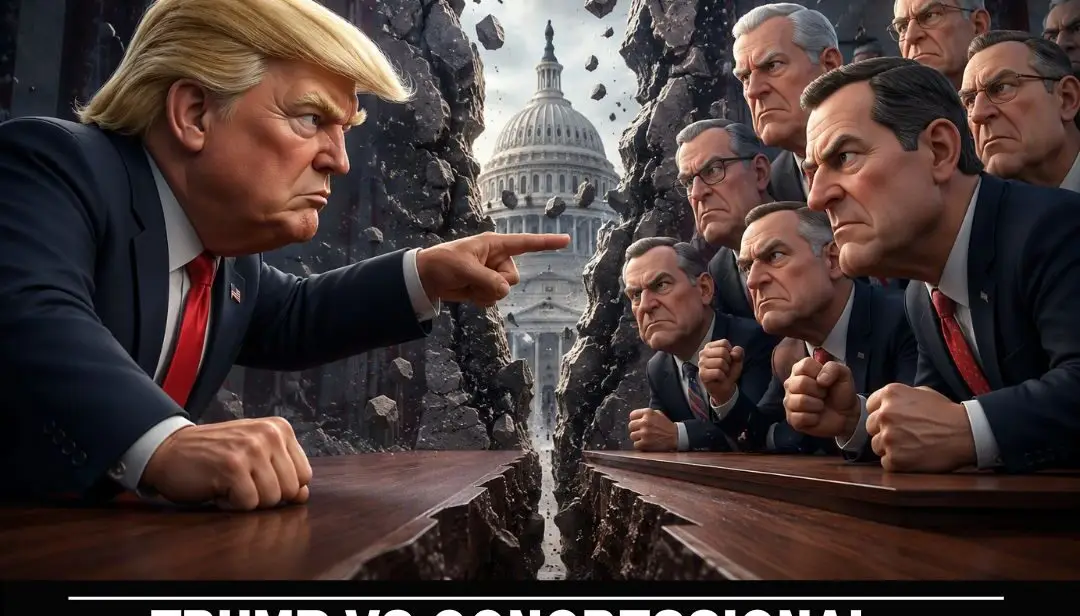
The clash between Trump and Congressional Republicans was, in many ways, always coming. A war launched without a vote, sustained without a strategy, and defended without a timeline was never going to hold a fractious majority together indefinitely. The only question now is whether June brings a vote or another postponement, as both sides wait to see who blinks first.

Oil & Energy Markets
A look at crude price swings, OPEC supply moves, and how energy markets react to geopolitical shocks.

Geopolitics & Conflict
Breaking down how wars, ceasefires, and diplomatic deals ripple through global trade and security.
US Foreign Policy
Coverage of Trump administration negotiations, sanctions, and strategic decisions shaping world events.
Economy & Inflation
Tracking how commodity prices, gas costs, and supply chains affect everyday consumers.