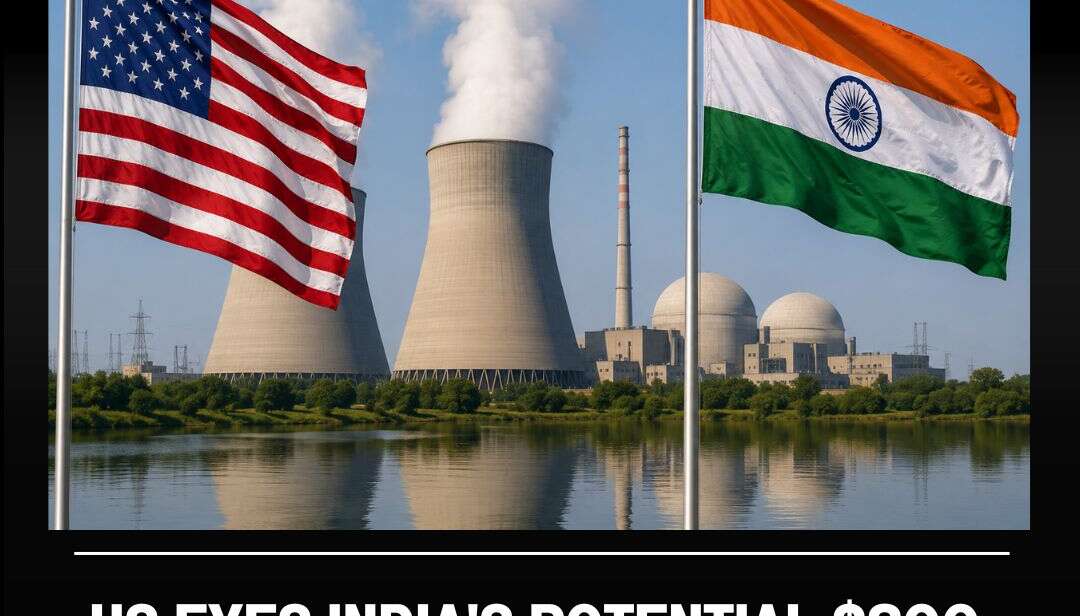
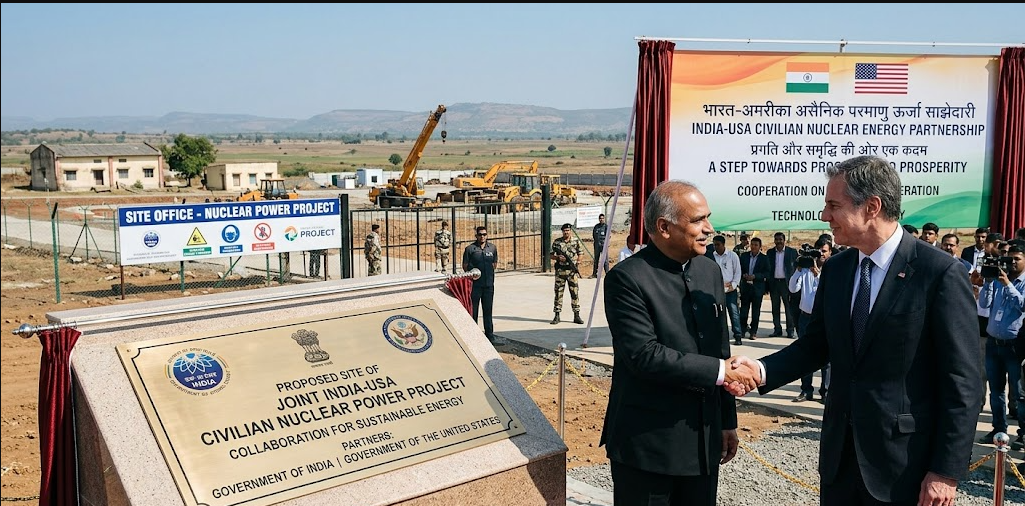
New Delhi / Washington, May 19, 2026 — For seventeen years, one of the most strategically significant civilian nuclear agreements in history sat largely dormant. The 2008 US-India 123 Civil Nuclear Agreement opened the door. India’s nuclear liability law — which held foreign suppliers legally responsible for reactor accidents in ways no global company would
New Delhi / Washington, May 19, 2026 — For seventeen years, one of the most strategically significant civilian nuclear agreements in history sat largely dormant. The 2008 US-India 123 Civil Nuclear Agreement opened the door. India’s nuclear liability law — which held foreign suppliers legally responsible for reactor accidents in ways no global company would accept — kept it shut.
That door is now open. And the timing could not be more consequential.
With global oil prices at $111 a barrel, the Strait of Hormuz functionally closed by Iranian strikes, the US-Iran War in its 80th day, and India burning through foreign exchange to fund a $19 billion monthly oil import bill, the political will to transform India’s energy architecture has never been stronger — or more commercially attractive to Washington.
The prize: a nuclear energy market that India’s own TERI institute values at ₹25 lakh crore — approximately $300 billion — required to reach the government’s target of 100 gigawatts of nuclear capacity by 2047, from today’s 8.78 GW.
The SHANTI Act: The Law That Changed Everything
The breakthrough came not from a summit communiqué but from Parliament. In December 2025, both houses passed the Sustainable Harnessing and Advancement of Nuclear Energy for Transforming India (SHANTI) Act — the most consequential restructuring of India’s nuclear sector since independence. President Droupadi Murmu gave her assent on December 18.
The Act repeals both the Atomic Energy Act of 1962 and the Civil Liability for Nuclear Damage Act of 2010 — the statute whose Sections 17(b) and 46 had placed supplier liability obligations on foreign companies in ways that violated global norms and killed every major US and French nuclear project in India for over a decade.
In its place: a graded liability framework aligned with international standards, permission for private companies to hold up to 49 percent equity in civilian nuclear power projects, and an open door for joint ventures, technology transfer, and foreign investment in nuclear power generation and equipment manufacturing. Only uranium enrichment, heavy water production, and spent fuel management remain under government control.
As CSIS analysed: the SHANTI Act gives the US-India nuclear partnership “a new opening” — its most credible commercial runway since the 123 Agreement was signed.
Westinghouse, Holtec, and the Race to India
American companies have moved fast. Westinghouse Electric — whose six AP1000 pressurised water reactors at Kovvada, Andhra Pradesh, have been negotiated on-and-off since 2016 — is back at the table with new momentum. Modi and Trump reaffirmed commitment to the Kovvada project in their February 2026 summit, with a joint statement pledging to “fully realise the US-India 123 Civil Nuclear Agreement by moving forward” on large-scale US-designed reactors and small modular reactor deployment.
Holtec International has made the most aggressive play. CEO Kris Singh has announced plans to build 200 SMR-300 reactors — each 300 MW — across India, with a dedicated manufacturing facility in Gujarat in partnership with Tata Consulting Engineers, Larsen & Toubro, and Holtec Asia. The US Department of Energy has already authorised Holtec to transfer SMR technology to India. As The Print reported, 200 SMR-300s would collectively deliver 60 gigawatts — more than half of India’s 2047 nuclear target in a single programme.
The uranium supply chain is also moving. Canadian giant Cameco signed a $2.6 billion long-term uranium supply agreement with India’s Department of Atomic Energy on March 2, 2026 — nearly 22 million pounds of uranium ore concentrate over nine years from 2027, at $86.95 per pound, as Investingnews confirmed. It is the largest uranium supply deal India has ever signed.
How the US-Iran War Turbocharged Nuclear Demand
The iran crisis did not create India’s nuclear ambitions. But it has compressed the urgency of executing them from decades to years.
India sources nearly 91 percent of its LPG imports from the Gulf. More than 330 million households depend on LPG for cooking. The US-Iran War‘s closure of the Strait of Hormuz severed the primary route for roughly 50 percent of India’s crude oil imports. Global oil prices above $111 a barrel have pushed the rupee to a record low of 96.17, inflated the monthly import bill to $19 billion, and forced the first retail fuel price hike in 49 months.
As the Atlantic Council’s energy analysis assessed, the US-Iran War is accelerating a permanent structural shift in how energy-importing nations think about fuel dependency — with nuclear, green hydrogen, and domestic renewables all benefiting from the demonstrable danger of relying on Gulf hydrocarbon corridors. Grist’s analysis put it plainly: “Two months in, the Iran war has changed the global energy system forever.”
India’s Prototype Fast Breeder Reactor at Kalpakkam, Tamil Nadu, achieved first criticality on April 6, 2026 — making India only the second country after Russia to operate a commercial fast breeder reactor, and marking entry into the second stage of India’s three-stage nuclear programme. That milestone, largely overlooked amid the noise of the Iranian strikes and global market turbulence, is the technological anchor of India’s long-term energy independence strategy.
What Stands Between Ambition and Execution
The obstacles remain real. The SHANTI Act resolves liability but does not resolve procurement timelines — Westinghouse’s Kovvada project has been in negotiation since 2016 without a signed contract. China continues to block India’s membership of the Nuclear Suppliers Group, complicating multilateral fuel and technology access. The 4.5 GW of annual capacity additions India must sustain after 2031 to reach 100 GW by 2047 is an engineering and financing challenge of a scale India has never previously attempted.
And over 200 Indian nuclear entities remain on US restricted lists — a legacy of India’s 1998 nuclear weapons tests — though National Security Advisor Jake Sullivan announced in January 2025 that the formal de-listing paperwork is underway.
But the direction is set. The law has changed. The companies are circling. The US-Iran War has made India’s energy vulnerability impossible to ignore. And a $300 billion nuclear market — with a government committed to building it, a parliament that has removed the legal barriers, and an energy crisis that makes the urgency visceral — is exactly the kind of opportunity Washington, and American industry, have been waiting eighteen years to access.
Market Analysis
A quick snapshot of market trends, customer behavior, and competitor movements.