
Share This Article
When US President Donald Trump launched what the Pentagon named Operation Epic Fury on February 28, 2026, he promised a swift and decisive victory. Just ten days into the conflict, he declared the United States had “already won the war in many ways.” Two months later, the fighting has been paused under a fragile conditional ceasefire but a definitive end to the Iran War is nowhere in sight, and the ledger of losses stretches far beyond the battlefield.
“There aren’t any real winners from the war, but there are some countries that are comparatively well-positioned to manage its effects,” Melanie Sisson, a senior fellow at the Brookings Institute, told CNN. The evidence bears that out actor by actor, the Iran War has exacted a price from almost everyone it touched.
The Human Cost: Thousands Dead Across the Region
The starkest losses are measured in lives. According to Iran’s Ministry of Health, at least 3,375 people have been killed in US-Israeli strikes on Iran since February 28, including 376 children and 496 women. Human rights group HRANA has documented 3,636 deaths in Iran, including 1,701 civilians, and warns actual military casualties are likely far higher given restricted access to conflict zones.
Lebanon has suffered deeply too. More than 2,500 people have been killed by Israeli airstrikes since March 2, according to the Lebanese Health Ministry with CNN satellite analysis indicating Israel has razed whole villages to the ground in its operations against Hezbollah. Over 600,000 Lebanese have been displaced from southern Lebanon.
The US military has confirmed 13 combat-related deaths among its service members across the region, with over 200 injuries. Iraq, Jordan, Bahrain, Kuwait, Qatar, the UAE, and Saudi Arabia have all absorbed Iranian missile and drone strikes.
The United States: $25 Billion and No Clear Strategic Win
The Pentagon estimates the war has cost the United States $25 billion in just two months one of the highest per-day expenditure rates of any conflict in modern history. Defense Secretary Pete Hegseth, during combative congressional testimony, offered no timeline for the war’s end and responded to cost questions by asking, “What is it worth to ensure that Iran never gets a nuclear weapon?”
Yet Washington remains short of its stated goals. Regime change has not occurred. Iran’s IRGC continues to hold firm control of military operations. Iran’s nuclear program has been struck but not eliminated the UN’s nuclear chief has noted highly enriched uranium likely remains buried at Isfahan. And sixty percent of Americans now disapprove of the strikes, up from 43% at the start of the war, according to a Reuters/Ipsos poll.
At home, the war’s economic toll is beginning to bite. The Consumer Price Index reached 3.3% on an annual basis in March the highest since May 2024 driven by an energy price surge. Gas prices have averaged over $4 a gallon, up more than $1 since the conflict began. Economists at EY-Parthenon and Oxford Economics warn that the spillover into core inflation could push the Personal Consumption Expenditures index to 4% by year end double the Federal Reserve’s target.
Iran: Militarily Weakened, Politically Hardened
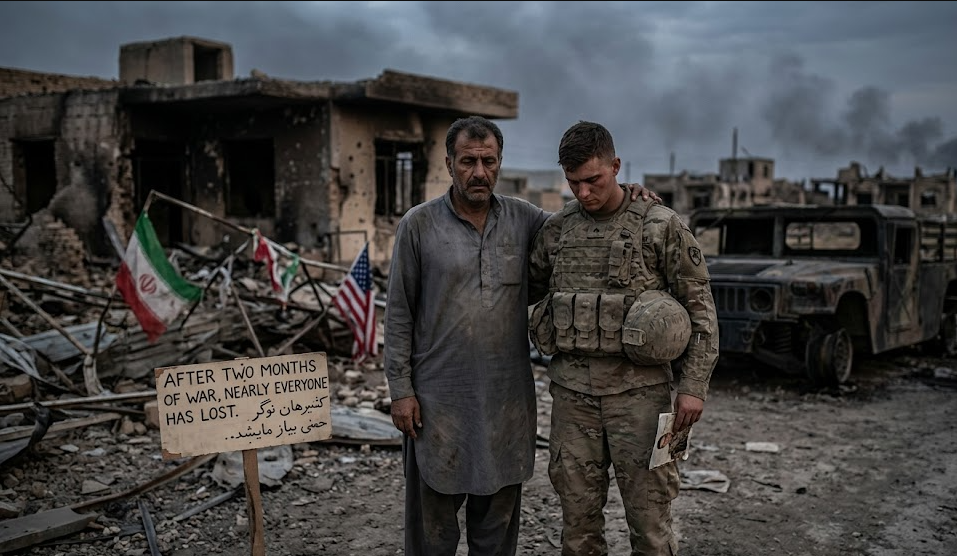
Iran has absorbed the most direct military punishment. The US claims to have struck over 13,000 targets and sunk more than 90% of Iran’s naval fleet before the ceasefire. Iran’s economy is projected to shrink by 10% as a result of the war. Job losses are mounting, poverty is rising, and rampant inflation is decimating households.
Yet the clerical and IRGC structure has not collapsed. Hardliners have, if anything, grown more entrenched. Iran’s new security council leadership is stacked with IRGC old guard unwilling to grant major concessions. Tehran has successfully internalized the costs of war as a point of national pride, and continues to use the Strait of Hormuz as its most potent lever controlling passage, charging tolls exceeding $1 million per vessel, and laying naval mines that have brought commercial traffic to roughly 5% of pre-war levels.
The Gulf States and the Global Economy
Countries across the Gulf the UAE, Kuwait, Iraq, and Qatar have been devastated by a war they neither started nor wanted. Iran’s attacks on Gulf infrastructure have killed dozens, damaged energy sites, and threatened the region’s carefully cultivated image as a stable hub for business and investment. The closure of the Strait has crippled Iraq, Qatar, and Kuwait’s ability to export their oil and gas.
The global economic fallout is vast. Brent crude has surged past $111 per barrel, up from $72.87 on the eve of the war. The World Economic Forum describes the conflict as “a structural shock to the world economy, delivered at a moment of geoeconomic fragility.” Global GDP growth forecasts have been cut by 0.4 percentage points. Damage to Gulf energy infrastructure alone could cost $25 billion to repair. Airlines have rerouted or cancelled flights, adding costs and stranding travellers in what some have compared to the disruptions of the COVID-19 pandemic.
The few relative beneficiaries Russia, whose energy revenues nearly doubled in March, and major oil companies projected to post a combined $94 billion in profits this year stand as a stark contrast to the widespread damage everywhere else.
Where Things Stand
Peace talks mediated by Pakistan remain deadlocked, with the status of the Strait of Hormuz as the central unresolved sticking point. The US has now proposed a new international coalition the “Maritime Freedom Construct” to restore shipping, an implicit admission that it cannot reopen the waterway alone.
Two months in, the contours of this war have confounded nearly every pre-conflict assumption. Iran was not quickly defeated. Regime change did not materialize. The strait did not reopen. And a conflict framed as limited has drawn much of the world into an expanding and expensive quagmire.
As analysts at CSIS put it plainly: “We are witnessing a fundamental miscalculation.” The only question now is how long the reckoning lasts and who bears the heaviest price when it ends.

Oil & Energy Markets
A look at crude price swings, OPEC supply moves, and how energy markets react to geopolitical shocks.

Geopolitics & Conflict
Breaking down how wars, ceasefires, and diplomatic deals ripple through global trade and security.
US Foreign Policy
Coverage of Trump administration negotiations, sanctions, and strategic decisions shaping world events.
Economy & Inflation
Tracking how commodity prices, gas costs, and supply chains affect everyday consumers.