
Geopolitics
US and Iran Are Trading Strikes Almost Daily, and the Pentagon Isn’t Telling You About All of Them
WASHINGTON, Nov. 18, 2026 – The US Iran strikes you hear about on the evening news are only part of the story. The United States and Iran are now exchanging military fire almost every day, and most American strikes are never publicly announced, according to a new NBC News report citing two US officials and…
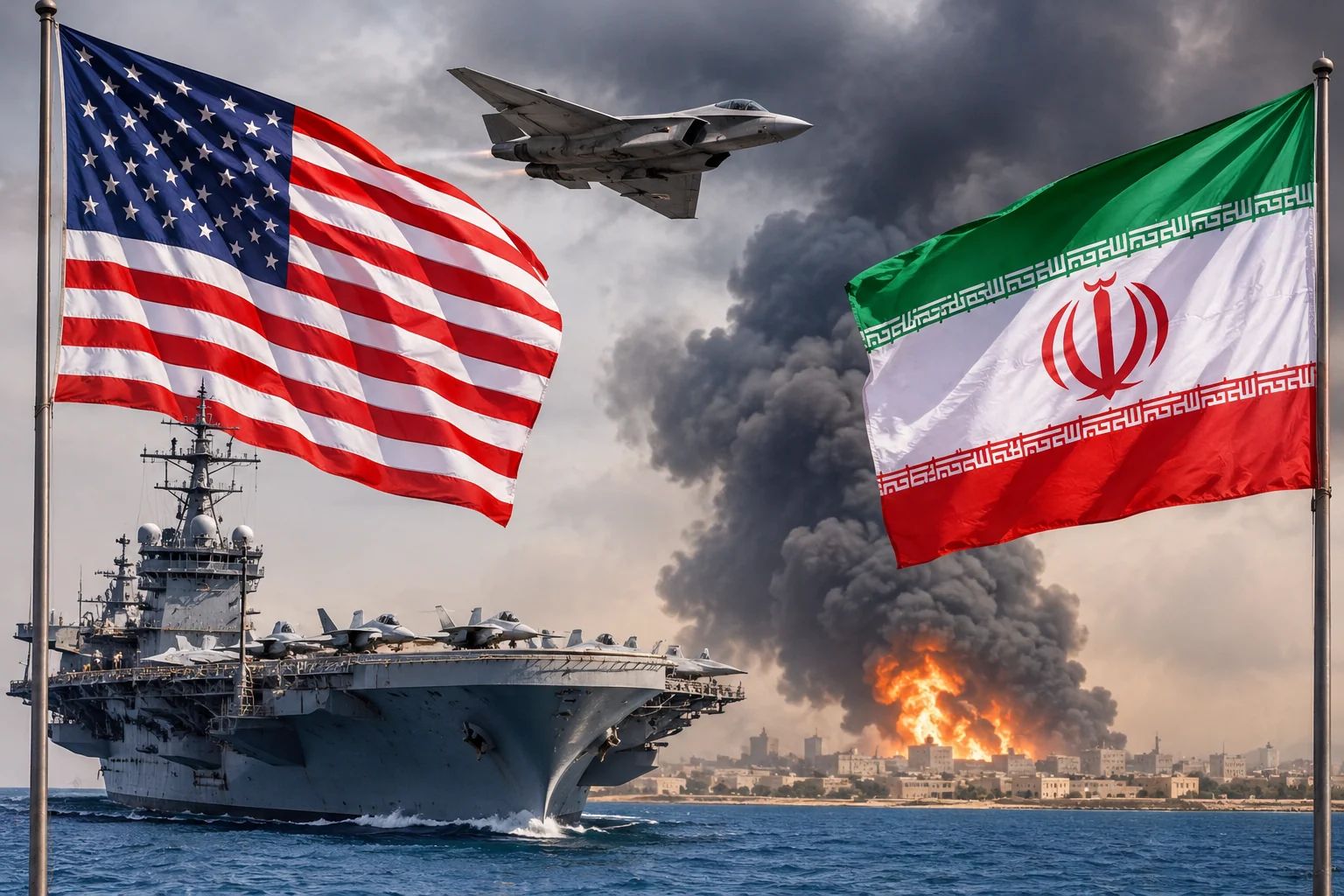
WASHINGTON, Nov. 18, 2026 – The US Iran strikes you hear about on the evening news are only part of the story. The United States and Iran are now exchanging military fire almost every day, and most American strikes are never publicly announced, according to a new NBC News report citing two US officials and a person familiar with the matter.
The disclosure landed in a week when the conflict visibly widened. On Tuesday, US fighter jets hit an Iranian missile site. On Wednesday, Iran answered with drone attacks on a US air base in Kuwait and on targets in Bahrain. It is a sharp contrast with Trump’s claim a week ago that the war was “effectively over” militarily, and with his declaration that the US does not need a deal with Tehran.
Track the Numbers Behind the Iran War
Tanker attacks and Gulf strikes show up in prices first. Follow both live:
Live Oil Price Tracker →
Brent and WTI in real time, the fastest read on whether the Gulf is escalating or easing.
Live Trump Tariff Tracker →
Every tariff move as it lands, since trade pressure and the war are moving the same markets.
What the Pentagon Isn’t Confirming
According to NBC News, Iran has been targeting US Navy vessels, US military facilities and commercial tankers in the Strait of Hormuz. American forces have been shooting down incoming drones and missiles and, at times, striking missile launchers and other targets inside Iran.
The key detail: most of those US strikes have not been disclosed, especially over the past two months. “They are carrying out these strikes and not acknowledging them,” one source told the network. The Pentagon declined to comment, and the White House did not respond.
The scale behind the quiet campaign is large. More than 50,000 US troops and two aircraft carrier strike groups are deployed in the Middle East, and the conflict is reportedly costing the US millions of dollars a day.
Did the US Strike Iran Today? The Latest Confirmed Attacks
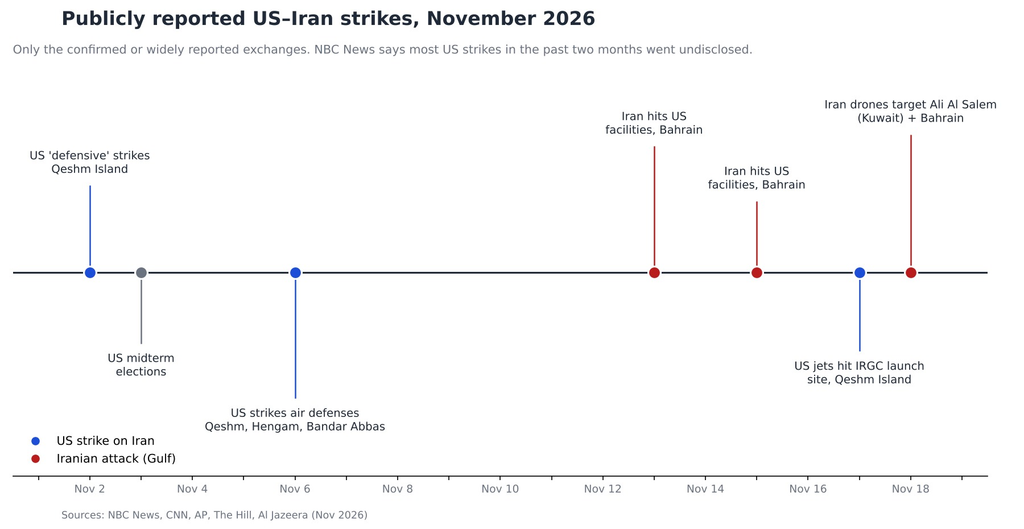
If you are asking “did the US strike Iran today,” the honest answer is that the public record only shows the strikes Washington chooses to confirm. Here is what has been confirmed or widely reported this month:
- Nov. 2: US forces carried out what officials called “defensive strikes” on Qeshm Island, a day before the midterm elections.
- Nov. 6: President Trump confirmed “minor” strikes on Iranian air defenses. Explosions were reported on Qeshm and Hengam islands and in Bandar Abbas.
- Nov. 13 and 15: Iran attacked US facilities in Bahrain, saying it was responding to US drone surveillance and an attack on Iranian communications towers.
- Nov. 17: US jets used precision munitions on an IRGC missile launch site on Qeshm Island after Iranian drones targeted a US radar at Bahrain’s Isa Air Base. A US official called it self-defense “in response to IRGC aggression targeting US personnel and assets.”
- Nov. 18: Iran’s army targeted Ali Al Salem Air Base in Kuwait with drones, its first attack on Kuwait in more than two months. Bahrain, home of the US Fifth Fleet, also sounded air raid sirens and reported intercepting “a number of Iranian aerial attacks.”
Timeline of publicly reported US–Iran strikes, November 2026 Chart: Publicly reported US Iran strikes in November 2026. Officials say the real number is higher.
Is the Iran War Getting Worse?
The short answer: the Iran war escalation is real, but both sides are still keeping it below an all-out war.
US officials describe their recent strikes as defensive, not as a major escalation. Yet the pattern has shifted. Iran is no longer hitting only ships and US assets near the Strait. It is now reaching across the Gulf to Kuwait and repeatedly to Bahrain. The Revolutionary Guard even warned Bahrain that leaning on an American “security bubble” could threaten its survival.
Shipping is also under pressure. The IRGC Navy claimed a supertanker carrying over two million barrels of crude and a gas carrier struck sea mines in the strait. Separately, the UK Maritime Trade Operations agency said a vessel near Khasab, Oman, was hit a second time and caught fire, with its crew unaccounted for. Monitoring agencies now report attacks on ships near the strait almost daily.
The conflict began on Feb. 28, when US and Israeli strikes hit Iran. It is now close to nine months old, with a ceasefire that collapsed earlier and a US naval blockade that has helped restore some oil flows.
Gulf Attacks: Why Neighbors Are Bracing for More
The Gulf attacks are pushing America’s partners to speak up. Secretary of State Marco Rubio condemned the strikes and reaffirmed US support for Bahrain. Saudi Arabia called for an immediate halt to Iranian attacks, and Qatar warned of serious escalation.
Diplomacy is still alive. Qatar said it would meet Iranian officials on proposals to narrow gaps between Tehran and Washington, and Iran’s foreign minister recently visited Pakistan and Oman, both mediators. Gulf states are also hardening their defenses: on Nov. 10, the GCC approved a headquarters for its Unified Military Command in Kuwait.
The war is also overshadowing Trump’s Asia trip. Iran is on the agenda for his three-way meeting in Shenzhen, as we covered in our Trump-Xi-Putin summit preview and our guide to who is meeting Trump at the nuclear summit. Officials do not expect a breakthrough on Iran there.
Will Gas Prices Go Up?
For American drivers, this is the question that matters most. The Strait of Hormuz carried about 20% of the world’s oil before the war, so any flare-up there moves prices.
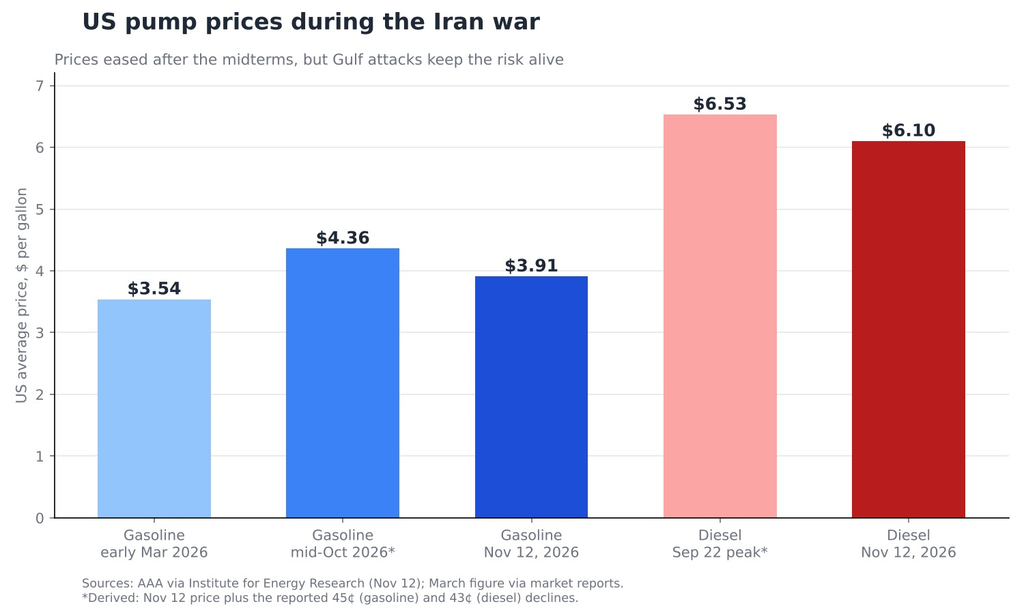
The good news, for now: on Nov. 12, the US average for gasoline was $3.91 a gallon, 45 cents lower than a month earlier, according to AAA. Diesel averaged $6.10, down 43 cents from its Sept. 22 peak. The US blockade, tanker escorts and pipelines that bypass the strait have pushed Middle East oil exports back to near pre-war levels. Fuel prices have eased since October but remain well above pre-war levels.
The risk: earlier this year, when the ceasefire broke down and Iran hit tankers and US bases, oil jumped to multi-week highs. Wider attacks on Kuwait and Bahrain, plus new mine strikes, could push prices back up quickly. Markets already swung on oil after the midterms, as we covered in our report on the stock market after the Democratic sweep. You can watch the move live on our oil price tracker.
US gasoline and diesel prices during the Iran war, 2026 Chart: US fuel prices have eased since October, but remain well above pre-war levels.
What to Watch Next
- Whether the Pentagon starts confirming more strikes, especially if US personnel are hurt.
- Iran’s target list. Kuwait and Bahrain this week; Saudi Arabia, the UAE or Qatar would mark a bigger step.
- Qatar’s talks with Tehran, the clearest diplomatic off-ramp right now.
- Tanker incidents in the Strait of Hormuz, the fastest signal for your gas prices.
Trump’s leverage-first posture is not limited to Iran. He has also said he wants to “get Cuba done” before leaving office, another sign of how he approaches adversaries.
For live coverage of the Iran war and its fallout, visit DonaldTrump.Coach.
Frequently Asked Questions
Did the US strike Iran today?
The latest confirmed US strike was on Tuesday, Nov. 17, 2026, when US jets hit an IRGC missile launch site on Qeshm Island. US officials say many other strikes are not publicly disclosed, so the confirmed record is incomplete.
Why isn’t the Pentagon confirming all US Iran strikes?
The Pentagon has declined to comment. US officials describe most actions as defensive responses to Iranian drones and missiles, which may explain why many are not announced individually.
Is the Iran war getting worse?
The fighting is widening. Iran attacked a US air base in Kuwait on Nov. 18 for the first time in over two months and has hit Bahrain repeatedly. Both sides still describe their actions as limited.
Where are the Gulf attacks happening?
Mainly around the Strait of Hormuz, Qeshm Island and Bandar Abbas in Iran, and at US-linked sites in Bahrain and Kuwait.
How many US troops are in the Middle East?
More than 50,000 US troops and two aircraft carrier strike groups, according to NBC News.
Will gas prices go up because of the US Iran conflict?
They could. Gas fell to about $3.91 a gallon on Nov. 12, but new attacks on tankers or Gulf oil sites could reverse that quickly, since the strait handles about a fifth of global oil.
References & Sources
- NBC News via Iran International – “US and Iran exchange near-daily strikes, many undisclosed by Pentagon” (Nov. 18, 2026)
- CNN – “US carries out ‘self-defense’ strikes on Iranian missile launch site” (Nov. 17, 2026)
- Associated Press via AOL – “Iran widens Gulf attacks by targeting a US air base in Kuwait and sites in Bahrain” (Nov. 18, 2026)
- Stars and Stripes — “Iran-US conflict escalates with renewed attacks across Persian Gulf” (Nov. 18, 2026)
- Fox News – “Iran targets US air base in Kuwait after US defensive strikes“
- The Hill – “US military targets Iranian defense system in latest round of limited strikes” (Nov. 7, 2026)
- NBC News – “U.S. military carries out new limited strikes on Iran“