Three of Europe’s most powerful governments made their position unmistakable on June 7, 2026. France and Germany, standing alongside the United Kingdom at a high-stakes summit inside 10 Downing Street, gave their full formal backing to President Volodymyr Zelensky’s demand for direct, face-to-face ceasefire negotiations with Vladimir Putin — announcing five binding conditions for peace in a joint statement that represents the sharpest coordinated European diplomatic signal since the war began.
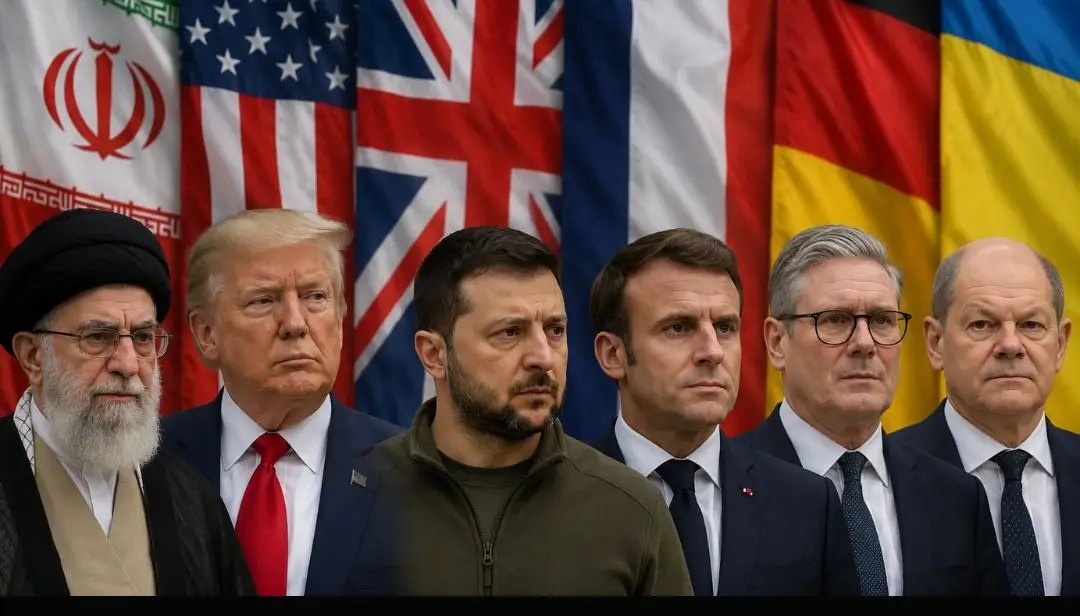
The E3 summit brought together Prime Minister Keir Starmer, President Emmanuel Macron, and Chancellor Friedrich Merz — all three co-signing a declaration that calls for “a direct dialogue between Ukraine and Russia, with active US and European participation” as the only credible route out of a conflict now consuming its fourth year and stretching Western strategic attention across two simultaneous theaters: Eastern Europe and the Strait of Hormuz.
Putin’s response, delivered the day before the summit, was to call Zelensky’s overture “boorish” and say he saw “no point” in a meeting. The timing made the European show of unity both more urgent and more deliberate.
What Zelensky Proposed — and Why Now
The diplomatic sequence was triggered on June 4, when Zelensky published an open letter directly addressed to Putin — released, with pointed symbolism, as Russian drones struck near the St. Petersburg International Economic Forum where Putin was speaking. The letter issued a direct public challenge: agree to a full ceasefire, meet face-to-face in a neutral country, begin an “all-for-all” prisoner exchange, and return civilians and children forcibly displaced by the war.
Zelensky named Switzerland, Turkey, or an Arab state as potential venues. He proposed the United States as ceasefire monitor — a deliberate inclusion designed to keep Washington anchored in a process that Trump has been pressuring to conclude before US midterm elections. He insisted that EU and UK leaders must participate at the table alongside Ukraine, and he named the current front line as the baseline for any territorial discussion — directly contradicting Russia’s demand that Ukraine first withdraw from Donbas regions Moscow controls but has not fully captured.
Putin rejected the framing outright on June 6, saying Moscow seeks a “comprehensive settlement, not a temporary truce” and would only meet Zelensky to “finalize an already agreed deal.” The Kremlin’s position has not moved: Ukraine must accept Russia’s territorial claims before negotiations begin. Zelensky’s position is the inverse: ceasefire first, then negotiate.
The Five Conditions: London’s Non-Negotiables
The joint E3 Leaders’ Statement published on GOV.UK formalised European support around five specific conditions that france and germany, alongside Britain, collectively placed on the table:
- Putin must accept an immediate and complete ceasefire
- Negotiations must begin at the current line of contact
- Ukraine must receive robust and legally binding security guarantees
- A multinational enforcement force must be deployed to monitor the ceasefire
- Russia must provide full compensation for war damages
Chancellor Merz framed Germany’s commitment plainly: “Germany will keep contributing politically, financially and militarily,” adding that Berlin could deploy forces to Ukraine on neighbouring NATO territory following any ceasefire agreement. He acknowledged that “Ukraine and its European allies will have to make compromises” — a signal of realism amid the firm public posture, noted by Kyiv Independent’s E3 coverage.
Macron struck a carefully calibrated tone alongside the firmness, stating that “Europe is interested in cooperation with Russia in the field of security” — leaving a diplomatic opening even while co-signing conditions Moscow has so far rejected entirely. Bloomberg’s European ceasefire report described the summit as the clearest unified European signal yet that the continent will not accept a settlement imposed over Kyiv’s objections.
The Money Behind the Message
The E3 statement carries financial credibility because it is backed by already-deployed capital. In April 2026, the EU finalized a €90 billion loan to Ukraine — €60 billion for military assistance and €30 billion for budget support — with repayment explicitly structured around Russian war reparations, per the European Council’s formal press release. Over 93,000 Ukrainian soldiers have been trained under the EU Military Assistance Mission since its founding.
France and Germany are now among Europe’s biggest defense spenders in absolute terms. Germany’s defense budget surged to €97 billion in 2025 — a 24% year-on-year increase — and is projected to reach €117.2 billion in 2026, making Berlin Europe’s largest defense investor, overtaking London for the first time. France has committed €68.5 billion (2.25% of GDP) to defense in 2026 despite domestic fiscal constraints. The UK allocated $88.5 billion.
On the battlefield, the latest Institute for the Study of War assessment confirms that Russian advances have “suddenly stalled” as of June 7 — attributed to Ukraine’s systematic investment in drone and UAV capabilities that have disrupted Russian logistics and momentum. Moscow has responded by intensifying aerial strikes on Ukrainian cities — a shift European officials interpret as evidence of “increasing military and economic difficulties” inside Russia.
Trump, Timing, and the Transatlantic Fault Line
The E3 summit was carefully constructed to include rather than exclude Washington. The joint statement explicitly calls for US participation in direct Ukraine-Russia talks — threading the needle of Trump’s desire for dealmaking credit while ensuring Europe retains its seat at the table.
Trump had previously stated he wanted a Ukraine peace framework finalized by June 2026 before midterm campaign pressures dominate the White House calendar. Zelensky has said 90% of a potential peace deal framework was agreed following December 2025 discussions with Trump. But the central sequencing dispute remains unresolved: Trump’s team insists all security guarantees be signed simultaneously with a peace deal; Zelensky wants legally binding guarantees first, to build domestic Ukrainian public trust in any agreement. That gap is extensively documented in CSIS’s Ukraine peace plan analysis.
Two Wars, One Alliance
The London summit did not happen in a vacuum. The same European alliance now rallying around Ukraine is simultaneously managing the economic fallout from the US-Iran war and the Strait of Hormuz shutdown — now in its 97th consecutive day of effective closure — which has driven energy costs across Europe to crisis levels and stretched Western strategic bandwidth across two simultaneous theaters.
Zelensky made the connection explicit in a separate statement this week, offering Ukraine’s expertise in maintaining maritime corridors under fire — pointing to its Black Sea navigation model as a potential template for eventually restoring Hormuz passage. It was a characteristically bold piece of Ukrainian diplomacy: positioning Kyiv not just as a beneficiary of Western support, but as a contributor to solving the broader security crisis consuming global attention.
The E3 leaders left London having delivered the clearest joint message the continent has sent since the war began. Five conditions. One unified voice. The question now is whether Moscow reads any of it as an invitation to negotiate — or simply as noise to outlast.