Trump’s White House Press Briefing: Nothing Was Off the Table
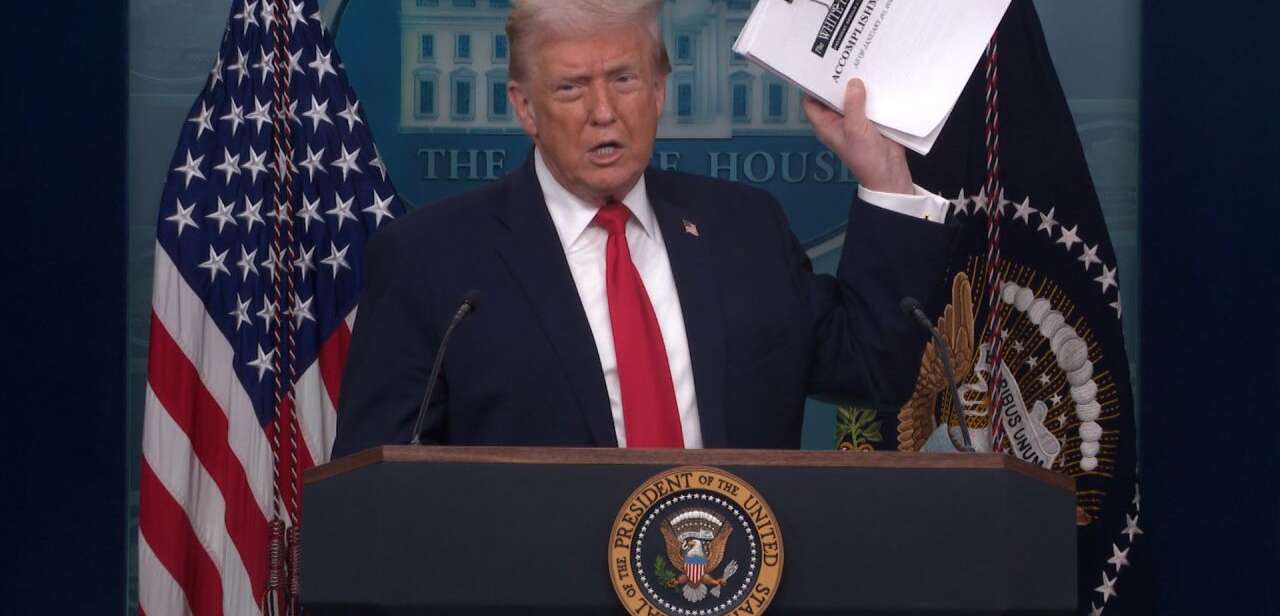
Before Air Force One lifted off for Davos, President Trump staged one of the most chaotic and revealing Trump White House press briefing sessions of his second term — a nearly two-hour performance that touched everything from mugshot displays and Greenland annexation to a proposed replacement for the United Nations and promises of direct cash payments to American households.
The Trump press conference was less a formal media engagement and more a preview of the president’s second-term governing philosophy: aggressive, improvisational, and entirely unbothered by institutional norms. Here is a full breakdown of what happened and why it matters.
The Mugshots: Setting the Tone Immediately
Trump opened the briefing in a manner that left the White House press corps momentarily speechless. Large display boards featuring mugshots of individuals he characterized as dangerous immigrants were wheeled into the briefing room — a visual designed to frame the administration’s ongoing Trump immigrant crackdown resistance narrative before a single question was asked.
The move was theatrical but calculated. With federal courts actively challenging deportation orders and Democratic governors mobilizing legal resistance, Trump used the visual to put opponents on defense: oppose our immigration enforcement and you are defending these people. It was political framing at its most blunt, and it set the combative tone for everything that followed.
Trump went on to complain at length about what he called his administration’s “public relations problem” — a remarkable admission that despite controlling the White House, Senate, and House, he remains frustrated by media coverage he views as systematically hostile.
The Greenland Ultimatum and the UN Replacement Plan
The Trump Greenland question dominated a significant portion of the briefing. Asked directly whether he would commit to ruling out military force to acquire the autonomous Danish territory, Trump declined — again. He framed Greenland as a matter of American national security and economic interest, and suggested that Danish objections were ultimately irrelevant to US strategic calculations.
But the most startling foreign policy moment came when Trump floated his concept for a Trump Board of Peace — an alternative international body that would, in his framing, replace or supersede the United Nations in mediating global conflicts. Details were sparse, but the implication was clear: Trump views multilateral institutions like the UN as obstacles to American interests rather than forums for shared governance. A US-led alternative, structured on terms favorable to Washington, would better serve his vision of transactional global order.
Foreign policy analysts watching the briefing noted the proposal — however loosely articulated — as consistent with Trump’s broader effort to dismantle rules-based international architecture and replace it with bilateral power arrangements the United States can dominate.
Hells Angels, Minnesota Protests & the Limits of Presidential Authority
In a briefing already dense with provocations, Trump found time to praise the Hells Angels motorcycle club in the context of discussing Trump Minnesota protest crackdowns — a jaw-dropping rhetorical detour that nonetheless reflected his consistent alignment with extra-institutional displays of force over civic process.
On domestic policy, Trump made a claim that immediately triggered alarm among constitutional scholars: he suggested his administration was exploring a mechanism to send Trump tariff checks Americans — direct payments to US households funded by tariff revenue — without requiring Congressional approval. The proposal echoed the logic of executive revenue-sharing but bypassed the fundamental constitutional reality that spending authority rests with Congress, not the White House.
The ability to Trump bypass Congress on direct payments to citizens does not exist under current law. Independent budget experts were swift in flagging the claim as either a misunderstanding of executive authority or a deliberate test of how far the administration can push unilateral fiscal action before facing legal challenge.
What the Briefing Revealed About Trump’s Second Term
Taken together, the pre-Davos press briefing was a remarkably clear window into the operating logic of Trump’s second administration. Norm-breaking is the point, not a side effect. Institutions — the UN, Congress, the press — are treated as friction to be overcome rather than guardrails to be respected.
For Americans and global observers trying to anticipate what comes next, the Trump White House press briefing changes on display that day offered the clearest possible signal: the boundaries of conventional presidential conduct are no longer the operating framework. Trump is writing new ones in real time.