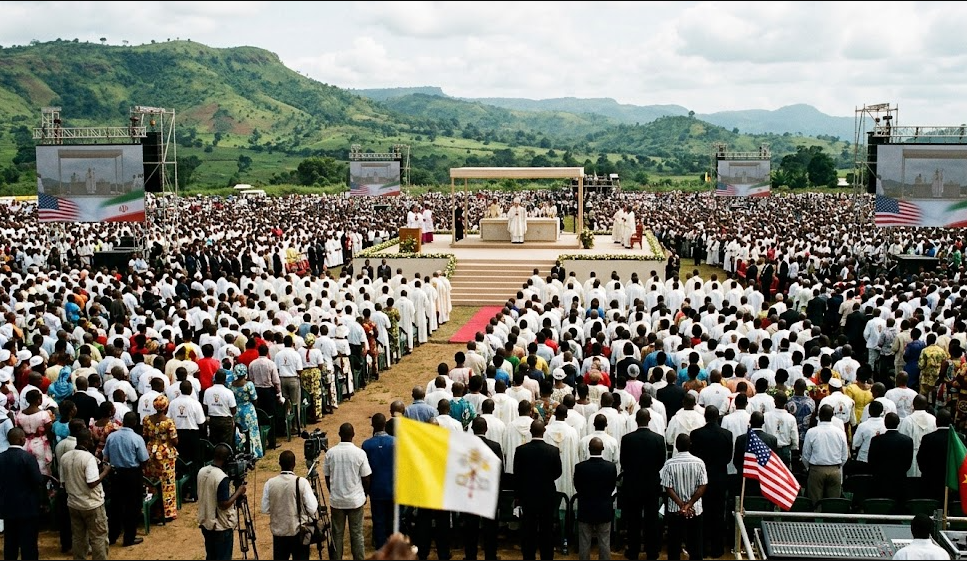
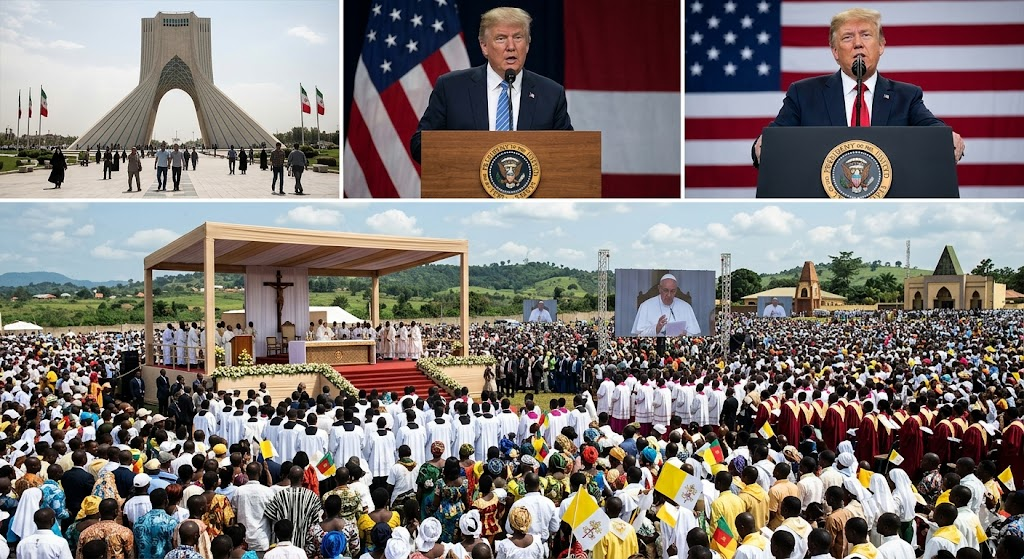
Under sweltering 90-degree heat beside Douala’s Japoma Stadium, more than 120,000 Cameroonians gathered on April 17 to worship with the first American pope — and in doing so, staged a vivid portrait of where Christianity’s future is being written. The crowd that turned out for Pope Leo XIV’s open-air Mass in Cameroon’s largest coastal city
Under sweltering 90-degree heat beside Douala’s Japoma Stadium, more than 120,000 Cameroonians gathered on April 17 to worship with the first American pope — and in doing so, staged a vivid portrait of where Christianity’s future is being written.
The crowd that turned out for Pope Leo XIV’s open-air Mass in Cameroon’s largest coastal city was not merely large. It was a statement. Worshippers arrived hours before dawn, filling every inch of the stadium’s sprawling car park — the only venue in Douala capable of holding them. They came carrying Vatican flags, homemade banners, and the kind of fervor that has quietly, steadily made sub-Saharan Africa the most dynamic engine of Catholic growth on Earth.
“Bring the bread of life to your neighbours,” Leo told the congregation in his homily, drawing from the Gospel account of the feeding of the five thousand. “Jesus looks at all these hungry people, weighed down by fatigue — and asks each one of us: what will you do?”
It was a question the continent itself has been answering for decades, one baptism at a time.
The Numbers Behind the Spectacle
The Douala Mass was not a diplomatic courtesy stop. It was a data point made flesh.
According to the Vatican’s own Annuario Pontificio 2026, released in March, the number of Catholics in Africa rose from 281 million in 2023 to over 288 million in 2024 — a growth rate of 2.6%, nearly five times that recorded in Asia. Africa’s share of the global Catholic population has now crossed 20%, overtaking Europe for the first time in modern Church history. Europe’s share, meanwhile, declined from 20.4% to 20.1%.
The trajectory is unambiguous. By 2050, the World Christian Database projects that African Catholics will account for 32% of the universal Church — meaning that within a generation, nearly one in three Catholics on earth will be African.
In Cameroon specifically, approximately 30% of the population is Catholic. The Church is not a peripheral institution here — it is a foundational one, running hospitals, schools, and civil society networks that extend far beyond what the government provides in many regions.
A Missionary Pope on Missionary Ground
What gave the Douala Mass an added layer of significance was the man presiding over it. Leo XIV spent more than two decades as a missionary in Peru’s poorest northern regions before his eventual rise within the Church. He is a pope shaped by the Global South even before he became its most powerful religious leader.
His visit to Cameroon — the first African tour by a sitting pope in several years — took him from the capital Yaoundé to the university students he challenged to cultivate “holy restlessness” and reject corruption, and then to Douala, where the full force of African Catholic devotion surrounded him.
“Africa must be freed from the scourge of corruption,” he told students in Yaoundé, his message blending pastoral care with political accountability. A few hundred kilometers north, in Bamenda — the heart of the country’s Anglophone crisis — he had already confronted the continent’s political wounds more directly, warning against “tyrants” who spend billions on weapons while dedicating nothing to healing the people beneath them.
Challenges Beneath the Growth
The surge in African Catholicism is not without friction, either within the Church or against it.
Pentecostal and Evangelical denominations have grown aggressively across the continent. In 1970, Pentecostals represented roughly 5% of Africa’s population; today that figure exceeds 12%. The competition for souls is real, and Catholic pastoral leaders know it.
Inside the Vatican, the continent’s growing influence has surfaced uncomfortable theological tensions. A March 2026 report from the Symposium of Episcopal Conferences of Africa and Madagascar flagged polygamy as an unresolved pastoral challenge in dozens of dioceses, where rapid social change has outpaced Church doctrine. How Rome responds to distinctly African social realities — rather than simply applying European frameworks — will define the institution’s credibility across the continent for decades.
Catholic World Report noted in April that the African Church’s rising demographic weight is already shifting conversations inside the Vatican on questions of doctrine, leadership, and moral authority. “The challenge now is how much Africa will reshape the church’s rules,” one observer noted, “as its flock keeps growing.”
A New Center of Gravity
The Douala crowd was a reminder that the Catholic Church’s future congregation does not look like its past hierarchy. It is younger, poorer, more geographically southern, and growing faster than at any point in the modern era.
Leo XIV, standing before 120,000 Cameroonians in the equatorial heat, represented a Church that is slowly — and not without resistance — catching up to where its faithful already are.
The numbers have been building for years. The spectacle in Douala was simply the most recent, and most visible, proof.
Market Analysis
A quick snapshot of market trends, customer behavior, and competitor movements.