Share This Article
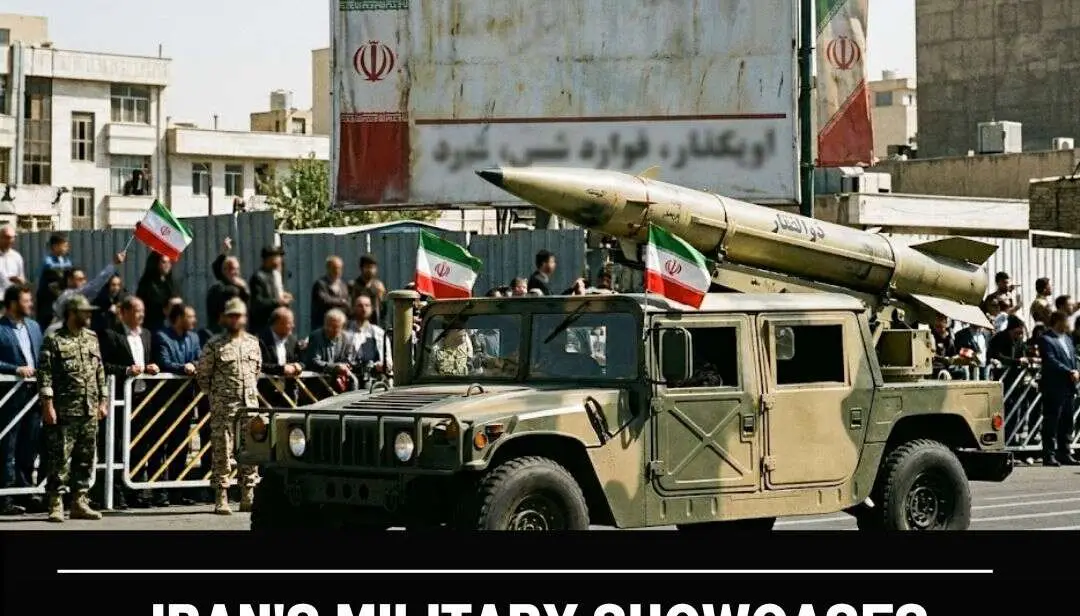
Tehran / Washington, May 20, 2026 — On the streets of Tehran, military vehicles mounted with Soviet-era machine guns have become a fixture of public life. Ballistic missiles are displayed on stages at mass wedding ceremonies. IRGC units parade Kalashnikov-style rifles through city squares. The messaging from the Islamic Republic is unmistakable: Iran’s military is unbowed, unbroken, and ready.
The iran crisis that has consumed the region for 81 days the US-Iran War launched by coordinated Iran strikes on February 28, the assassination of Supreme Leader Ali Khamenei, the closure of the Strait of Hormuz, and a ceasefire that both sides have honoured selectively has produced a regime that performs strength with increasing theatrical urgency. The question analysts are asking is whether the performance reflects reality, or is designed to paper over a domestic concerns crisis that is, by many measures, more threatening to the Islamic Republic than any American bomb.
What Iran Is Showing the World
Iran’s military has not been passive in the 80-plus days since Operation Epic Fury dismantled an estimated 60 percent of its ballistic missile launchers and destroyed much of its conventional naval fleet. What survived and what has been rebuilt, replenished, and displayed has been showcased with deliberate intent.
Iran has fired more than 1,000 drones since hostilities began. The workhorse is the Shahed-136 a kamikaze drone costing approximately $20,000 per unit, carrying a 110-pound payload over 1,000+ miles, flying low and slow in ways that challenge conventional air defence systems. A new variant, the Shahed-136B, has been unveiled featuring a 4,000-kilometre range, turbojet engine, larger warhead, and improved stealth characteristics. HESA, Iran’s aerospace manufacturer, has scaled production to exceed 200 units per month, as Al Jazeera’s weapons analysis confirmed.
Iran’s precision-strike ballistic missile Jahad 1,000-kilometre range, solid-fuel, dual-platform has been displayed publicly alongside claims of operational hypersonic weapons. The Fattah-2 hypersonic glide vehicle was reportedly first deployed on February 28. Western analysts at RAND and Jane’s remain sceptical of full hypersonic capability, suggesting Iran may be fielding upgraded ballistic missiles with manoeuvrable reentry vehicles rather than true Mach 13–15 systems. The distinction matters militarily; the propaganda value is identical regardless.
At sea, Iran has deployed domestically-produced Ghadir-class light submarines in the Strait of Hormuz under heightened readiness, as Army Recognition reported. It has also test-fired the Sayyad-3G air defence missile from a naval vessel in the Strait a deliberate signal that Iran retains layered defensive capacity in its most strategically vital waterway.
As Euronews assessed, “Iran is preparing for renewed war as military assets remain largely intact.” CBS News cited US intelligence officials saying Iranian forces “are still very much poised to wreak absolute havoc throughout the entire region” a sobering assessment given that Operation Epic Fury destroyed 60 percent of missile launchers and the entire Russian-supplied conventional fleet.
The Domestic Crisis: What the Parades Cannot Hide
Behind the weapons displays, Iran faces a domestic concerns catastrophe that no military parade can address. The rial has collapsed to 1,750,000 to one US dollar an 84 percent depreciation in a single year and a loss of roughly 20,000 times its value over four decades. Inflation has crossed 100 percent. Food inflation is running at extraordinary levels: bread and cereals up 140 percent, red meat up 135 percent, cooking oil and fats up 219 percent, as Iran International reported.
Seven million Iranians have gone hungry since the war began. Barbari bread a staple now costs 250,000 rials per loaf. Meat has become a luxury item. Iran imported 2.75 million tonnes of wheat worth approximately $1 billion in the ten months to February 2026, before the naval blockade complicated every import corridor. As Al Jazeera’s food crisis analysis documented, fears of a broaderglobal market food crisis are being driven in significant part by Iranian fertiliser supply disruption.
The protests that preceded the war Iran’s largest since the 1979 Islamic Revolution, which erupted in December 2025 across more than 200 cities were triggered by the same economic pressures. The government’s response was lethal: Khamenei ordered live fire, resulting in thousands dead. The new Supreme Leader Mojtaba Khamenei, installed through IRGC orchestration on March 9, as the Times of Israel confirmed, has been largely invisible since communicating only through IRGC intermediaries, his health and precise whereabouts uncertain.
The Strategic Logic of the Showcase
The weapons displays serve multiple audiences simultaneously. Domestically, they signal to a population living through 100 percent inflation and bread shortages that the regime retains coercive authority and military dignity a message designed to deter the kind of mass uprising that economic desperation and war fatigue might otherwise catalyse.
Internationally, they signal to Washington and Tel Aviv that the iran crisis has not produced a defeated Iran. Roughly 50 percent of missile launchers survived the initial strikes by some estimates. The drone programme has not been degraded it has been accelerated. The Ghadir submarines remain in the Strait. And the IRGC which now functions as the de facto governing authority has both the institutional motivation and the material capability to resume full-scale hostilities if the ceasefire collapses.
RAND’s post-Khamenei analysis concluded that “the theocracy is expected to survive battered and bruised, but standing.” Foreign Policy’s May 2026 assessment of Iran’s strategy found a regime doubling down on Strait leverage and military demonstration precisely because diplomatic trust as Foreign Minister Araghchi stated publicly “cannot be restored with the Americans.”
The missiles on the wedding stages and the submarines in the Strait are Iran’s answer to that conclusion. They are also, in the bread queues of Tehran and the collapsed purchasing power of 90 million people, a statement about what sustaining that posture is costing.

Oil & Energy Markets
A look at crude price swings, OPEC supply moves, and how energy markets react to geopolitical shocks.

Geopolitics & Conflict
Breaking down how wars, ceasefires, and diplomatic deals ripple through global trade and security.
US Foreign Policy
Coverage of Trump administration negotiations, sanctions, and strategic decisions shaping world events.
Economy & Inflation
Tracking how commodity prices, gas costs, and supply chains affect everyday consumers.