Share This Article
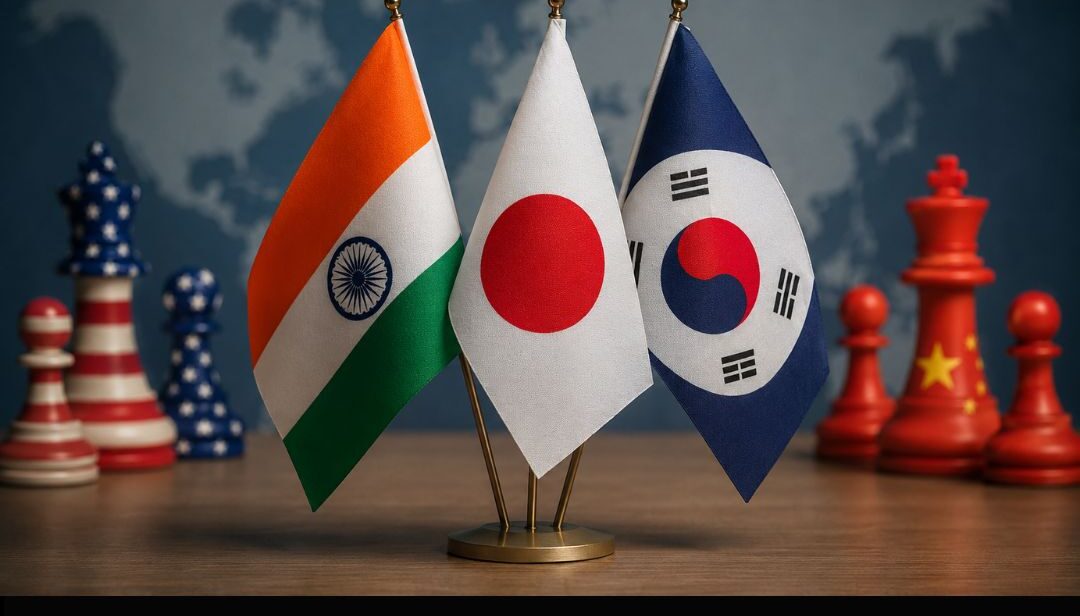
A sweeping realignment is reshaping the Indo Pacific. As the United States and China wage an escalating trade war with tariffs reaching 145% and 125% respectively, India and its East Asian neighbours are moving with unusual speed to build the architecture of a new strategic partnership, one that spans missiles, microchips, shipbuilding, and maritime surveillance.
This shift is not accidental. It is the direct result of a world in which the Strait of Hormuz crisis, US China technological decoupling, and the fragility of existing supply chains have forced nations across Asia to hedge, and hedge hard.
The BrahMos Arc: Missiles Signal the New Alignment
Nothing captures India’s accelerating East Asia pivot more dramatically than the emergence of what defence analysts are calling the “BrahMos Arc,” a chain of supersonic missile deployments stretching across the South China Sea.
In March 2026, India quietly signed a $629 million deal to supply Vietnam with BrahMos Block 3 coastal missile batteries, confirmed publicly at the Shangri La Dialogue on May 30. Indian Defence Secretary Rajesh Kumar Singh described it as a milestone in the Enhanced Comprehensive Strategic Partnership signed during Vietnamese General Secretary To Lam’s state visit to New Delhi in May 2026, the highest diplomatic designation available in bilateral relations. According to The Diplomat, Singh confirmed the agreement had already been signed even though it had not yet been formally announced, making Vietnam the second Southeast Asian BrahMos operator after the Philippines.
Manila, which signed its original $375 million BrahMos contract in 2022 and received its second coastal battery in April 2025, was simultaneously offered India’s BrahMos Extended Range (ER) variant in May 2026, extending strike reach beyond 290 kilometres at speeds exceeding Mach 2.8. The offer arrived as South China Sea tensions between China and the Philippines reached their most dangerous point in years.
Defence Security Asia noted that the BrahMos network, once Indonesia joins negotiations, would create a maritime denial corridor capable of threatening Chinese surface combatants at ranges exceeding 400 kilometres across critical sea lanes. Beijing has not responded publicly, but Chinese strategic analysts cited by Indian Defence News in June 2026 warned of an “accelerated arms race” in response.
Quad Deepens: From Framework to Operations
On May 26, 2026, the Quad Foreign Ministers, representing the United States, India, Japan, and Australia, convened in New Delhi and announced the most operationally significant steps the grouping has taken since its revival. The meeting launched the Indo Pacific Maritime Surveillance Collaboration (IPMSC), the first ever framework to pool Quad maritime surveillance assets into a Common Operational Picture, a real time shared intelligence layer covering sea lanes from the Indian Ocean to the Pacific.
A second tabletop exercise for the Indo Pacific Logistics Network was scheduled in Japan later in 2026, while Pacific Island Forum nations were committed to undersea cable connectivity by year’s end. The joint statement expressed “strong opposition to any unilateral attempts to change the status quo by force or coercion,” language directed unambiguously at Beijing’s activities in the East and South China Sea.
The timing matters. The Quad meeting came twelve days after the US Iran peace deal was announced, as India worked to simultaneously manage the aftermath of the Strait of Hormuz crisis and deepen its eastern partnerships, a dual track diplomacy that reflects New Delhi’s strategic ambition. For background on how that crisis unfolded, see our earlier coverage of the US Iran ceasefire and the reopening of the Strait of Hormuz.
South Korea and Japan: The Tech Defence Double
India’s eastward pivot is not purely military. It is also industrial, and two of Asia’s most advanced economies are at the centre of it.
South Korean President Lee Jae Myung chose India for his first foreign state visit after assuming office, arriving in New Delhi on April 19, 2026. The visit produced 25 formally agreed outcomes under a new India Republic of Korea Strategic Vision 2026 2030, including a target to double bilateral trade from $27 billion to $50 billion by 2030, cooperation on semiconductors, artificial intelligence, and small modular reactors, and the landmark India ROK Comprehensive Framework for Partnership in Shipbuilding, Shipping and Maritime Logistics, a direct response to the commercial shipping crisis exposed by the Hormuz closure.
Japan moved simultaneously on the defence technology front. On April 21, 2026, Tokyo removed the “five category rule” from its Three Principles on Transfer of Defence Equipment, lifting long standing restrictions on exporting surveillance, transportation, and minesweeping technology. India immediately welcomed the change. Negotiations are now underway for Japan’s first ever military technology transfer to India: the UNICORN (Unified Complex Radio Antenna) radar system for integration into Indian naval warships.
The Hormuz Crisis Accelerated Everything
The Strait of Hormuz crisis that ran from February 28 to June 14, 2026 proved to be an accelerant for India’s eastern realignment. With the strait closed, approximately 46 to 50% of India’s crude oil imports were disrupted. India’s Chabahar port operations, its western trade corridor into Central Asia, faced severe uncertainty after US sanctions waivers expired on April 26, 2026. New Delhi’s 2026 Union Budget contained zero allocation for Chabahar, signalling a quiet strategic retreat from westward infrastructure investment.
The lesson was direct: when Middle Eastern corridors close, India needs eastern corridors to be deep, diversified, and secure. The ASEAN India Year of Maritime Cooperation 2026, declared by PM Modi at the 22nd ASEAN Summit in October 2025, took on new urgency as the crisis unfolded. ASEAN is now India’s second largest trading partner, accounting for 20% of both inbound and outbound investment.
China Watches, and Responds
Beijing is not a passive observer of these developments. East Asia Forum described China India rapprochement as “tactical, not strategic” in May 2026, noting that Chinese troops remain forward deployed along the Line of Actual Control, and that infrastructure construction near disputed border areas continues unabated.
In January 2026, China reasserted its claim over the Shaksgam Valley in Jammu and Kashmir. Construction on the Yarlung Tsangpo mega dam in Tibet, with enormous downstream implications for India’s water security, continues on schedule. China’s deepening partnership with Pakistan, including the admission of sanctioned defence manufacturer AVIC into Pakistani aviation contracts, directly complicates India’s attempt at a “China Reset.”
The US China trade war, now running at 145% tariffs in both directions, is reshaping US India relations simultaneously. India signed a Strategic Critical Minerals Cooperation Framework with Washington on May 26, the same day as the Quad Foreign Ministers’ meeting, committing to joint mining, processing, and financing of critical minerals as part of a broader Quad initiative mobilizing up to $20 billion in supply chain investment.
A New Order Taking Shape
The Iran US war’s latest chapter may be closing. But its strategic consequence, an India that is more deeply woven into East Asia’s security fabric than at any point in modern history, will define the Indo Pacific order for years to come.

Oil & Energy Markets
A look at crude price swings, OPEC supply moves, and how energy markets react to geopolitical shocks.

Geopolitics & Conflict
Breaking down how wars, ceasefires, and diplomatic deals ripple through global trade and security.
US Foreign Policy
Coverage of Trump administration negotiations, sanctions, and strategic decisions shaping world events.
Economy & Inflation
Tracking how commodity prices, gas costs, and supply chains affect everyday consumers.