The gunfire outside the white house correspondents’ dinner had barely stopped echoing when a different kind of assault began — one waged not with weapons but with screenshots, clipped video, and algorithmic amplification. Within minutes of the first reports of shots fired outside the Washington Hilton on April 25, 2026, social media platforms were saturated
The gunfire outside the white house correspondents’ dinner had barely stopped echoing when a different kind of assault began — one waged not with weapons but with screenshots, clipped video, and algorithmic amplification.
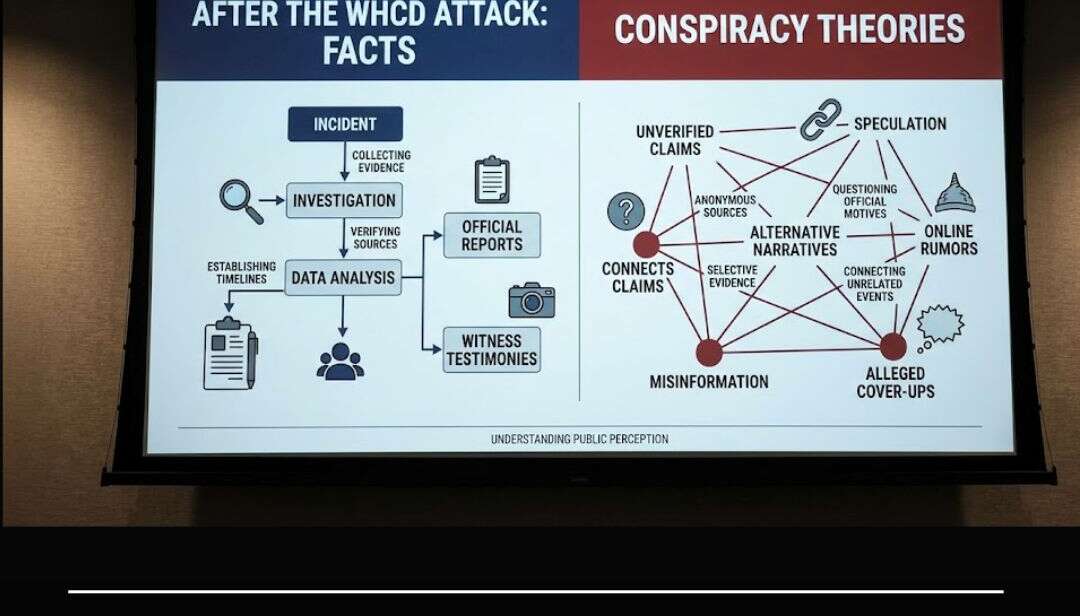
Within minutes of the first reports of shots fired outside the Washington Hilton on April 25, 2026, social media platforms were saturated with theories that had nothing to do with Cole Tomas Allen, the suspect already in custody, and everything to do with the fractured information ecosystem that has become America’s defining condition. By Sunday morning, fact-checkers were playing defense on a dozen fronts simultaneously. By Monday, one post on X theorizing that time travel was involved had accumulated more than 1.2 million views.
This is what the aftermath of a major news event now looks like.
The Staged Attack Theory
The most widely circulated falsehood following the WHCD shooting was also the most politically loaded: that the entire incident had been orchestrated. Specifically, a substantial volume of posts across X, Telegram, and lesser-known platforms claimed the attack was a false flag operation staged by the Trump administration itself — designed to generate public sympathy, silence media criticism, and most concretely, to build political support for a proposed $400 million ballroom on the White House East Wing grounds.
The theory traveled fast, dressed in the language of skepticism and packaged with the cadence of investigation. It posited that a real gunman — with documented weapons, a documented manifesto, a documented hotel reservation made three weeks in advance, and a documented exchange of gunfire with Secret Service agents — was somehow a manufactured actor in a pre-planned political production.
There is no evidence to support this. None.
The “Shots Fired” Clip
The conspiracist ecosystem found what it believed was a smoking gun in a Fox News red carpet interview that aired before the dinner began. White House press secretary Karoline Leavitt, in her pre-event remarks, said: “It’ll be funny, it’ll be entertaining, there will be some shots fired tonight.”
The clip was stripped of context and circulated as evidence of foreknowledge — proof, some claimed, that Leavitt had accidentally previewed the attack before it happened.
Fact-checkers at Snopes, PolitiFact, and PBS NewsHour addressed the claim the same day. “Shots fired” is a widely used idiom in American political and entertainment culture, meaning that someone is expected to deliver pointed jokes or sharp criticism. Leavitt was describing the anticipated tone of Trump’s planned speech at the white house correspondents’ dinner — an annual event historically characterized by pointed roasts of politicians and the press. The phrase had no relationship to the shooting.
Both Leavitt and Trump were asked directly about the staged theories. Leavitt called them “crazy nonsense.” Trump called them “sick.”
Fabricated Media and AI Manipulation
The misinformation did not stop at misinterpreted quotes. Fake images purporting to show Allen circulated across platforms within hours. Security footage of Allen’s sprint through the checkpoint — real video released by law enforcement — was further manipulated with AI enhancement and shared with altered timestamps and framing designed to suggest it had been rehearsed. What appeared to be an AI-generated video of Tucker Carlson endorsing the staged theory also spread, though no such statement from Carlson was verified.
The pattern is familiar to researchers who study post-crisis disinformation: real events generate real footage, which is then edited, slowed, reversed, and recontextualized by bad-faith actors who exploit the initial chaos before authoritative information can reach mass audiences.
What the Facts Actually Show
While conspiracy theories raged online, federal prosecutors were assembling the evidentiary record of what actually happened. On Monday, April 27, the Department of Justice unsealed charges against Allen that went beyond the initial counts: he was formally charged with attempted assassination of the president, along with using a firearm during a crime of violence and transporting a firearm across state lines with intent to commit a felony. The attempted assassination charge alone carries a potential sentence of life in prison.
Court documents revealed that Allen had reserved his room at the Washington Hilton on April 6 — nearly three weeks before the WHCD — suggesting months of premeditation. An email Allen allegedly sent to family members before approaching the checkpoint stated that “Administration officials (not including Mr. Patel)” would be considered “targets, prioritized from highest-ranking to lowest,” with the president implied as the primary target.
None of this evidence is consistent with a staged event. It is, however, consistent with what investigators have described from the outset: a politically motivated attack by a radicalized individual who planned carefully, traveled cross-country, and was stopped only by the security infrastructure surrounding the event.
Why Conspiracy Theories Win Anyway
Understanding why the false narratives spread so quickly requires confronting an uncomfortable reality. Researchers who study political disinformation note that a collapse of institutional trust combined with an inability to sort credible information from fabricated content creates “a textbook recipe” for conspiracy theories to take root — and that even when abundant factual information is available, the entertainment value and emotional resonance of conspiratorial narratives can outcompete them for audience attention.
In a country where the gap in perceived reality between partisan groups has reached historic highs, an event like the WHCD shooting does not produce a shared experience. It produces two completely different stories — each internally consistent, each reinforced by the media ecosystems its audience inhabits, and each increasingly impervious to correction from the other side.
That is the deeper competition the facts are losing.
Market Analysis
A quick snapshot of market trends, customer behavior, and competitor movements.