Share This Article
KYIV / TEHRAN / WASHINGTON – Two wars. Two theaters. One revolution.
The conflict in Ukraine and the US-Iran war of 2026 share no formal connection, no joint command structure, and no diplomatic coordination. But they share something more consequential: they are the two most drone-intensive military conflicts in recorded history, and the strategic lessons each is generating are flowing through intelligence channels, defense contractors, military academies, and battlefield adaptation into a single, rapidly evolving global doctrine of drone warfare that is permanently altering how nations fight, deter, and survive.
Understanding the convergence between these two conflicts is not an academic exercise. It is the most important military analysis of 2026.
The Iran-Russia Drone Pipeline And Its Disruption
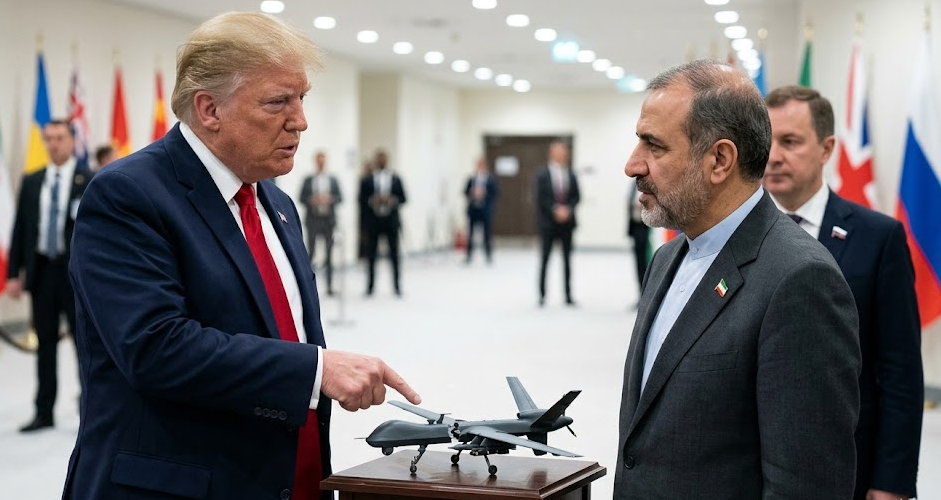
To understand the Ukraine-Iran strategic convergence, start with the supply chain that connected them before either conflict reached its current intensity.
Beginning in mid-2022, Iran began supplying Russia with Shahed-136 loitering munition one-way attack drones with a distinctive delta-wing design, a range exceeding 2,000 kilometers, and a unit cost of approximately $20,000–$50,000. Russia deployed them in mass swarm attacks against Ukrainian power infrastructure, civilian energy grids, and military logistics. By late 2023, Iran had supplied Russia with an estimated 3,000–4,000 Shaheds, with a parallel production facility established inside Russia under technology transfer agreements.
For Ukraine, the Iranian drone became the defining threat of the winter war a cheap, proliferate, difficult-to-intercept weapon that systematically dismantled the energy infrastructure keeping Ukrainian cities alive.
Then came February 28, 2026. – The US-Israeli strikes on Iran that opened the 2026 war targeted, among other facilities, Iranian drone production infrastructure. The Islamic Revolutionary Guard Corps aerospace division which oversees Shahed production and export suffered significant losses in the first week of strikes. The pipeline to Russia did not stop entirely. But it was constricted. Russian inventory levels of Iranian-origin drones dropped measurably in March 2026, according to Western intelligence assessments cited by Reuters and the Institute for the Study of War. Ukraine’s air defense teams reported a notable reduction in Shahed swarm frequency during the weeks coinciding with peak US-Iran combat operations.
Kyiv drew the strategic conclusion immediately: the US-Iran war had inadvertently served Ukrainian interests by degrading the supply chain sustaining Russia’s most cost-effective long-range strike capability.
Ukraine’s Drone Evolution Built Against Iranian Technology
The darkest irony of the Ukraine-Iran drone convergence is that Ukrainian engineers built their most sophisticated countermeasure and offensive drone systems in direct response to Iranian technology used against them.
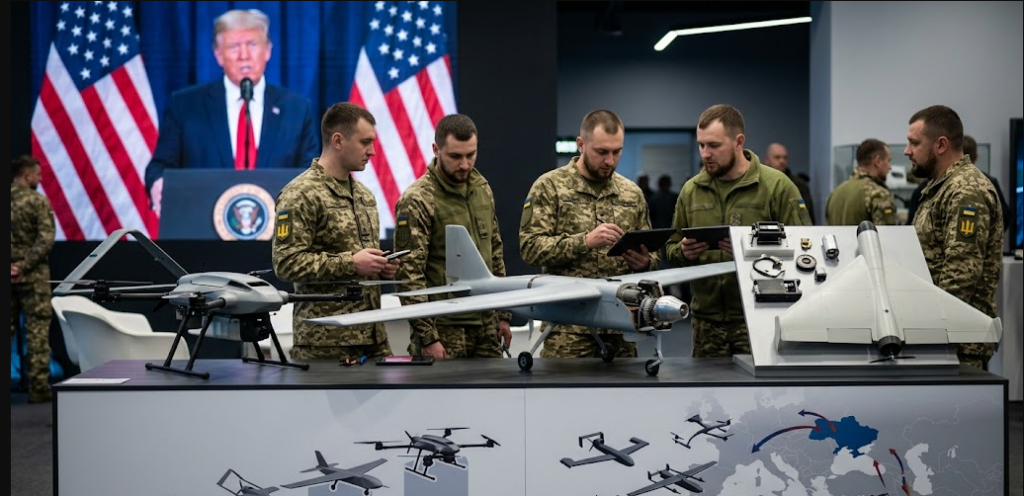
Ukraine’s FPV drone program which now produces hundreds of thousands of first-person-view attack drones annually was partly accelerated by the need to counter Shahed swarms with asymmetric cost ratios. A $500 FPV drone intercepting a $30,000 Shahed is economically decisive at scale. Ukraine’s drone interception networks, electronic warfare systems, and mobile air defense teams were all optimized, iteratively, against the specific electronic signature, flight profile, and swarm behavior of Iranian-designed drones.
In effect, Iran’s technology transfer to Russia created Ukraine’s drone warfare doctrine.
And that doctrine refined under real combat conditions against Iranian hardware is now the most battle-tested drone defense architecture in the world. NATO members are studying it. Israel has studied it. The US military has incorporated Ukrainian FPV and counter-drone lessons into its own doctrine updates.
The student has become the teacher. And the teacher’s curriculum was written, inadvertently, in Tehran.
Iran’s Own Drone War Learning in Real Time
The 2026 US-Iran conflict has forced Iran to operate its drone arsenal not as a supplier but as a combatant and the results have exposed both the strengths and critical vulnerabilities of the doctrine it helped create.
Iranian drone attacks on US bases in Bahrain, Kuwait, Qatar, Saudi Arabia, and the UAE during the conflict demonstrated that Shahed-class drones can penetrate sophisticated air defense perimeters when launched in sufficient volume and with sufficient trajectory variation. Several strikes reached their targets. Several US military installations sustained damage. The swarm saturation tactic overwhelming point defense systems with simultaneous multi-vector attacks proved partially effective even against PATRIOT and THAAD batteries.
But US counter-drone systems, informed by Ukrainian battlefield data, also performed better than Iranian planners anticipated. Directed energy systems, layered electronic warfare, and AI-assisted threat prioritization all technologies accelerated by the Ukraine conflict degraded Iranian drone effectiveness below pre-war projections.
The feedback loop is now closed. Iran used drones against Russia’s enemies. Russia’s enemies refined counter-drone doctrine. That doctrine degraded Iranian drones when deployed against American forces. Two wars, one technology, a full circle.
The Russian Calculation
For Moscow, the Ukraine-Iran drone convergence creates a strategic dilemma with no comfortable resolution.
Russia depends on Iranian drone resupply to sustain its long-range strike campaign against Ukraine. The US-Iran war has degraded that supply chain. Russia cannot openly support Iran against the United States without catastrophically damaging its relationship with Washington tenuous as it already is and risking direct confrontation with NATO. But Russia also cannot afford to see Iran so damaged that the drone pipeline permanently closes.
Russian President Putin’s response has been characteristically calibrated: public calls for ceasefire, private maintenance of the Iran relationship, and quiet acceleration of domestic Shahed-equivalent production at the Russia-based facility established under the original technology transfer reducing dependence on Iranian supply without abandoning the Iranian relationship.
It is a difficult balance. The drone wars have made it harder.
The Global Doctrine Shift
Beyond the specific bilateral dynamics, the Ukraine-Iran convergence is producing a doctrine shift that will define military planning for the next generation.
The core lesson validated simultaneously in two separate theaters against two separate adversaries is that cheap, proliferate, autonomous or semi-autonomous aerial munitions have permanently altered the cost calculus of conventional warfare. A nation does not need F-35s to threaten a superpower’s regional infrastructure. It needs factories, engineers, and enough drones to overwhelm point defense systems.
Iran proved this against Russian proxy interests in Ukraine. Ukraine proved this against Russian forces. Iran then proved it, partially, against American forces in the Gulf. And the United States which has the most sophisticated military on earth spent 38 days discovering that asymmetric drone warfare is not a problem that superpower air superiority fully solves.
The RAND Corporation’s April 2026 assessment described the convergence plainly: “Ukraine and Iran have, in different ways and for different reasons, demonstrated that the drone warfare revolution is now a permanent feature of the strategic environment. The question for every military in the world is no longer whether to adapt it is whether the adaptation is happening fast enough.”
Two wars. One revolution. The world is still catching up.
Oil & Energy Markets
A look at crude price swings, OPEC supply moves, and how energy markets react to geopolitical shocks.

Geopolitics & Conflict
Breaking down how wars, ceasefires, and diplomatic deals ripple through global trade and security.
US Foreign Policy
Coverage of Trump administration negotiations, sanctions, and strategic decisions shaping world events.
Economy & Inflation
Tracking how commodity prices, gas costs, and supply chains affect everyday consumers.