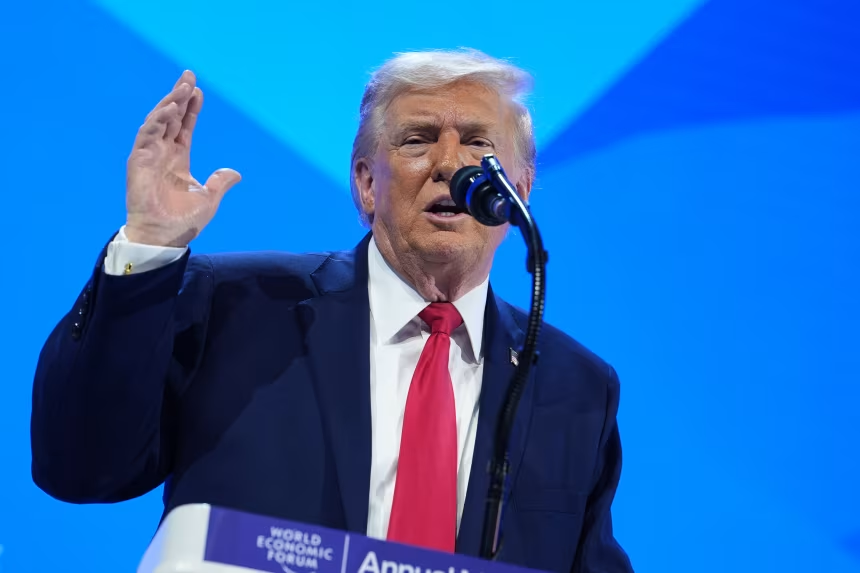
What Did Trump Say About the Economy at Davos?
Standing before the world’s most powerful financial elite at the World Economic Forum, President Trump did something few politicians would attempt with a straight face: he bragged about making the wealthy wealthier — and dared anyone in the room to criticize him for it.
Trump’s Davos 2026 economic policy address was a victory lap wrapped in superlatives. He cited 52 consecutive stock market records, claimed $9 trillion in retirement account gains, and boasted of attracting $18 trillion in investment commitments to the United States. He declared America the epicenter of global capital, technological innovation, and economic dominance.
The crowd — composed largely of billionaires, hedge fund managers, and multinational CEOs — responded warmly. They had every reason to. Under Trump’s economic policy, the asset-owning class has never had it better. For everyone else, the picture is considerably more complicated.
Who Actually Benefits From Trump’s “Economic Miracle”?
The gap between Trump’s economic narrative and lived reality for working Americans is not subtle — it is structural. Critics, including Oxfam researchers present at Davos, were quick to point out what Trump’s celebratory data conveniently omits.
Stock market records and retirement account gains disproportionately benefit the top tier of American wealth holders. The bottom 50% of Americans own less than 1% of all stock market wealth. When Trump celebrates Trump K-shaped economy metrics — where asset values soar while wages stagnate and housing costs crush middle-class purchasing power — he is celebrating an economy that has bifurcated into two entirely separate realities.
Trump deregulation 2026 has accelerated this divergence. Rolling back financial oversight, environmental protections, and labor regulations has delivered near-term profit boosts to large corporations and their shareholders. The Trump wealth gap, already at historic levels, has widened further in the first year of his second term. Oxfam’s latest global wealth report, released during Davos week, noted that the world’s billionaires had collectively added trillions to their net worth since Trump’s return to office — a data point Trump’s team did not dispute, because from their perspective, it is proof of success.
The Billionaire Entourage: Who Was in Trump’s Davos Delegation?
Trump did not arrive at Davos alone. His delegation read like a who’s who of the new American plutocracy. Elon Musk Davos appearances generated significant media coverage, with the world’s richest man serving simultaneously as informal Trump surrogate and living symbol of the administration’s ideological alignment with tech-sector ultra-wealth.
Jensen Huang Trump — Nvidia’s CEO, whose company has become the defining corporate beneficiary of America’s AI investment surge — was also part of the broader Davos orbit, reinforcing Trump’s narrative that deregulation and Trump crypto capital policies are driving a genuine technological renaissance.
The message the delegation projected was deliberate: America’s economic future belongs to those bold enough to invest, innovate, and align with Trump’s vision. What it did not address is who gets left behind when that vision is executed through Trump trickle-down policy — a framework economists have spent decades documenting as effective at concentrating wealth rather than distributing it.
What Is the “One Big Beautiful Bill”?
Perhaps the most consequential economic policy signal to emerge from Trump’s Davos appearance was his renewed push for what he has branded the Trump One Big Beautiful Bill — a sweeping legislative package that would extend and expand the 2017 Tax Cuts and Jobs Act while layering on new deregulatory provisions and spending cuts to social programs.
The bill, still working its way through Congressional negotiations, would deliver its largest benefits to households in the top 0.1% of income distribution — the Trump tax cut 0.1% effect that independent budget analysts have consistently flagged. Proponents argue the bill unleashes investment and growth. Critics argue it is the most aggressive upward wealth transfer in modern American legislative history.
What is not in dispute is who is cheering loudest for its passage. The Davos audience — the same billionaires and asset managers celebrating 52 stock market records — left Trump’s 2026 speech with reason for optimism. Their taxes may be heading lower. Their portfolios are already near all-time highs. And the president of the United States just traveled to Switzerland to tell the world that making them richer is the plan — and it is working exactly as designed.