The White House released a record-breaking $1.5 trillion defense budget request — how Trump is using the Iran war to reshape all federal spending while gutting domestic programs. There is a line in the Trump administration’s fiscal year 2027 budget proposal that functions as the clearest statement of national priorities in modern American history. President
The White House released a record-breaking $1.5 trillion defense budget request — how Trump is using the Iran war to reshape all federal spending while gutting domestic programs.
There is a line in the Trump administration’s fiscal year 2027 budget proposal that functions as the clearest statement of national priorities in modern American history. President Trump delivered it not in the budget document itself, but in remarks to a private White House gathering the week it was released: “We’re fighting wars. We can’t take care of day care. It’s not possible for us to take care of day care, Medicaid, Medicare — all these individual things.”
The budget makes that trade-off explicit, in arithmetic.
The White House is requesting $1.5 trillion in total defense spending for fiscal year 2027 — the largest Pentagon budget in American history and the single largest year-over-year increase in a presidential military spending request since World War II. Simultaneously, it proposes cutting every major domestic program that has defined the American social contract for the past six decades.
This is what the war economy coming home looks like.
The Numbers Behind the Request
The $1.5 trillion is structured in two layers: $1.15 trillion in base budget appropriations — itself a historic first, marking the inaugural time a base defense request has crossed the $1 trillion threshold — and an additional $350 billion to be pushed through the reconciliation process, the legislative fast-track that bypasses the Senate filibuster.
That 44 percent increase over the previous year’s defense allocation is not primarily driven by peacetime procurement. It is driven by war. The Pentagon has already requested $200 billion in supplemental funding to cover the operational costs of the Iran conflict. The $1.5 trillion FY2027 request folds that wartime tempo into the baseline, institutionalizing conflict-level spending as the new normal.
The nonpartisan Committee for a Responsible Federal Budget calculated the full 10-year impact: $3.2 trillion in additional defense spending piled onto a national debt already sitting at $39 trillion, growing by $2.8 trillion since Trump returned to office — with Americans already paying nearly $1 trillion annually just in debt service.
Fortune’s headline captured the moment: “Trump just raised the $39 trillion national debt with the largest budget hike since WWII — and nobody can figure out how to pay for it.”
What Gets Cut to Pay for the Pentagon
The administration’s answer to how it pays for the military expansion is $73 billion in nondefense cuts — a figure that, on its face, represents a fraction of the new defense spending, but in practice dismantles program infrastructure built over generations.
The cuts read like a comprehensive audit of the modern American state. The State Department and international programs are down $15.5 billion — a 30 percent reduction. NASA loses $5.6 billion, a 23 percent cut. The EPA is slashed by more than half. HUD drops $10.7 billion. The Department of Agriculture faces a 19 percent reduction. HHS, which administers much of the country’s health safety net, is cut by 12 percent. The Department of Labor loses $3.5 billion. More than $15 billion from the Biden-era bipartisan infrastructure law is simply canceled.
Then there is the larger reconciliation machinery running in parallel. The enacted “One Big Beautiful Bill” — the legislative vehicle carrying the $350 billion in defense reconciliation funds — is simultaneously projected to reduce federal Medicaid expenditures by $1.035 trillion over ten years, with an estimated 11.8 million enrollees losing coverage. Medicare faces $536 billion in automatic cuts under PAYGO sequester rules triggered by the same legislation — $45 billion in fiscal year 2026 alone, growing to $76 billion annually by 2034.
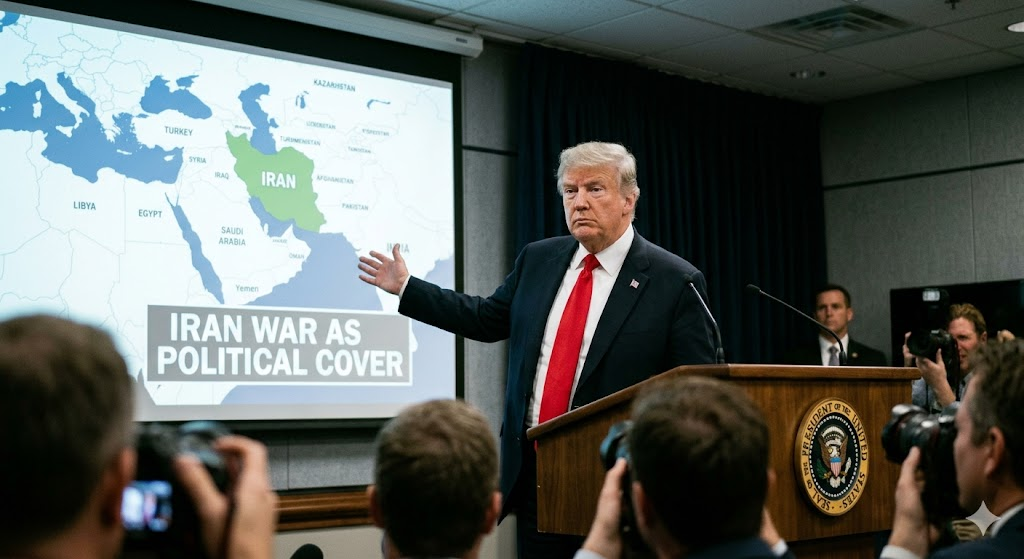
The Iran War as Political Cover
What the budget request reveals, above all else, is the political mechanics of wartime spending. The Iran conflict has given the Trump administration something that peacetime defense hawks never had: a live-fire justification for the largest military expansion in 80 years.
The Defense Spending Reduction Caucus, led by Congressman Mark Pocan, called it bluntly a “war budget” — not a defense budget. Democracy Now labeled it “a moral obscenity.” But the Senate and House Armed Services Committees, both chaired by Republicans, immediately backed the topline number, giving the request its fastest bipartisan institutional support in recent memory.
Axios framed Trump’s broader governing bet in a single line: “We’re fighting wars: Trump bets his presidency on the Pentagon.” The Iran conflict, now entering its seventh week with a naval blockade active and a ceasefire expiring April 21, gives that bet an immediate, visceral justification that domestic critics find difficult to counter on the floor of Congress.
Who Bears the Cost
The Center for American Progress put it without ambiguity: Trump’s budget “cuts programs that help ordinary Americans and sinks that money toward war.” The 11.8 million people projected to lose Medicaid are not defense contractors. The rural hospitals threatened by Medicare sequestration do not build destroyers. The communities losing community development block grants do not manufacture missile systems.
What the $1.5 trillion Pentagon budget represents is a fundamental reordering of the American government’s obligations — from citizen-facing services to military capacity. Whether the Iran war that justified it ends in April or drags into the summer, that reordering, once built into the baseline, will not easily reverse.
The war economy is no longer coming home. It has arrived.
Market Analysis
A quick snapshot of market trends, customer behavior, and competitor movements.