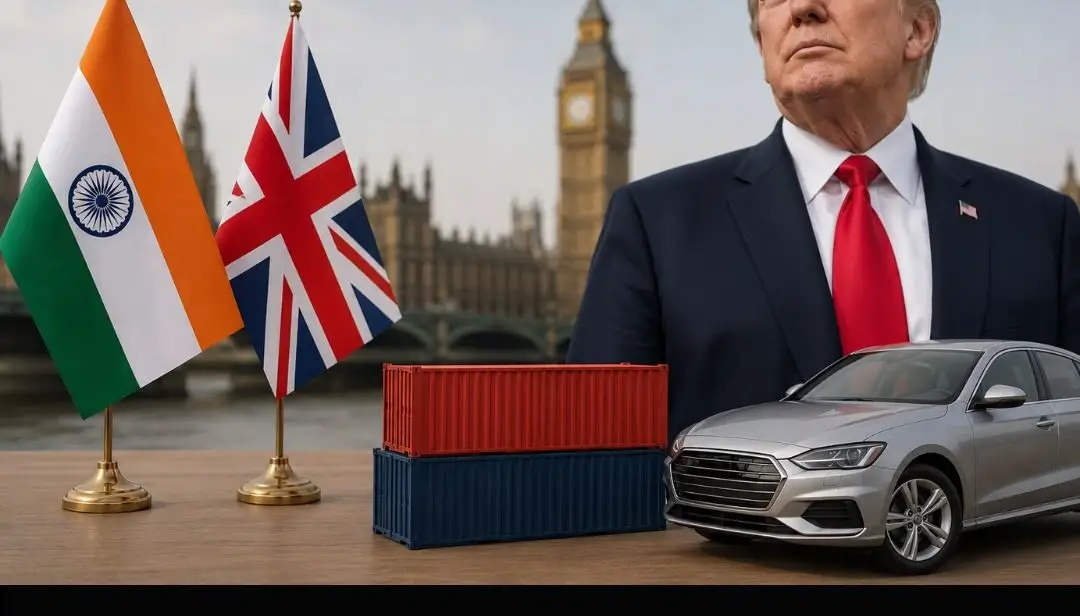
After more than four years and 15 rounds of negotiations, India and the United Kingdom have finalized one of the most consequential trade pacts either country has signed in decades. At the heart of the India UK trade deal — formally known as the Comprehensive Economic and Trade Agreement (CETA) — is a carefully engineered quota system that will reshape how British cars enter the Indian market.
The agreement, set to enter into force on July 15, 2026, was signed by Commerce and Industry Minister Piyush Goyal and UK Secretary of State for Business and Trade Jonathan Reynolds, in the presence of Prime Minister Narendra Modi and UK Prime Minister Keir Starmer.
For car buyers, importers, and the domestic auto industry alike, the question is the same: how exactly does the new quota work?
The Big Number: 378,000 Cars Over 15 Years
Under the CETA terms, India will allow the import of up to 378,000 units of UK-made passenger cars over a 15-year window — including vehicles in the mass-market segment, not just luxury models. This is a landmark shift for a market that has historically protected its domestic auto sector with import duties as high as 110%.
According to the official India-UK CETA document, the deal slashes these duties down to a floor of 10%, but only for vehicles within specified annual quotas. Anything imported beyond the quota continues to face steep out-of-quota tariffs, ranging from 50% to 95% depending on engine size and vehicle category.
This structure means the deal is not a blanket opening of India’s auto market — it’s a carefully phased, capped liberalization designed to protect domestic manufacturers while rewarding British exporters with predictable, growing access.
How the Quota Is Broken Down by Engine Size
The quota system splits eligible vehicles into three tiers based on engine displacement, each with its own starting duty rate and growth path:
Large luxury vehicles — petrol engines above 3,000cc and diesel engines above 2,500cc — start with a quota of 10,000 units in year one, with duty cut from 110% to 30%. By year five, this quota grows to 19,000 units, with duty falling steadily toward the 10% floor.
Mid-sized vehicles — petrol up to 3,000cc, diesel between 1,500cc and 2,500cc — begin at a quota of 5,000 units, with an initial in-quota duty of 50%, falling to 10% by year five.
Mass-market small cars — engines up to 1,500cc — also start at a 5,000-unit quota in year one, with the same 50%-to-10% duty trajectory.
Combined across all categories, the total annual quota peaks at 37,000 units by year five and remains capped at that level for the remainder of the 15-year term.
What Happens with Electric Vehicles?
One of the more closely watched provisions concerns EVs. From the sixth year of the agreement onward, alternative-fuel and electric vehicles priced above roughly £40,000 become eligible for phased tariff reductions, with their own quota track.
Importantly, the agreement specifies that the number of conventional ICE (internal combustion engine) vehicles permitted under the quota will be reduced proportionally as EV imports increase — a mechanism designed to keep the total annual quota volume fixed at 37,000 units rather than letting EV access add to the cap. Industry analysts say this protects the overall ceiling while still creating a gradual pathway for British EV brands to enter India’s fast-growing green vehicle market. For background on global EV trade dynamics, Reuters’ coverage of international EV tariff trends offers useful context on how other markets are handling similar transitions.
Why This Deal Is a Big Deal — Literally
Trade analysts are calling this India’s first-ever auto tariff concession in any free trade agreement. Ajay Srivastava, founder of the Global Trade Research Initiative (GTRI), noted that the precedent set here is significant: “This is India’s first-ever auto tariff concession in any FTA, and is likely to trigger similar demands from Japan, the EU, South Korea, and the US.”
That prediction is already playing out. Just weeks before the India-UK CETA was finalized, India separately agreed to cut EU car tariffs to 40% — and eventually to 10% — as part of a broader EU-India trade pact, signaling that the UK deal may be the template other trading partners now expect.
What It Means for Indian Car Buyers
For consumers, the practical impact will unfold gradually rather than overnight. Luxury brands like Jaguar Land Rover (JLR), MINI, Aston Martin, Bentley, McLaren, and Rolls-Royce are expected to be among the biggest beneficiaries, given that high-end vehicles dominate the large-engine quota tier where duty cuts are steepest in percentage terms.
However, because the quotas are volume-capped — not duty-free — buyers shouldn’t expect a flood of cheap imports. A 37,000-unit annual ceiling, spread across all UK auto brands and engine categories, is a small fraction of India’s annual new car sales, which run into the millions. The deal is designed to create meaningful price relief on specific imported models, not to restructure the broader Indian car market.
What Comes Next
With the agreement set to take effect July 15, 2026, automakers on both sides are now expected to finalize allocation strategies, import logistics, and pricing models ahead of the deadline. Indian officials have indicated they will monitor quota utilization closely in the early years to assess real consumer demand for UK-manufactured vehicles before any future renegotiation.
The India UK trade deal marks a turning point — not just for the automotive sector, but as a signal of how India intends to balance trade liberalization with protection of strategic domestic industries in future agreements with other major economies.