
Share This Article
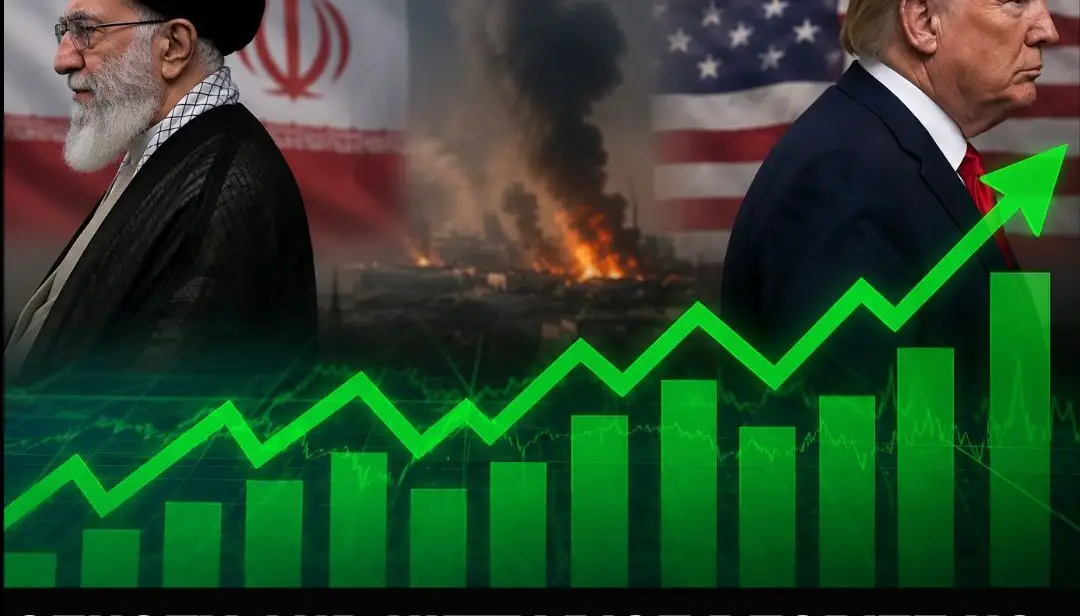
Indian equity markets are doing something that seems counterintuitive right now: going up while a US-Iran escalation.
The BSE Sensex surged nearly 600 points up 0.81% to 74,518 and the NSE Nifty 50 held firmly above 23,390, gaining 155.50 points or 0.67% as of midday Wednesday. The gains come against a backdrop of fresh US military action in the Middle East and a growing crisis around one of the world’s most critical oil chokepoints.
So what’s actually driving this rally? And should retail investors be reading this as a green light or a warning sign?
What Happened Overnight: US Strikes Near the Strait of Hormuz
The geopolitical backdrop couldn’t be more volatile. The United States launched targeted strikes on Iranian air defence sites, ground control stations, and radar installations near the Strait of Hormuz after President Donald Trump said Tehran had shot down a US Apache helicopter a significant escalation that rattled crude oil markets and weighed on Asian and US technology stocks.
Iran has continued to block most shipping through the Strait of Hormuz which carries roughly a fifth of the world’s crude oil and LNG while Washington has imposed its own blockade of Iranian ports, keeping the energy supply disruption risk elevated and adding to inflationary concerns for oil-importing economies like India.
This is not a minor skirmish. The Iran-US war latest developments represent one of the most serious escalations in the Persian Gulf in decades. The broader crisis has effectively halted commercial shipping through the strait, after the IRGC warned it would “set ablaze” any vessel attempting transit
For India, which imports roughly 85% of its crude oil needs, a prolonged US-Iran escalation and a disrupted Strait of Hormuz is, on paper, a serious macro risk.
So Why Is the Market Rallying?
The answer lies in domestic insulation and the specific sectors leading today’s gains tell the story clearly.
1. FMCG and Private Banks Are Carrying the Index
HDFC Bank, Hindustan Unilever, and Kotak Mahindra Bank emerged among the top Nifty 50 gainers, while metal and commodity-linked stocks Hindalco Industries, Coal India, and Tata Steel remained under selling pressure.
This is a deliberate rotation. The fact that Indian indices have not only held but accelerated gains through the morning underscores the strength of domestic buying interest, particularly in FMCG, private banking, and healthcare names where earnings visibility remains strong and exposure to global commodity supply chains is limited.
Investors are essentially hedging war-risk by parking money in sectors that don’t break when oil spikes.
2. Crude Oil Is Rising But Hasn’t Gone Parabolic (Yet)
Brent crude futures rose 83 cents or 0.9% to $92.29 per barrel, while US WTI gained 68 cents or 0.8% to $88.97 both recovering after Brent settled at its lowest since April 17, when the brief Iran-Israel ceasefire had temporarily depressed supply risk premiums.
The market is reading current crude levels as manageable for India’s import bill particularly with the RBI’s ongoing liquidity support in play. Earlier in the conflict cycle, oil had briefly touched $110 per barrel, which triggered a sharper selloff. At current levels, the pain is priced in but not panic-inducing.
3. DII Buying Has Been a Consistent Backstop
Domestic institutional investors (DIIs) have remained strong buyers of Indian equities in 2026, with net purchases crossing ₹4.16 lakh crore in just over five months, effectively absorbing waves of global uncertainty. While FIIs have been more cautious, the sheer force of domestic SIP flows and mutual fund buying continues to provide a floor under the market.
4. Wall Street’s Blue-Chip Resilience Gave a Cue
A broadly constructive close on Wall Street’s blue-chip indices and the RBI’s ongoing liquidity support measures also contributed to positive sentiment at the open giving Indian traders a reason to buy the dip rather than extend the selloff.
The Sectors to Watch and the Ones to Avoid
Outperforming today: FMCG, Private Banking, Healthcare, IT Underperforming today: Metals, Energy, Commodities, Defence (profit-booking)
The Nifty Auto index slipped 0.50% and the Nifty India Defence index fell 0.63%, with the latter’s weakness appearing counterintuitive given the escalating conflict but reflecting domestic profit-taking after a strong recent run.
This is a classic geopolitical playbook: buy domestic consumption, sell global commodity exposure, and wait for clarity.
What This Means for Investors
India’s market resilience during the US-Iran war latest developments is partly structural and partly a bet. The structural piece: India’s economy is domestically driven enough that even a major Middle East crisis doesn’t automatically crater earnings for FMCG, banks, and healthcare. The bet: that crude doesn’t spike back above $100 on a sustained basis, and that the Strait of Hormuz doesn’t remain disrupted long enough to hit India’s current account balance in a meaningful way.
If Brent holds below $95–$100, today’s rally makes sense. If geopolitical risk reprices energy markets sharply higher, expect a rapid unwind particularly in auto, cement, and aviation, which are the most sensitive to fuel costs.
Quick Market Snapshot — June 10, 2026
| Index | Level | Change |
|---|---|---|
| BSE Sensex | 74,518 | +599.68 (+0.81%) |
| NSE Nifty 50 | 23,397 | +155.50 (+0.67%) |
| Brent Crude | $92.29/bbl | +0.9% |
| WTI Crude | $88.97/bbl | +0.8% |

Oil & Energy Markets
A look at crude price swings, OPEC supply moves, and how energy markets react to geopolitical shocks.

Geopolitics & Conflict
Breaking down how wars, ceasefires, and diplomatic deals ripple through global trade and security.
US Foreign Policy
Coverage of Trump administration negotiations, sanctions, and strategic decisions shaping world events.
Economy & Inflation
Tracking how commodity prices, gas costs, and supply chains affect everyday consumers.