Chinese President Xi Jinping is set to make a rare two-day state visit to Pyongyang on June 8–9, 2026 — his first trip to North Korea since June 2019 — in a move that carries enormous weight for the global nuclear crisis, ongoing US-Iran talks, and China’s emerging role as the world’s most consequential diplomatic broker.
The visit, confirmed this week by Beijing and reported by CNN, Bloomberg, and the Washington Post, arrives at a moment when Xi Jinping North Korea diplomacy could reshape the security calculus across multiple simultaneous global flashpoints — from the Korean Peninsula to the Strait of Hormuz.
Why Now? The Strategic Timing of Xi’s Visit
The seven-year gap between visits was never purely logistical. COVID-19 played a role, but deeper frictions drove the distance: North Korea’s growing irritation with China’s historical support for Korean Peninsula denuclearization, and Beijing’s discomfort as Pyongyang deepened its military alliance with Moscow.
Both dynamics have now shifted enough to bring Xi back to Pyongyang — and the timing is deliberate.
Just weeks ago, in mid-May 2026, Xi hosted both President Trump and President Putin in Beijing within the same diplomatic window. Trump and Xi explicitly discussed Korean Peninsula denuclearization as a “shared goal” — setting the stage for China to position itself as intermediary between Washington and Pyongyang. Xi arrives in North Korea carrying that conversation as implicit leverage, presenting himself, as Foreign Policy analysis notes, as a leader with “direct lines to a diverse cast of counterparts” — an asset no other world leader currently holds.
The visit also coincides with the 65th anniversary of the 1961 China-DPRK Treaty of Friendship, Cooperation and Mutual Assistance — China’s only mutual defense treaty still in force — lending the occasion symbolic weight beyond routine diplomacy.
The Nuclear Crisis: How Dangerous Is the Situation?
The nuclear crisis context surrounding this visit is not abstract. North Korea has conducted seven weapons tests in 2026 alone, including hypersonic missile trials in January and short-range ballistic missile launches from Sinpo in April. After observing those April launches, Kim Jong Un publicly called for the “limitless expansion” of North Korea’s nuclear forces and issued new directives to sharpen “nuclear attack and rapid-response capabilities.”
IAEA Director General Rafael Grossi has separately confirmed “a rapid increase” in activities at North Korean nuclear manufacturing facilities — mirroring the same inspector-access crisis his agency faces with Iran.
In December 2025, Beijing made a quiet but seismic policy shift: China omitted “denuclearization of the Korean Peninsula” from its official arms control white paper for the first time, replacing the language with a call for countries to “restart dialogue and negotiations.” South Korea analysts read this as Beijing edging toward tacit acceptance of North Korea’s nuclear status — a shift that, if formalized, would collapse the nonproliferation architecture that has anchored regional security for decades.
The Russia-North Korea Factor
Any reading of Xi’s visit must account for what Beijing is reacting to. North Korea’s alliance with Russia has deepened dramatically. An estimated 14,000–15,000 North Korean soldiers have been deployed alongside Russian forces in Ukraine, with a further 16,000 in engineering and guard roles. North Korea has transferred over 12 million artillery shells, short-range ballistic missiles, and anti-tank weapons to Moscow, per South Korea’s Defense Intelligence Agency.
In May 2026, North Korean troops marched alongside Russian soldiers in Moscow’s Red Square Victory Day parade — a symbolic alignment broadcast to the world. Russia’s Defence Minister Andrey Belousov simultaneously announced a 2027–2031 military cooperation plan with Pyongyang, describing ties as “unprecedentedly high.”
For Beijing, a Pyongyang that is militarily and financially secured by Moscow has far less incentive to heed Chinese pressure — or to engage Washington. As 38 North analysts put it, North Korea is “far less motivated to engage Washington than it was during the first Trump administration.” Xi’s visit is, in part, an attempt to reclaim Chinese centrality in Pyongyang before it slips entirely into Moscow’s orbit.
The Hormuz Connection: One Axis, Multiple Crises
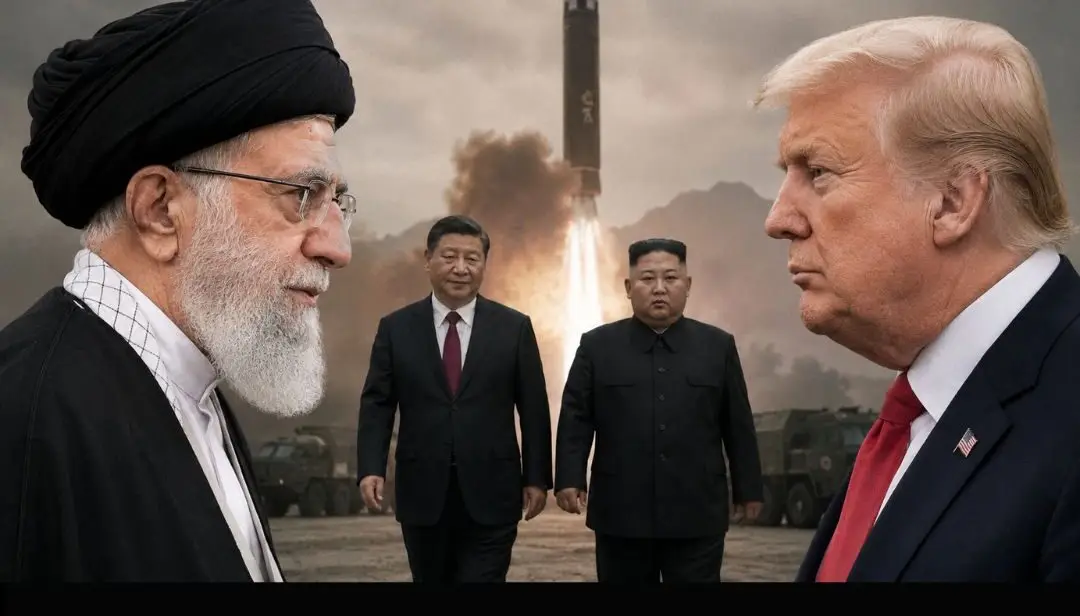
The visit cannot be fully understood without the Iran dimension. China, Russia, North Korea, and Iran have been described by security analysts at JINSA as a coordinated “Axis of Upheaval” — with each member sustaining the others’ military and economic resilience against Western pressure.
China has played a carefully hedged role in the Iran conflict. It co-authored with Pakistan a five-point proposal in March 2026 calling for a ceasefire and the resumption of normal navigation through the Strait of Hormuz — while simultaneously providing Iran indirect financial and logistical support. With US-Iran talks now at a critical juncture and the Hormuz closure entering its 97th day, Beijing’s posture toward both Tehran and Pyongyang is part of the same strategic calculation: maximize leverage across every active crisis simultaneously.
What to Watch For on June 8–9
The key question is whether Xi returns from Pyongyang with any signal — however indirect — that Kim Jong Un is open to a renewed diplomatic process with Washington. Even a vague statement of willingness would shift market sentiment and give the Trump administration a second major diplomatic win alongside the Iran framework.
More likely, analysts suggest, is a reaffirmation of bilateral ties, a discussion of the 1961 treaty’s modern relevance, and behind-the-scenes messaging about the limits of China’s tolerance for further North Korean provocations.
Whatever emerges, the world will be watching. In a year defined by nuclear anxiety — from Iran’s missing enriched uranium to North Korea’s seventh missile test — a conversation between Xi Jinping and Kim Jong Un carries weight that no other diplomatic meeting in 2026 quite matches.