Share This Article
Trump’s Republic Day Message to India: What He Said
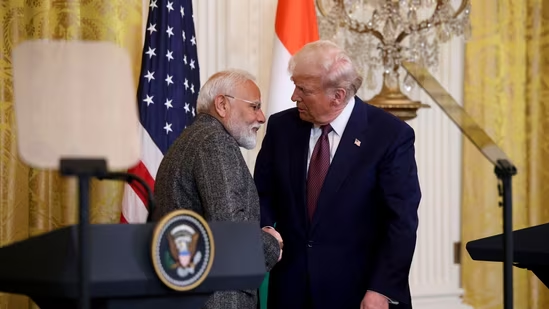
On India’s 77th Republic Day, President Trump extended what the White House described as a message celebrating the “historic bond” between the United States and India two democracies, Trump noted, bound by shared values, deepening defense cooperation, and a strategic partnership increasingly central to Indo-Pacific stability.
The Trump India Republic Day 2026 message was warm, carefully worded, and diplomatically appropriate. It acknowledged Prime Minister Narendra Modi as a key partner, celebrated the growth of the US India strategic partnership, and framed the bilateral relationship as one of the defining alliances of the 21st century.
What the message did not mention and what anyone tracking India US relations under Trump closely already knows is that beneath the diplomatic pleasantries, the relationship is under mounting strain. Tariffs, energy policy, and competing strategic interests are quietly eroding the goodwill both governments have spent years carefully cultivating.
The State of US-India Relations in 2026
The arc of Trump Modi 2026 diplomacy has been more complicated than either side publicly acknowledges. Trump’s return to the White House in January 2025 was initially welcomed in New Delhi. Modi had cultivated a visible personal rapport with Trump during his first term, and there was cautious optimism that the relationship would pick up where it left off.
That optimism has been tested. Trump’s America First trade doctrine does not carry exemptions for strategic partners. India, which runs a meaningful trade surplus with the United States, has found itself in the same position as the EU and Japan: valued as a geopolitical ally, targeted as a trade competitor.
The appointment of Sergio Gor as Ambassador to India signaled Trump’s intent to treat the relationship as a priority Gor is a close Trump loyalist, not a career diplomat, indicating the administration wants direct political alignment in New Delhi rather than conventional embassy management. Whether that translates into progress on trade friction or simply more pressure remains to be seen.
Why Tariffs Are Straining the “Historic Bond”
The core tension in the US India tariffs dispute is straightforward: Trump wants India to buy more American goods, reduce its trade surplus, and align its economic policies more closely with US interests. India, pursuing its own industrial development agenda, is unwilling to open its markets on terms that undercut domestic manufacturing a priority Modi has staked significant political capital on.
US India tariffs proposed under Trump’s trade framework would hit Indian pharmaceutical exports, textiles, and information technology services three sectors that form the backbone of India’s export economy. New Delhi has signaled it is prepared to negotiate but not to capitulate, mirroring the posture European leaders have adopted in their own trade standoffs with Washington.
The India Russian oil Trump issue adds another layer of complexity. India has continued purchasing discounted Russian crude oil despite Western sanctions pressure a pragmatic energy policy decision that infuriates Washington. Trump has threatened secondary tariffs or trade consequences for countries that continue funding Russia’s war economy through energy purchases, and India has made clear it will not sacrifice energy security for geopolitical alignment.
This is not a minor diplomatic wrinkle. It goes to the heart of India’s strategic doctrine of multi-alignment maintaining productive relationships with the United States, Russia, and other major powers simultaneously rather than choosing sides. Trump’s transactional worldview has little patience for strategic ambiguity.
What the US-India Strategic Partnership Means Going Forward
Despite the friction, the structural logic of the US India defense partnership remains compelling for both sides. China’s growing assertiveness in the Indo-Pacific along the Line of Actual Control with India, in the South China Sea, and across the broader region creates a powerful shared interest in military and intelligence cooperation that neither government is willing to sacrifice over trade disputes.
The India US defense partnership has deepened significantly under both Trump terms, with joint military exercises, technology transfer agreements, and defense procurement deals expanding the practical cooperation between the two militaries. This strategic foundation gives both sides reason to manage bilateral friction carefully rather than allowing it to escalate.
What Republic Day 2026 ultimately revealed is the central tension defining India US relations under Trump: the relationship is simultaneously more strategically important and more commercially contentious than at any previous point. Trump’s “historic bond” framing is not wrong but it is incomplete. The bond is real. So is the pressure testing it.

Oil & Energy Markets
A look at crude price swings, OPEC supply moves, and how energy markets react to geopolitical shocks.

Geopolitics & Conflict
Breaking down how wars, ceasefires, and diplomatic deals ripple through global trade and security.
US Foreign Policy
Coverage of Trump administration negotiations, sanctions, and strategic decisions shaping world events.
Economy & Inflation
Tracking how commodity prices, gas costs, and supply chains affect everyday consumers.