Share This Article
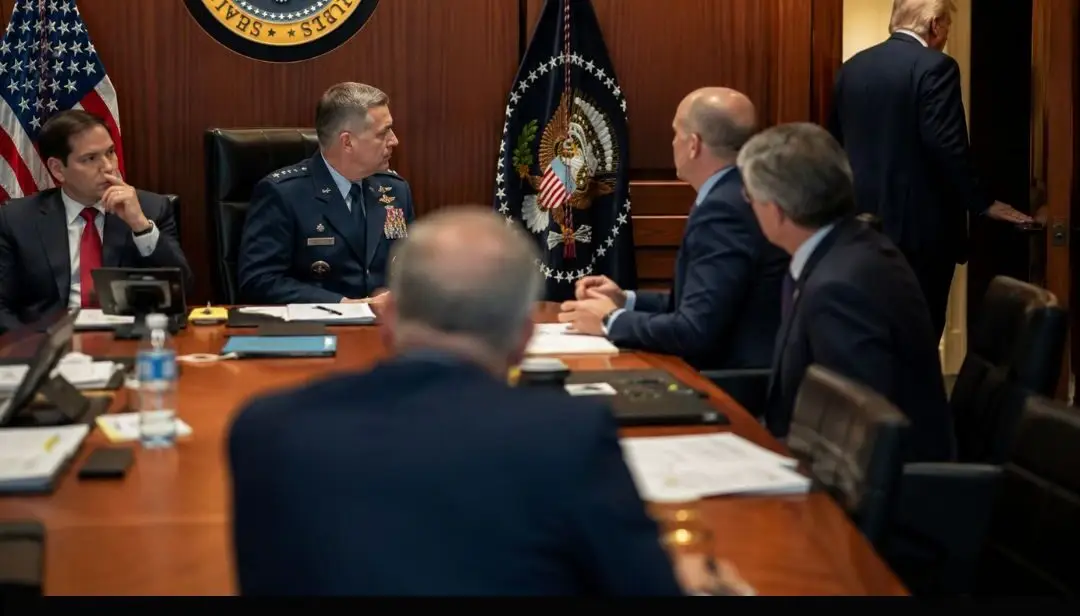
The meeting was billed as a “final determination.” It lasted roughly two hours. When it ended on May 29, 2026, President Trump walked out of the Situation Room and said nothing that resolved anything.
No signature. No announcement. No deal.
The silence that followed one of the most consequential Situation Room sessions of Trump’s second term is not empty it is loaded with information about where the US-Iran war negotiations actually stand, what Trump wants that he has not yet been given, and how much distance remains between a tentative diplomatic framework and a decision the President is willing to own.
What Happened in the Room
The Washington Post reported that Trump convened his senior advisers specifically to make a final call on whether to approve the 60-day memorandum of understanding that US and Iranian negotiators have been working toward for weeks. Vice President JD Vance, Special Envoy Steve Witkoff, and other senior officials were present. The meeting was structured as a decision point not another deliberation session.
It became one anyway.
CNBC reported that the meeting ended without Trump announcing any final determination on the deal. The Times of Israel confirmed that the session concluded with no decision a result that, given how it was framed going in, is itself a statement about where Trump’s confidence in the deal stands.
What Trump Said Before He Walked In
Before entering the Situation Room, Trump posted his conditions on Truth Social a move that functions simultaneously as a negotiating signal to Tehran and a domestic political marker for his base. The demands were unambiguous: Iran “must agree” to never possess a nuclear weapon. The Strait of Hormuz must be “immediately open” for unrestricted shipping in both directions. All mines must be removed. No tolls, no conditions, no Iranian permit system.
Those demands are not new. They are the same red lines Trump has stated publicly for weeks. The question is whether the MOU text his negotiators brought into the Situation Room actually satisfies them and the answer, based on what emerged, appears to be: not yet, not clearly enough.
Iran’s Contradictory Reading of the Same Document
The gap between Trump’s public characterization of the deal and Iran’s is striking and it explains much of the delay. CGTN reported that Iranian state media outlet Fars stated Trump “raised issues that contradict the provisions of the agreement’s text.” Iran claims the MOU contains no clause requiring the Strait of Hormuz to be opened without tolls directly contradicting Trump’s stated expectation. Iran further insists the MOU contains no clauses related to nuclear issues at all, despite Trump’s public assertion that nuclear commitments are part of the framework.
Two sides are apparently reading the same document and reaching opposite conclusions about what it says. That is not a translation problem. It is a fundamental substantive disagreement about what was agreed — and it is the kind of gap that, if not closed at the text level, will produce a deal that collapses the moment implementation begins.
NBC News reported that an Iranian official accused Trump of “stalling talks with excessive demands” — framing that positions Tehran as the cooperative party and Washington as the obstacle. That framing is tactically useful for Iran’s domestic audience, and it is also, from Tehran’s perspective, factually defensible: the negotiators agreed to a text; the President has not accepted it.
The Adviser Landscape
Reading the internal White House dynamics from the outside requires inference, but the contours are visible. Vance and Witkoff have both signaled publicly that a deal is close and progress is real suggesting they are broadly supportive of the MOU framework. Jerusalem Post reported that Jared Kushner has also been involved in back-channel talks through Pakistani intermediaries, adding a further diplomatic track that has been working toward a resolution.
But Trump consulted with a range of Arab and Muslim leaders the UAE’s Mohammed bin Zayed, Saudi Arabia, Qatar, Egypt, Turkey, and Pakistan who all indicated support for the deal. That level of regional endorsement suggests the diplomatic case for signing has been made. The resistance is not coming from America’s allies. It is coming from Trump’s own assessment of what the text delivers versus what he has said publicly it would deliver.
What the Silence Actually Signals
A president who wanted to sign the deal could have signed it. A president who wanted to walk away could have said so. Trump did neither which means the most likely reading of the Situation Room non-decision is that he is still negotiating, using the delay itself as leverage to extract a final clarification or concession on the nuclear language before committing.
Breitbart reported that Trump has consistently described the deal as “largely negotiated” language that acknowledges near-completion without confirming it. That formulation has been his public posture for over a week. The Situation Room non-decision keeps it exactly there: close, but not done.
The cost of that posture is real. With US defense officials warning that the military remains ready to resume full combat operations in the Gulf if needed, every day without a signed MOU is a day the ceasefire remains fragile, oil markets remain volatile, and the Royal Navy’s mine-hunters sit waiting for a deal that has not arrived.
Trump left the Situation Room without a decision. The world is still waiting for one.

Oil & Energy Markets
A look at crude price swings, OPEC supply moves, and how energy markets react to geopolitical shocks.

Geopolitics & Conflict
Breaking down how wars, ceasefires, and diplomatic deals ripple through global trade and security.
US Foreign Policy
Coverage of Trump administration negotiations, sanctions, and strategic decisions shaping world events.
Economy & Inflation
Tracking how commodity prices, gas costs, and supply chains affect everyday consumers.