New Delhi / Washington / Moscow, May 18, 2026 — The deadline arrived. This time, Washington did not blink. On May 16, 2026, the Trump administration allowed the US sanctions waiver permitting India and other nations to purchase Russian seaborne crude oil to expire without renewal — the first time since the US-Iran War began
New Delhi / Washington / Moscow, May 18, 2026 — The deadline arrived. This time, Washington did not blink.
On May 16, 2026, the Trump administration allowed the US sanctions waiver permitting India and other nations to purchase Russian seaborne crude oil to expire without renewal — the first time since the US-Iran War began on February 28 that Treasury Secretary Scott Bessent declined to extend General License 134B. The two previous extensions, in March and April, had been framed as temporary humanitarian accommodations for vulnerable economies caught in the supply shock of a closed Strait of Hormuz. This time, there was no reversal, no last-minute Truth Social announcement, no diplomatic reprieve.
And the very next day, a drone struck the UAE Nuclear complex at Barakah — the most alarming Iranian strikes of the war yet — sending oil markets and energy planners in New Delhi into simultaneous crisis mode.
What the Waiver Expiry Actually Means
The mechanics of General License 134B’s expiry are specific but consequential. The waiver had covered Russian crude oil already loaded onto tankers on or before April 17, 2026, giving Indian refiners a defined window to receive contracted cargoes without triggering US secondary sanctions. With that window now closed, any new Indian purchases of Russian crude — particularly those involving US financial institutions, dollar clearing, or American-flagged vessels — face the full weight of Washington’s sanctions architecture.
As Fortune reported, the US allowed the waiver to lapse “despite tight market conditions” — a pointed choice that signals the Trump administration’s willingness to impose energy market pain in pursuit of its Russia pressure campaign, even while managing the separate, equally painful dynamics of the US-Iran War.
RFE/RL confirmed that sanctions are now formally reimposed on the relevant Russian oil flows — leaving India in the position it has occupied throughout 2026: legally squeezed between Washington’s demands and the structural reality of a disrupted Middle East.
India’s Answer: Defiance, Diversification, and a ₹3 Price Hike
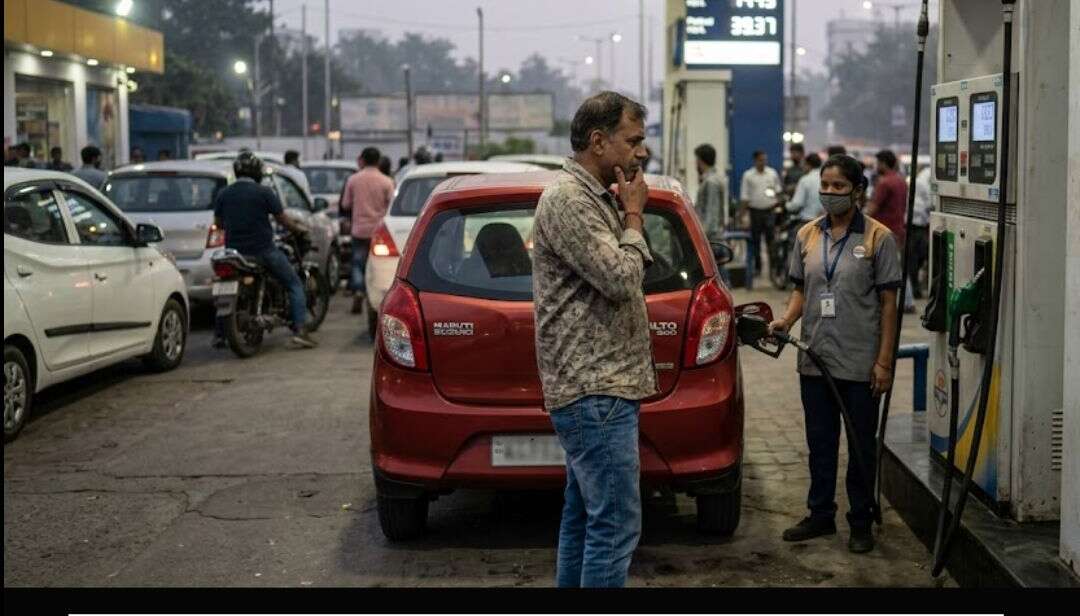
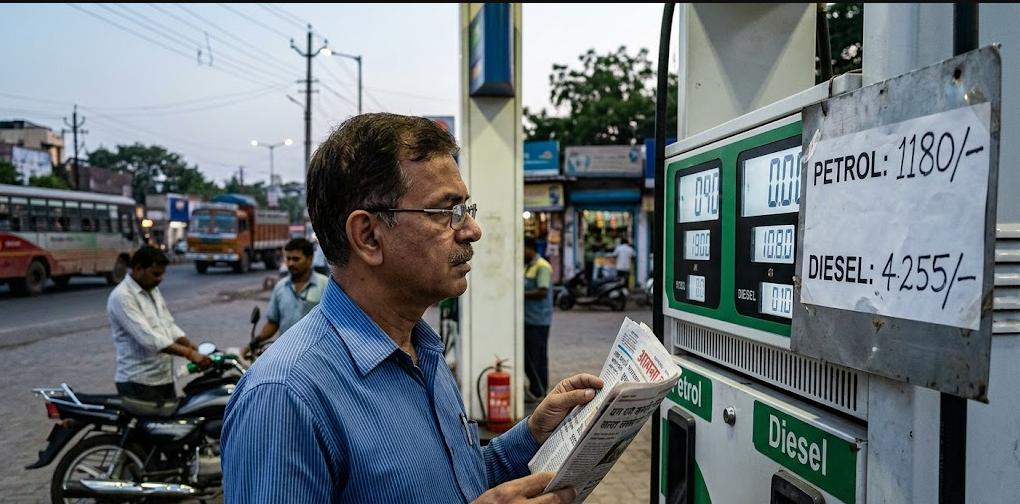
New Delhi’s response came in three parts. One day before the waiver expired — on May 15 — the government announced a ₹3 per litre increase in petrol and diesel and ₹2 per kg on CNG across Delhi, Mumbai, Kolkata, and Chennai. Petrol in Delhi now stands at ₹97.77 per litre; in Mumbai, ₹106.68; in Hyderabad, a painful ₹110.89.
The hike was India’s second fuel price increase since the US-Iran War began — the first in 49 months before that. The market read the timing clearly: oil at $111 a barrel, a US waiver about to expire, and the rupee already at a record low of 96.17. The OMC stocks responded accordingly — BPCL fell 3.5 percent, IOC 2.3 percent, HPCL 3.2 percent — because the market knows what the government has not yet said publicly: the hike is not enough.
Business Standard analysis estimated OMCs are bleeding approximately ₹30,000 crore per month under current crude prices and frozen retail margins. To reach breakeven at current Brent levels, India’s state refiners would require a further ₹25 per litre increase — a figure that would be economically combustible in an inflation-strained economy where retail food prices are already at a 13-month high.
On the oil procurement front, India’s Petroleum Ministry was blunt. Joint Secretary Sujata Sharma stated plainly: “India has been purchasing from Russia before the waiver, during the waiver, and continues to do so now.” As Bloomberg reported, India can ride out the disruption in the near term — holding approximately 60 days of crude and LNG stockpiles and 45 days of LPG reserves — while refiners pivot to West African crude, US oil, and Azerbaijani BTC Blend grades as supplementary sources. Nayara Energy and Reliance Industries both had scheduled maintenance shutdowns in May, temporarily reducing demand and easing the procurement crunch.
The Barakah Shock: Timing That Could Not Be Worse
Into this already tightly wound energy situation came the Iranian strikes of May 17. Three drones entered UAE airspace. Two were intercepted. One reached the electrical generator perimeter at the UAE Nuclear Barakah power plant — a 5,600-megawatt facility supplying 25 percent of UAE electricity — sparking a fire that emergency teams contained without casualties or radiation release.
The attack did not directly alter India’s oil procurement calculus overnight. But its timing — one day after the US waiver expired, on the same weekend the rupee broke 96 per dollar — compounded an already extreme risk environment. India had spent the previous week watching Iran’s Foreign Minister Abbas Araghchi leave Delhi after a failed BRICS summit, then watching the Barakah drone strike crystallise every fear about conflict escalation into concrete, visible reality.
Trump’s response — “For Iran, the Clock is Ticking” — and a Situation Room meeting called for May 19 to discuss military options signalled that the US-Iran War ceasefire, already on “massive life support,” could move from stalled diplomacy to resumed hostilities within days. Every scenario in which that happens is a scenario in which Indian fuel costs rise again, regardless of what the government decides to do at the pump.
The Question India Cannot Avoid
The arithmetic is unforgiving. Russian crude — India’s largest single source at a record 2.3 million barrels per day in recent weeks — now sits in a legally grey zone as the US waiver has lapsed. The Iranian strikes keep the Strait of Hormuz closed and Middle Eastern alternatives scarce. Brent above $111 means OMCs lose money on every litre sold at current retail prices. And the US-Iran War, which created this entire set of constraints, shows no sign of resolution after 77 days and three rounds of collapsed negotiations.
India raised fuel prices once. It will almost certainly need to raise them again. The only open question is when the government calculates that the political cost of further hikes is lower than the financial cost of letting state refiners bleed.
That calculation is getting harder to delay.
Market Analysis
A quick snapshot of market trends, customer behavior, and competitor movements.