Share This Article
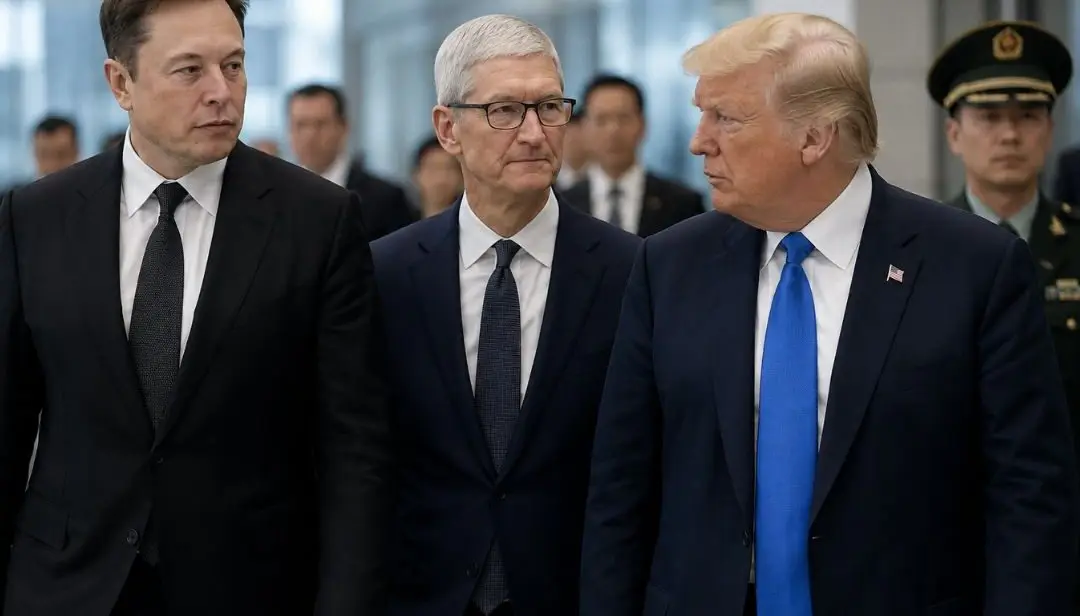
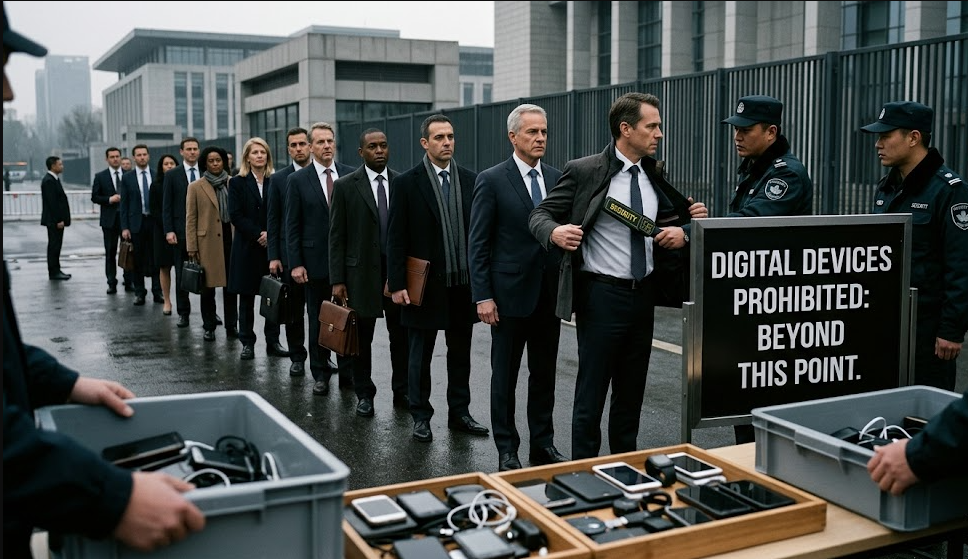
Beijing, May 15, 2026 – Before a single handshake was exchanged at the Beijing bingo summit between Donald Trump and Xi Jinping, another, quieter protocol had already been enforced. Every member of the most powerful corporate delegation in American diplomatic history from Elon Musk to Tim Cook, from Goldman Sachs CEO David Solomon to Mastercard chief Michael Miebach surrendered their personal phones and laptops before setting foot on Chinese soil. Zero devices. Full digital lockdown. No exceptions.
The measure reflects a stark new reality in great-power diplomacy: in 2026, the most dangerous weapon aimed at a U.S. delegation in Beijing is not a missile. It is a USB port.
The Lockdown Protocol: What It Actually Means
According to reporting by Fox News and Business Today, the security framework imposed on Trump’s delegation was sweeping and unprecedented in its scope.
All personal phones and laptops were left behind. In their place, delegation members including the 17 CEOs whose combined net worth approaches $1 trillion were issued stripped-down “clean devices”: temporary phones and laptops configured with known baseline images, limited app access, and no cloud synchronization. Hotel Wi-Fi was off-limits. Public charging stations were explicitly forbidden, guarding against so-called “juice jacking” attacks, in which compromised USB ports silently extract data or install malware.
Here are Some Related Blogs to Read
- NATO chief calls US strikes on Iran “absolutely necessary”
- Will gold rally as US-Iran tensions escalate
- Oil jumped but the market stayed calm
- 5 takeaways from Tuesday’s 2026 primaries
- US tariff system reset across 60 economies
- Trump tariffs Section 122 surcharge expires
- Trump had deliberately paused Hormuz operations to force Iran into a deal
- JD Vance claims Hegseth has been misleading Trump on the Iran war
- Iran has been digging out hidden missile stockpiles after rejecting Trump’s peace offer
- US Navy destroyer just fired on and seized an Iranian cargo ship
- Iran and Israel’s spy war is heating up amid claims of stolen F-15 secrets
- he’s now clashing with his own SCOTUS picks back home
Sensitive Compartmented Information Facilities SCIFs were physically established inside secure hotel areas to prevent electronic eavesdropping during classified discussions. Paper documents replaced digital files for any communication deemed sensitive. And in a detail that underscores just how seriously U.S. security teams took the threat: all hardware used during the trip was slated for disposal upon return to Washington. No device that touched Chinese soil comes home to an American network.
Former Secret Service special agent Bill Gage has previously noted that “China is a mass surveillance state. Briefings for U.S. officials begin well before the president arrives, and they make clear that everything is monitored.”
Why China, Why Now
China’s cyber environment is ranked among the world’s most aggressive. State-sponsored threat groups including operations linked to Chinese intelligence have been documented conducting persistent surveillance targeting government networks, diplomatic channels, and corporate infrastructure. The FBI’s Cyber Division has repeatedly warned executives travelling to China about the risks of device compromise, noting that hotel rooms, conference facilities, and even airline lounges in China are potential interception environments.
For a delegation that included Elon Musk (whose companies Tesla and SpaceX hold some of the United States’ most sensitive aerospace and electric vehicle intellectual property), Tim Cook (whose Apple supply chain is deeply intertwined with Chinese manufacturing), and Jensen Huang of Nvidia (whose AI chips sit at the centre of a U.S.-China technology war), the stakes of a single compromised device are almost incalculable.
The Cybersecurity and Infrastructure Security Agency (CISA) explicitly advises government personnel and contractors to treat all devices used in high-risk countries as permanently compromised upon return.
Beijing Bingo and the Iran Shadow
The digital lockdown backdrop adds a layer of tension to what was already the most consequential U.S.-China summit in years. The Beijing bingo visit Trump’s May 13–15 state summit with Xi was convened against the backdrop of the ongoing US-Iran War, now in its 77th day following the February 28 U.S.-Israeli strikes that killed Supreme Leader Ayatollah Ali Khamenei and closed the Strait of Hormuz to normal oil traffic.
Trump and Xi agreed on the principle that the Strait must remain open and free of tolls a direct nod to the US-Iran War’s economic devastation, including $138-per-barrel oil peaks, a 95 percent surge in jet fuel costs, and $29 billion in direct U.S. military expenditure. Xi also expressed willingness to purchase American oil, soybeans, and LNG concessions that, for Trump, justified the trip politically.
But as Al Jazeera reported, the summit “failed to yield an Iran war breakthrough.” Beijing declined to commit concrete action to resolve the conflict, preferring to maintain its leverage as the one power with deep ties to Tehran. For Elon Musk, who operates Starlink and Tesla in markets directly affected by US-Iran War energy shocks, and for Tim Cook, whose Apple logistics network is sensitive to any disruption in global shipping lanes, the absence of a ceasefire deal was acutely personal not just geopolitical.
The Trillion-Dollar Room With No Wi-Fi
Only two of the 17 CEOs earned seats on Air Force One: Elon Musk and Jensen Huang. Tim Cook, Larry Fink of BlackRock, and the remaining executives flew separately but all arrived under identical security constraints. As CNBC reported, Xi personally addressed the assembled executives, pledging that China would “open wider” to U.S. business a message calibrated to the room’s collective balance sheets.
But that room had no personal devices in it. No personal emails. No live stock tickers. No encrypted Signal messages to boards of directors back home. The most connected corporate executives on the planet sat in Beijing the epicentre of global digital surveillance deliberately, strategically, and completely offline.
In the age of the digital lockdown, that is what diplomacy looks like.

Oil & Energy Markets
A look at crude price swings, OPEC supply moves, and how energy markets react to geopolitical shocks.

Geopolitics & Conflict
Breaking down how wars, ceasefires, and diplomatic deals ripple through global trade and security.
US Foreign Policy
Coverage of Trump administration negotiations, sanctions, and strategic decisions shaping world events.
Economy & Inflation
Tracking how commodity prices, gas costs, and supply chains affect everyday consumers.