
Share This Article
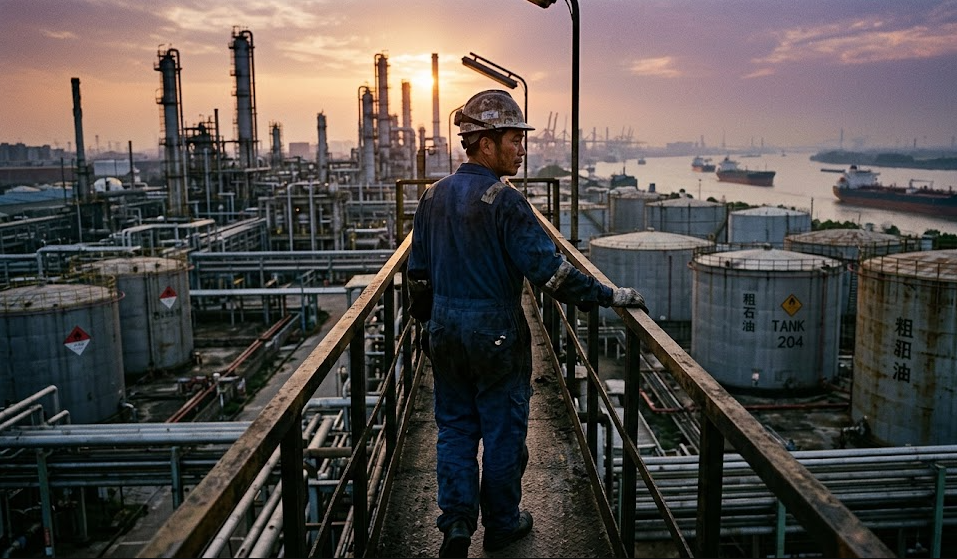
Beijing / Tehran / Washington – Beneath the surface of the US Iran war’s military strikes, diplomatic ultimatums, and cascading sanctions packages lies a financial reality that Washington has found extraordinarily difficult to confront directly: Iran is not broke. It is not collapsing. It is not being strangled into submission by the maximum pressure campaign that American strategy has staked its credibility upon. And the primary reason the singular mechanism most responsible for keeping the Islamic Republic economically afloat throughout the most intense period of American pressure in its history is a hidden Chinese oil refinery network that processes Iranian crude at industrial scale while the world’s attention remains fixed on missiles, diplomats, and nuclear centrifuges.
The network is not secret in the way that intelligence operations are secret. It is hidden in plain sight operating through legal fictions, regulatory gaps, and the structural unwillingness of the international financial system to bear the cost of genuinely enforcing American sanctions against a Chinese commercial sector that Beijing has chosen to protect. Understanding how it works, why it persists, and what it means for the US Iran war’s ultimate trajectory requires looking past the headline diplomacy and into the unglamorous machinery of global oil markets where Iran’s war economy is actually sustained.
The Scale of What Is Actually Happening
The numbers, assembled from vessel tracking data, satellite imagery of refinery feedstock inventories, and financial flow analysis conducted by energy intelligence firms operating independently of government, are staggering in their implications.
Iranian crude exports which American sanctions are explicitly designed to reduce to zero are currently running at approximately 1.5 to 1.8 million barrels per day. The overwhelming majority of that volume, estimated at between 85 and 90 percent, flows to China. And within China, the primary destination is not the state-owned refining giants whose international exposure makes them sensitive to American secondary sanctions pressure. It is the constellation of independent refineries the teapot network concentrated in Shandong province but extending across multiple Chinese coastal and inland provinces that processes Iranian crude without the compliance infrastructure, reputational constraints, or international banking relationships that might otherwise create meaningful sanctions vulnerability.
Here are Some Related Blogs to Read
- NATO chief calls US strikes on Iran “absolutely necessary”
- Will gold rally as US-Iran tensions escalate
- Oil jumped but the market stayed calm
- 5 takeaways from Tuesday’s 2026 primaries
- US tariff system reset across 60 economies
- Trump tariffs Section 122 surcharge expires
- Trump had deliberately paused Hormuz operations to force Iran into a deal
- JD Vance claims Hegseth has been misleading Trump on the Iran war
- Iran has been digging out hidden missile stockpiles after rejecting Trump’s peace offer
At current discounted Iranian crude prices Tehran sells at a 10 to 15 dollar discount per barrel to compensate buyers for sanctions risk 1.5 million barrels per day generates approximately 45 to 50 million dollars in daily revenue for Iran. Annualised, that figure approaches 17 billion dollars a sum sufficient to fund the IRGC’s entire operational budget, Iran’s ballistic missile development program, its proxy network across the Middle East, and the domestic security apparatus that suppresses internal dissent, with billions remaining for sovereign reserve accumulation.
Maximum pressure, at these funding levels, is not maximum. It is moderate. And Iran knows it.
How the Hidden Network Operates
The Iran-linked network sustaining this oil flow is engineered with a sophistication that reflects years of iterative refinement under American sanctions pressure a continuous adaptive evolution in which each round of U.S. enforcement action produces corresponding adjustments in the network’s operational methodology.
At the origin point, Iranian crude leaves Persian Gulf terminals loaded onto vessels that frequently conduct automatic identification system transponder manipulation switching off or falsifying their location broadcasts to obscure their Iranian port calls from commercial tracking services. The vessels, many of them operating under flags of convenience registered in jurisdictions with minimal maritime compliance capacity, conduct ship-to-ship transfers in international waters off Malaysian, Indonesian, or UAE coastal zones physically blending Iranian crude with other origin feedstocks and generating cargo documentation that lists Malaysian, Omani, or Iraqi origin.
The falsified documentation travels with the cargo to Chinese oil port terminals where customs declarations present non-Iranian origin. Port inspection capacity in the relevant Chinese facilities is not calibrated to detect sophisticated origin falsification and in facilities processing thousands of tanker arrivals annually, the incentive structure does not reward the kind of detailed investigation that would identify the deception.
Payment flows through an equally sophisticated architecture. Iranian oil trading entities many of them registered in the UAE, Hong Kong, or increasingly in less scrutinised jurisdictions including some African financial centres receive payment through a combination of Chinese yuan-denominated transfers, cryptocurrency transactions routed through mixing services, and barter arrangements that exchange Iranian crude for Chinese manufactured goods, eliminating dollar-denominated transaction trails entirely.
Beijing’s Calculated Tolerance
The Chinese government’s official position on Iranian oil imports by its domestic refining sector maintains the fiction of private sector autonomy that Beijing has deployed consistently as its primary defence against secondary sanctions accountability.
But the fiction requires increasingly strained maintenance as the evidence of state-level awareness accumulates. China’s National Development and Reform Commission tracks refinery feedstock sources as a matter of energy security planning. China’s banking regulatory apparatus monitors foreign exchange flows involving the UAE-based intermediaries that handle Iranian oil payments. And China’s state security apparatus which maintains surveillance of commercial activities with national security implications is not unaware of the vessel transponder manipulation operations that Chinese port operators accommodate.
Beijing tolerates the teapot refinery network’s Iranian oil purchases not because it cannot see them but because it has calculated that the benefits of tolerating them discounted energy feedstock, maintained Iranian strategic relationship, demonstrated resistance to American extraterritorial sanctions jurisdiction exceed the costs of the American pressure that tolerance generates.
That calculation is now being directly challenged by the Trump administration’s Beijing summit agenda. Whether it changes depends on what Washington offers in exchange and whether the offer is structured in ways that allow Xi to present the adjustment as voluntary strategic choice rather than capitulation to American coercion.
The Enforcement Gap: Why Sanctions Alone Cannot Close the Network
American officials who have spent careers building and implementing Iran sanctions architecture are candid, in private conversations that rarely reach public forums, about the fundamental limitation of the current enforcement approach: sanctions without Chinese compliance cannot achieve their stated objective of reducing Iranian oil revenues to a level that produces strategic behaviour change.
The Iran-linked network’s resilience is not a technical failure of sanctions design. It is a structural consequence of the enforcement gap created when the world’s largest oil importing nation declines to participate in the sanctions regime. Every secondary sanctions action Washington takes against individual Chinese entities produces the same result: the designated entity is replaced by a new one, the transaction routing adjusts marginally, and overall Iranian crude throughput into Chinese teapot refineries continues at volumes that sustain Tehran’s war economy.
US and UK coordinated sanctions have demonstrated the capacity to disrupt specific nodes in the Iran-linked network’s financial architecture the joint designations targeting financial facilitators and front company networks have imposed genuine operational costs on the network’s most exposed components. But node disruption in a network engineered for resilience produces adaptation rather than collapse.
The enforcement gap can only be closed through one of two mechanisms: Chinese voluntary compliance, achieved through diplomatic negotiation that makes Beijing’s tolerance of the teapot network more costly than its discontinuation, or the application of secondary sanctions at a scale and against entities of a systemic importance sufficient to force Chinese financial institutions to choose between Iranian oil facilitation and American market access.
The first mechanism is what Trump is attempting in Beijing. The second carries escalation risks that American economic planners assess as potentially more destabilising than the Iranian oil revenue they would eliminate.
What Iran’s Funded Resilience Means for the War
The strategic implication of China’s hidden oil refinery network for the US Iran war is simultaneously simple and profound: Iran can sustain its current posture active proxy operations, ballistic missile development, nuclear program maintenance, domestic security apparatus funding for considerably longer than American maximum pressure strategy anticipated, because its economic foundation is substantially more intact than the sanctions architecture was designed to leave it.
CIA assessments placing Iran’s blockade endurance at four months reflect this funded resilience a calculation that would look dramatically different if Iranian oil revenues had been reduced to the near-zero levels that maximum pressure originally targeted.
The hidden network has not won the war for Iran. But it has fundamentally altered the war’s timeline, its cost structure, and the range of outcomes that remain achievable through economic pressure alone. A Tehran that is adequately funded is a Tehran that can afford to negotiate slowly, absorb military strikes without existential economic panic, and maintain the internal political coalition built on IRGC institutional loyalty and security apparatus reliability that keeps the Islamic Republic functioning as a coherent strategic actor rather than fragmenting under pressure.
China’s hidden oil refinery network is not a footnote to the US Iran war. It is one of the war’s most decisive operational factors operating in a domain that missiles cannot reach and that diplomacy has not yet managed to close.

Oil & Energy Markets
A look at crude price swings, OPEC supply moves, and how energy markets react to geopolitical shocks.

Geopolitics & Conflict
Breaking down how wars, ceasefires, and diplomatic deals ripple through global trade and security.
US Foreign Policy
Coverage of Trump administration negotiations, sanctions, and strategic decisions shaping world events.
Economy & Inflation
Tracking how commodity prices, gas costs, and supply chains affect everyday consumers.