He was the candidate who promised to make America affordable again. Now, with gas at $4.50 a gallon, inflation at a three-year high, and 75% of Americans saying the Iran war has hurt their finances, Donald Trump has delivered the most politically explosive quote of his second term: “I don’t think about Americans’ financial situation.
He was the candidate who promised to make America affordable again. Now, with gas at $4.50 a gallon, inflation at a three-year high, and 75% of Americans saying the Iran war has hurt their finances, Donald Trump has delivered the most politically explosive quote of his second term: “I don’t think about Americans’ financial situation. Not even a little bit.”
The remark landed on Tuesday, May 13 — as Trump boarded Air Force One for Beijing — and immediately detonated across social media, newsrooms, and Democratic Party strategy meetings. Asked whether the financial strain the Iran war was placing on ordinary Americans motivated him to strike a peace deal with Tehran, Trump was unequivocal: “I don’t think about anybody. The most important thing, by far, is Iran cannot have a nuclear weapon.”
The honesty was striking. The political damage may be irreparable.
The Numbers Trump Isn’t Thinking About
On the same morning Trump made his remarks, the Bureau of Labor Statistics released the April Consumer Price Index — and the data was brutal. US inflation surged to 3.8% on an annual basis, its highest level in nearly three years, driven overwhelmingly by energy costs inflamed by the ongoing Iran war.
The breakdown tells the story in granular detail:
Gasoline prices rose 5.4% in a single month and are up 28.4% year-on-year — the national average now sits at $4.50 per gallon, more than $1.50 higher than before the war began on February 28
Grocery prices jumped 0.7% in April — the sharpest monthly rise in nearly four years
Food at home — the category that tracks what families pay at supermarkets — climbed 3.2% year-on-year
Energy overall accounted for more than 40% of the total CPI increase in April
Most critically, the 3.8% annual inflation rate has now overtaken wage growth of 3.6% — meaning that for the first time since 2023, prices are rising faster than paychecks. American workers are, in real terms, getting poorer every month the war drags on.
“Not Even a Little Bit” — The Quote That Will Define a Midterm
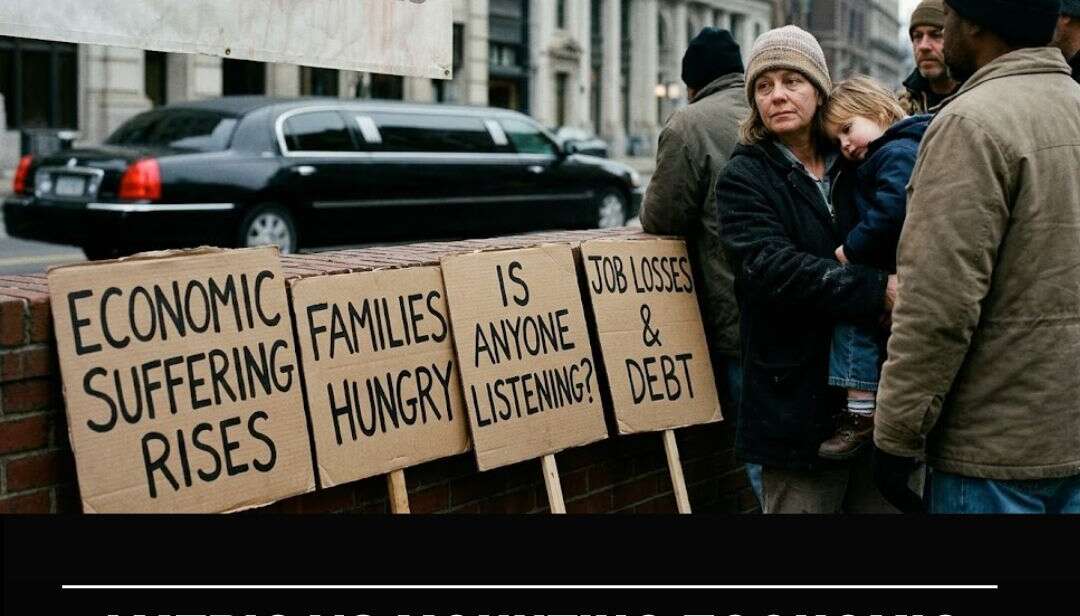
Politically, the timing of Trump’s statement is almost incomprehensibly damaging. The Iran war and the Israel-Iran war dynamic that set it in motion have already compressed Trump’s approval rating to 34% — the lowest of his second term. On the economy specifically, only 26% of Americans approve of his handling of inflation. A stunning 81% of respondents, including 79% of Republicans, said current fuel costs were creating financial strain in their households.
By a 63-37 margin, Americans blame Trump personally for the gas price surge. And now — as Democrats frantically archive the clip for attack ads — the president has told the country on camera that their financial situation is not something he thinks about.
Time magazine captured the moment with a headline that will follow Trump into the midterms: “‘Not Even A Little Bit’: Trump Shrugs Off Americans’ Economic Concerns Over Iran War.” Democratic operatives were explicit: the quote will be used in every competitive congressional race this November.
The affordability crisis that Trump weaponised against Joe Biden and Kamala Harris in 2024 — the relentless message of grocery bills, gas prices, and a White House that didn’t care — has now turned entirely around. The weapon is pointed back at him.
The Gilded Disconnect
CNN’s political analysis team labelled the dynamic precisely: “Trump’s gilded indifference ignores America’s growing economic pain.” The framing captures something real. Trump, surrounded by a cabinet of billionaires, operating from gilded interiors, and currently en route to Beijing for a state visit with Xi Jinping, has constructed an entirely separate reality from the one in which most Americans are navigating $4.50 gasoline and rising grocery bills.
The US stock market — which has climbed to record highs above 7,400 on the S&P 500 — has reinforced that disconnect. For the investor class, the Iran war is an earnings story: higher oil prices, booming defence stocks, record bank profits. For the household with a daily commute and a weekly grocery run, it is an affordability crisis that has made 2026 the most financially punishing year since the post-COVID inflation peak.
Top economist Mark Zandi warned in Fortune that the Iran war’s economic damage would exceed even the tariff inflation of 2025: “You had a miserable 2025 because of tariff inflation. The Iran war will be even worse.” With the April CPI now confirming that trajectory, the projection is no longer a forecast — it is a data point.
The Gas Tax Gambit — Too Little, Too Late
Recognising the political toxicity of the situation, Trump and Congressional Republicans floated the idea of suspending the federal gas tax — an 18.4 cents-per-gallon levy — as a relief measure for consumers. But economists and political analysts alike called it an inadequate response to a price surge of more than $1.50 per gallon since the war began. It is also, symbolically, an admission that the economic pain is real, acute, and politically dangerous — a direct contradiction of a president who, one day later, told reporters he doesn’t think about it at all.
The midterms are six months away. Americans are paying $4.50 at the pump, watching their paychecks lose ground to inflation, and now have on tape their president saying their financial situation is not something that crosses his mind.
In 2024, that was the argument that won Trump the presidency. In 2026, it may be the argument that costs his party Congress.
Market Analysis
A quick snapshot of market trends, customer behavior, and competitor movements.