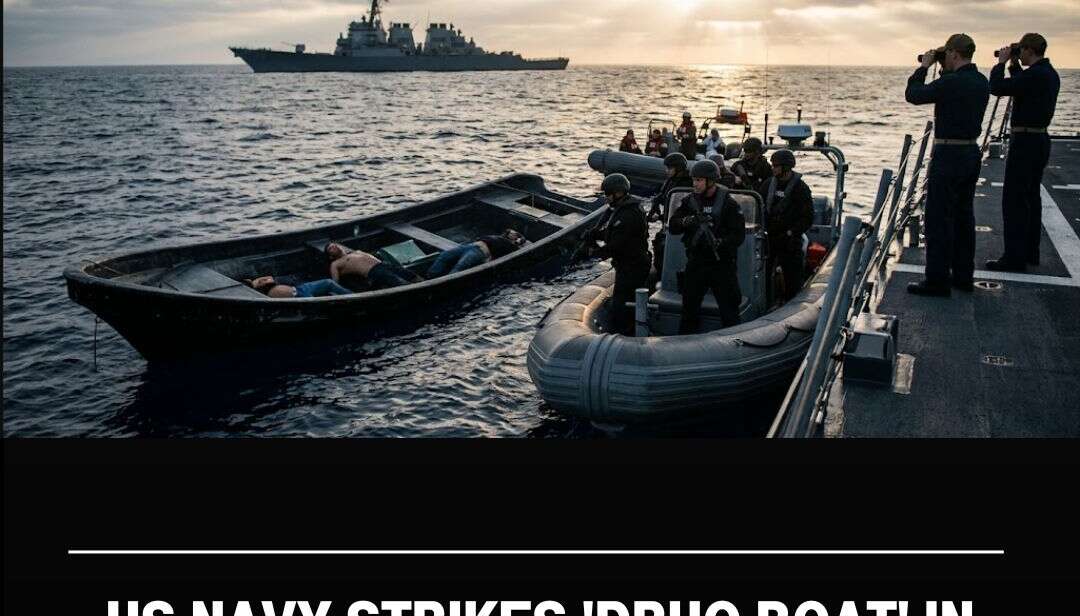
The United States military has struck another alleged drug-trafficking vessel in the Eastern Pacific Ocean, killing two men and leaving one survivor — the latest operation in a rapidly escalating campaign that has now killed nearly 200 people since it began in September 2025 and sits at the centre of the most aggressive anti-cartel strategy America has ever formally adopted.
The strike, carried out on May 8, 2026, adds to a mounting body count under Operation Southern Spear — the US military’s sustained campaign of targeted strikes on suspected narco vessels operating across the Eastern Pacific and Caribbean Sea. According to US Southern Command (SOUTHCOM), the boat was flagged as an alleged drug-trafficking vessel before being engaged. Two men on board were killed. One survivor was recovered.
No drugs, however, were publicly confirmed to be aboard.
Operation Southern Spear: Scale and Controversy
What began as a series of airstrikes in the Caribbean in September 2025 has grown into one of the most expansive — and legally contested — US military operations in the Western Hemisphere in decades.
As of late May 2026, at least 193 people have been killed across more than 57 vessel strikes, spanning 31 Eastern Pacific incidents and 15 in the Caribbean Sea. The operation is run under Joint Task Force Southern Spear, with assets from the US Navy, Coast Guard, and US Southern Command conducting or coordinating each strike.
The Trump administration’s legal basis rests on a memo from the Office of Legal Counsel asserting that lethal force against unflagged vessels carrying cocaine is permissible under US law, on the grounds that cartel drug proceeds fund violence and terrorism against Americans. Officials point to what they describe as a more than 90% decrease in maritime drug smuggling into the United States since the campaign began — a figure critics have disputed.
The Intercept and independent reports have questioned whether the strikes are actually curtailing the overall drug supply reaching American communities, or simply pushing trafficking routes elsewhere. A report released in early May found little evidence of measurable long-term impact on drug availability or cartel operational capacity inside the United States.
Trump Signs Cartels to the Top of America’s Terror List
The Eastern Pacific strike came days after President Trump signed the 2026 National Counterterrorism Strategy — a document that formally demotes jihadist groups like ISIS from the apex of America’s counterterrorism priorities for the first time since September 11, 2001.
In their place: Western Hemisphere drug cartels.
White House counterterrorism czar Sebastian Gorka, who spearheaded the new strategy, framed the shift in stark demographic terms. Far more Americans, he argued, have been killed by cartel-pushed illicit drugs flowing through US communities than service members lost in every military engagement since World War II combined.
The strategy document lists the administration’s full counterterrorism hierarchy: cartels first, then Islamic militant groups with the capability to strike the US, followed by “violent secular political groups” including those with “radically pro-transgender or anarchist” ideologies — a classification that drew immediate criticism from civil liberties organisations.
Legal Questions Mount
The human cost of Operation Southern Spear has attracted increasing legal scrutiny. The American Civil Liberties Union, the Center for Constitutional Rights, and attorney Jonathan Hafetz filed a federal lawsuit in January 2026 on behalf of families of two men from Las Cuevas, Trinidad and Tobago, killed in a strike on October 14, 2025.
Legal experts have raised pointed questions about the campaign’s compliance with international law, the laws of armed conflict, and US domestic statutes. Experts note that killing survivors of a strike — if confirmed in any incident — could constitute murder or a war crime, potentially exposing military commanders to charges under both the Uniform Code of Military Justice and the US War Crimes Act of 1996.
Critically, the military has not publicly presented evidence in any individual case confirming that the vessels struck were actually carrying drugs at the time of the attack — raising due process and proportionality concerns that legal observers say remain unresolved.
A New Kind of War, Fought at Sea
For Trump, Operation Southern Spear is a centrepiece of the muscular Western Hemisphere policy he campaigned on and has now institutionalised in national security doctrine. The campaign signals that the US military is no longer positioned solely as a last resort against foreign state adversaries — it is now the primary instrument of a domestic drug enforcement strategy conducted in international waters.
For the families of the men killed in boats across the Pacific and Caribbean, the legal and strategic debates are a distant abstraction. What is immediate is the loss — and the question that no official statement has yet answered: were the men on board who they were alleged to be, carrying what they were alleged to carry?
In the Eastern Pacific on May 8, two men died without that answer being given publicly. One man survived. And the operations continue.