Share This Article
From Hegseth comparing a downed pilot’s rescue to the resurrection, to Trump posting himself as Jesus Pope Leo XIV is mounting a systematic theological counter-argument to Christian nationalism in real time.
The dispute between Donald Trump and Pope Leo XIV looks, on its surface, like a political feud. It is something deeper than that. It is a contest over who gets to define Christianity in America what it demands of the faithful, whose suffering it requires us to see, and whether the Gospel can be used to bless a bombing campaign.
The first American pope has entered that contest fully. And he is not pulling punches.
The Theology Trump Built and Leo Is Dismantling
Since returning to office, the Trump administration has woven Christian imagery and language through its most aggressive policy actions with remarkable consistency. Defense Secretary Pete Hegseth, a self-described Christian warrior, delivered perhaps the most startling example: when a downed US crew member was rescued from Iran, Hegseth described the pilot being “flown out of Iran as the sun was rising on Easter Sunday” invoking the resurrection of Christ to frame a military extraction as divine vindication of the war.
Trump’s own AI-generated image posting himself in a white robe in a Christ-like healing pose later deleted after public backlash was less subtle but part of the same visual and rhetorical architecture. Vice President JD Vance, a Catholic convert who has become one of Washington’s most prominent religious voices, has promoted what he calls a “hierarchy of love” the theological argument that Christians are obligated to prioritize their own countrymen over foreigners. It was used explicitly to defend immigration enforcement.
Pope Leo XIV has rejected every plank of this framework, one by one, with the authority of someone who holds the oldest institutional office in Western Christianity.
“God Does Not Bless Any Conflict”
Leo’s counter-theology began before the Iran war. In October 2025, speaking directly to the question of immigration enforcement, the Pope declared that anyone who claims to be “pro-life” while supporting the “inhuman treatment of immigrants in the United States” is operating a contradiction that the Gospel does not support. “Someone who says I’m against abortion but I’m in agreement with the inhuman treatment of immigrants I don’t know if that’s pro-life,” he said.
The statement was not abstract. It was a direct rebuke of the most politically powerful coalition in American religious life the anti-abortion Catholic voting bloc that has delivered elections to Republican candidates for decades. Leo was telling that coalition that its moral framework had been selectively applied in ways that contradict the faith’s core commitments.
When the Iran war began and Trump issued threats to annihilate Iranian civilization, Leo escalated his theological counter-offensive. “God does not bless any conflict,” he wrote. “Anyone who is a disciple of Christ, the Prince of Peace, is never on the side of those who once wielded the sword and today drop bombs.”
That sentence written by a man who is both an American and the leader of the global Catholic Church is a direct challenge to every invocation of Christian identity by American political figures who support the war.
Here are Some Related Blogs to Read
- The financial fallout is spreading beyond oil, the rupee just hit a historic low against the dollar as regional tensions bite.
- Israel’s not treating this as a lull either, Netanyahu says the war isn’t over until Iran disarms, and he’s calling out China’s role in it.
- The intercepted missiles raise an uncomfortable question, is Trump trapped by his own Iran strategy?
- That brief pause before Tuesday’s attack wasn’t random, Trump had deliberately paused Hormuz operations to force Iran into a deal.
- Tuesday’s missiles didn’t come out of nowhere, Iran has been digging out hidden missile stockpiles after rejecting Trump’s peace offer.
- Global supply chains are already bracing for impact, Goyal’s courting 50 US leaders in New York over exactly that.
- While Washington and Tehran trade missiles, allies aren’t sitting still, the UK just sent a mine-hunter to Hormuz, and it signals more than routine patrol duty.
“Tyrants Dragging the Sacred Into Filth”
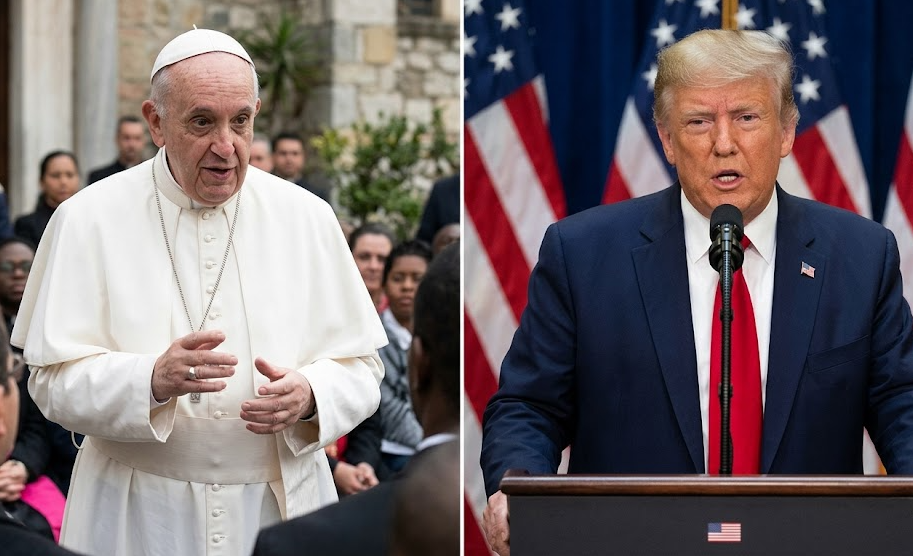
On his Africa tour, as Trump continued attacking him on Truth Social, Leo sharpened the argument into its most pointed form yet. In Cameroon, he declared that the world is being “ravaged by a handful of tyrants” spending billions on war while people suffer. Then came the line that resonated globally:
“Woe to those who manipulate religion and the very name of God for their own military, economic, and political gain dragging that which is sacred into darkness and filth.”
NPR, Foreign Policy, and Al Jazeera all recognized the gravity of the statement. Foreign Policy’s headline was unambiguous: “Pope Leo Takes Aim at U.S. War Against Iran Following Trump’s Insults.” The Algiers mosque visit a first for any pope and his invocation of Saint Augustine’s vision of communities living together in peace across difference were the affirmative counterstatement to the exclusionary Christian nationalism being practiced in Washington.
Vance’s Response and Why It Backfired
Vice President Vance, the administration’s chief Catholic voice, told the Pope to “stay out of politics” and restrict himself to “matters of morality.” It was a telling distinction one that Catholic theologians immediately identified as theologically illiterate.
Catholic social teaching, developed over 130 years of papal documents from Leo XIII onward, holds that care for the poor, the immigrant, the prisoner, and the oppressed is not a political add-on to Christian faith. It is its core content. To tell a pope to stay out of politics while using Christian language to justify bombing campaigns and mass deportations is not a request for religious neutrality. It is a request for selective silence.
Before he was even elected pope, Robert Prevost shared a National Catholic Reporter article on social media with a pointed headline: “JD Vance is wrong: Jesus doesn’t ask us to rank our love for others.” He knew exactly who his theological opponents were before he ascended to the papacy. He knew what argument he would need to have.
The Bigger Picture
National Catholic Reporter’s analysis framed the historical significance: Leo is doing something “in reversal of the nation’s anti-Catholic past” he is defending American ideals of pluralism, compassion, and the rule of law against an administration that claims Christian authority while undermining them.
Al Jazeera’s opinion section put it more directly: “The pope has shown the world how to stand up to Trump.”
What makes this moment genuinely historic is not that a pope is criticizing an American president that has happened before, though rarely so directly. It is that the first American pope, a man from Chicago who knows this country from the inside, is making the theological argument that the administration’s claim to Christian identity is not just politically wrong but spiritually incoherent.
Trump can post AI images of himself as Jesus. Hegseth can invoke Easter to celebrate military rescues. But the man who holds the Chair of Saint Peter and who happens to be American is standing in front of a mosque in Algiers telling the world that “we can live together in peace” and that God does not bless the bombs falling on Iran.
That is not a political disagreement. It is a dispute about what Christianity actually is.

Oil & Energy Markets
A look at crude price swings, OPEC supply moves, and how energy markets react to geopolitical shocks.

Geopolitics & Conflict
Breaking down how wars, ceasefires, and diplomatic deals ripple through global trade and security.
US Foreign Policy
Coverage of Trump administration negotiations, sanctions, and strategic decisions shaping world events.
Economy & Inflation
Tracking how commodity prices, gas costs, and supply chains affect everyday consumers.