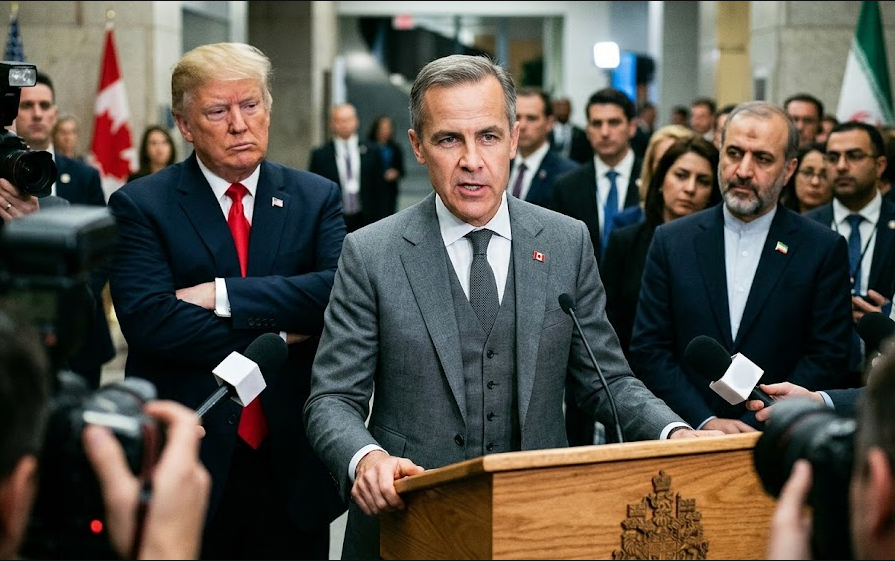
Three byelection wins, five floor crossings, and an unprecedented parliamentary maneuver have handed Mark Carney something that narrowly eluded him at the ballot box: a majority government built to resist Donald Trump. When Mark Carney stepped in front of cameras Monday night to claim victory in three federal byelections, he was not just celebrating a
Three byelection wins, five floor crossings, and an unprecedented parliamentary maneuver have handed Mark Carney something that narrowly eluded him at the ballot box: a majority government built to resist Donald Trump.
When Mark Carney stepped in front of cameras Monday night to claim victory in three federal byelections, he was not just celebrating a set of local wins in Toronto and suburban Montreal. He was announcing, in the language of parliamentary arithmetic, that Canada now has its clearest and strongest mandate in years to do exactly what he was elected to do: push back.
The Liberals now hold 174 seats in the 343-seat House of Commons — a razor-thin but fully operative majority. The threshold is 172. Carney crossed it through a combination that Canadian political historians say has never happened before: five floor crossings by opposition lawmakers over five months, followed by three byelection victories that locked the numbers in. Together, they transformed a precarious minority government into a governing majority without a general election.
Conservative Leader Pierre Poilievre was quick to call it “a cynical power grab” achieved through “backroom deals with politicians who betrayed the people who voted for them.” His objection was politically expected. It was also constitutionally irrelevant. The numbers are the numbers.
The Three Seats That Sealed It
Monday’s byelection results were decisive. In University-Rosedale, one of Toronto’s most progressive ridings, Liberal candidate Danielle Martin won with a landslide. In Scarborough Southwest, Liberal Doly Begum recorded a commanding victory. In Terrebonne, the Montreal-area Quebec riding that represented the most competitive of the three contests, Liberal Tatiana Auguste won narrowly — enough to push Carney definitively past the majority threshold.
Combined with the five Conservative defectors who crossed the floor over the preceding months — the last of whom joined just days before the byelections — the Liberals now command a parliamentary majority that could last up to three years without another confidence vote.
Trump Built This Majority
No political figure did more to deliver Carney’s majority than the one sitting in the White House.
Trump’s relentless hostility toward Canada — 25% tariffs on Canadian goods, repeated annexation threats, referring to Canada as a future “51st state,” and calling Carney himself “the Future Governor of Canada” in March — galvanized Canadian public opinion in ways that months of Liberal campaigning alone could not.
Canadian patriotism, long a quieter force in national politics, has become visceral and vocal. Polls show significant percentages of Canadians are refusing to travel to the United States or purchase American-made products as deliberate acts of economic resistance. The sentiment that was once diffuse has crystallized into a political identity — and that identity is now encoded in the seat count on the floor of the Commons.
Carney’s rise from Bank of Canada and Bank of England governor to Prime Minister was always framed as a technocratic response to a crisis. The crisis Trump created became his most effective campaign tool. “Canada is not for sale,” Carney told Trump in their face-to-face meeting, comparing his country to Buckingham Palace. “Won’t be for sale. Ever.” Trump replied: “Never say never.” Canadians heard both responses. They chose Carney’s.
What the Majority Now Unlocks
A minority government governs in permanent survival mode, calibrating every bill and budget vote against the risk of a non-confidence defeat. A majority government has no such constraint. For Carney, the arithmetic shift is transformative.
His stated agenda — rebuffing Trump’s tariffs, reducing Canada’s economic dependency on the United States, and repositioning Canada within a coalition of like-minded middle powers — can now be pursued legislatively rather than just rhetorically. Bills can pass. Budgets can be implemented. Trade diversification policy can be built into statute rather than announced as aspiration.
His first act after the majority was confirmed signaled the direction immediately: Carney suspended Canada’s fuel tax, a domestic affordability measure signaling that his majority platform is not purely defensive. He vowed “more substance, less showboating” — a pointed contrast to his predecessor Trudeau’s final, turbulent months, and to the theatrical volatility of Trump’s own governing style.
At the World Economic Forum earlier this year, Carney delivered a speech that was widely circulated internationally, warning of “the end of the international rules-based order” and calling on middle powers to band together against unilateral economic coercion. It was a message aimed beyond Canadian borders. With a majority government, he now has the political stability to act on it.
The Opposition’s Calculation
Poilievre’s Conservatives remain the largest single opposition force, and their argument — that the majority was assembled through defections rather than democratic mandate — will resonate with a segment of the electorate. But opposition arithmetic in a majority parliament is limited. The Conservatives cannot bring down the government through a confidence vote. They can oppose, delay, and amplify, but not block.
The NDP and Bloc Québécois, both weakened by the defections and byelection losses, face their own recalibrations in a parliament where the Liberals no longer need them.
A New Phase in the Canada-US Relationship
What Carney’s majority means for Washington is a Canadian counterpart who is now structurally insulated from domestic political collapse. Previous minority governments negotiated with the White House under the constant shadow of potential defeat. Carney no longer carries that vulnerability.
Whether Trump views that stability as an asset — a more durable partner for eventual trade normalization — or as an obstacle to the leverage he prefers to maintain through Canadian political fragility will shape the bilateral relationship through the next three years.
What is not in doubt is the mandate Canadians have given Carney to carry into that relationship. It is, as of Monday night, the largest he has ever had.
Market Analysis
A quick snapshot of market trends, customer behavior, and competitor movements.