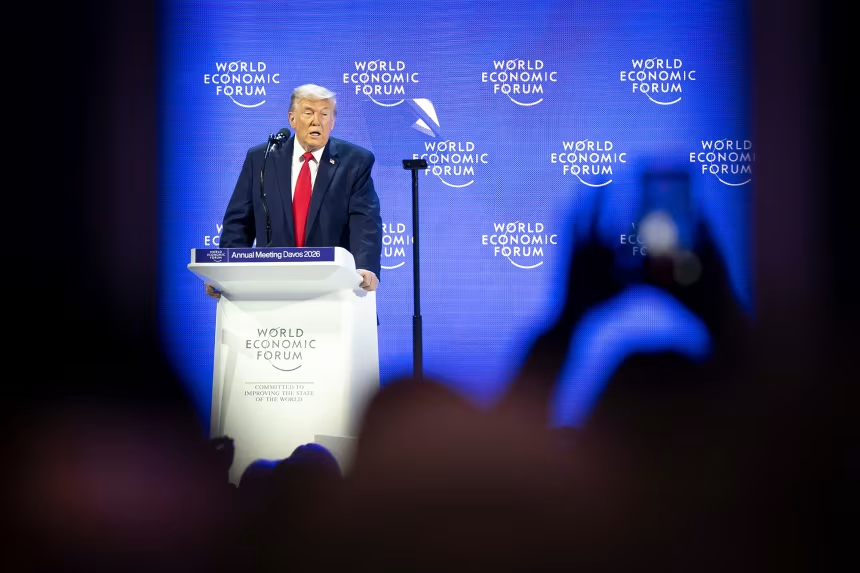
President Donald Trump’s Trump Davos speech at the World Economic Forum 2026 was nothing short of a geopolitical earthquake. In a 70-minute keynote that left global elites visibly unsettled, Trump delivered an unapologetically antagonistic address that challenged the foundational pillars of international cooperation — from trade agreements to military alliances and climate policy.
Speaking directly to the world’s most powerful business and political leaders, Trump made it clear: America First is not a slogan — it is a doctrine. Here are the five defining moments that will shape global diplomacy for years to come.
1. The EU Tariff Threat That Rattled Brussels
Trump opened with a blunt warning to European leaders: comply with US trade demands or face sweeping tariffs. Targeting the European Union’s trade surplus with the United States, he demanded immediate concessions, warning that punishing tariffs would follow if Europe failed to “step up.”
The message landed like a thunderclap in Davos. European Commission President Ursula von der Leyen, who was present at WEF 2026, responded cautiously but firmly, signaling that Brussels would not capitulate under pressure. For global markets already on edge, Trump’s EU tariff threats injected fresh uncertainty into an already fragile economic landscape.
2. The Greenland Ultimatum Explained
Perhaps the most jaw-dropping moment of the Trump WEF 2026 appearance came when he doubled down on his ambitions toward Greenland. In remarks that drew audible murmurs from the crowd, Trump refused to rule out using military or economic force to bring Greenland under US control — framing it as a matter of national security.
Denmark and NATO allies responded with alarm. The Greenland ultimatum wasn’t a throwaway line — it reflected a broader strategic doctrine under Trump: territorial and resource expansion as legitimate foreign policy tools. Analysts called it “let them eat cake” economics applied to geopolitics.
3. Dismissing NATO Allies — Again
Trump’s relationship with NATO has always been contentious, but his Trump Davos speech took the antagonism to a new level. He questioned the commitment of NATO members, suggested that allies failing to meet the 2% GDP defense spending threshold deserve less American protection, and implied that US military guarantees could no longer be taken for granted.
For European NATO members still processing the war in Ukraine, the message was alarming. The implicit threat: Europe may be on its own.
4. Attacking Renewable Energy on the Global Stage
In a room filled with ESG-focused investors and green-energy advocates, Trump declared war on wind turbines. Mocking renewable energy mandates as economically destructive, he championed fossil fuels as the backbone of American prosperity.
His attack on wind energy drew sharp criticism from climate advocates but resonated with energy-sector executives attending Davos. The Trump renewable energy Davos moment underscored the growing ideological rift between US energy policy and European climate commitments.
5. How Did Europe React to Trump’s Davos Speech?
European reaction was swift and pointed. Leaders who once hoped Trump’s second term might bring pragmatic deal-making found themselves facing a president more combative than ever. Ursula von der Leyen Davos exchanges signaled that Europe would seek to negotiate — but from a position of resistance, not deference.
The broader consensus among European diplomats: the Trump geopolitical earthquake at Davos 2026 demands a coordinated EU response on trade, defense, and energy.
What the Davos Speech Means for US Trade Policy
Trump’s Davos address was less a speech and more a statement of intent. On tariffs, territorial ambitions, NATO burden-sharing, and energy — the United States under Trump is operating on a unilateral axis. Jerome Powell and Federal Reserve independence also drew a pointed jab, with Trump reiterating his desire for lower interest rates.
For global investors and policymakers, the Trump Davos speech was a roadmap: the rules-based international order is being renegotiated — on Trump’s terms.