Share This Article
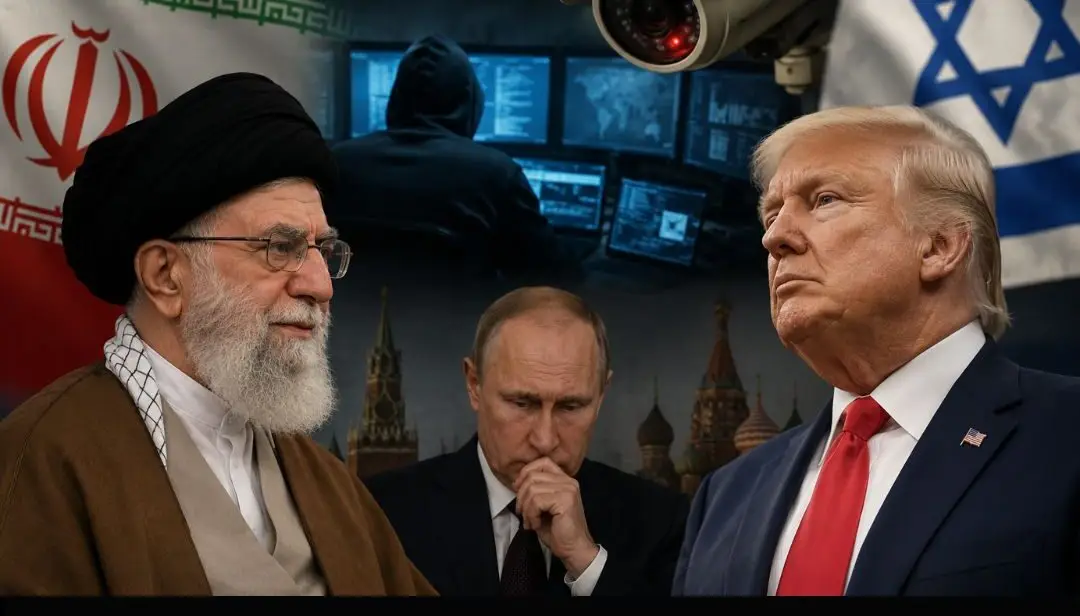
The most consequential battle of the Iran-US War is not being fought in the Strait of Hormuz. It is being fought in server rooms, fiber optic backbones, and surveillance network control panels and its latest chapter involves a hack so audacious it triggered a response nobody predicted: Vladimir Putin ordering the emergency shutdown of his own domestic surveillance infrastructure to prevent it suffering the same fate as Tehran’s.
According to a report published jointly by Recorded Future and cited by three separate Western intelligence sources speaking to Reuters, Israeli cyber operators penetrated Iran’s CCTV network with surgical precision last week accessing, exfiltrating, and in select cases publicly broadcasting live feeds from cameras positioned inside IRGC command facilities, nuclear adjacent infrastructure corridors, and key government ministry buildings in Tehran. The operation lasted approximately 11 hours before Iranian cyber defense teams severed the compromised network segments.
The geopolitical shockwave it sent northward to Moscow was immediate, unexpected, and arguably more strategically significant than the hack itself.
What Israel Actually Did
The operation against Iran’s CCTV network was not crude vandalism. Intelligence analysts who have reviewed the technical indicators describe it as a masterclass in layered network penetration the kind of operation that requires months of preparation, deep pre-positioned access, and intimate knowledge of the target system’s architecture.
Israeli Unit 8200 the signals intelligence and cyber warfare division widely regarded as one of the world’s two or three most capable offensive cyber organizations reportedly exploited a chain of vulnerabilities in the Chinese-manufactured Hikvision and Dahua surveillance hardware that forms the backbone of Iran’s national CCTV infrastructure. The same hardware, notably, forms the backbone of surveillance networks across Russia, Central Asia, and much of the developing world.
The operation achieved three simultaneous objectives. First, it provided Israeli intelligence with real-time visual access to Iranian military and government facilities at a moment of maximum operational value during active Iran-US War escalation. Second, selected footage including material showing IRGC commanders in apparent operational planning sessions was fed to Western intelligence partners, providing actionable targeting intelligence. Third, and most psychologically devastating for Tehran, brief clips were broadcast on Iranian state television’s own frequency before technicians could terminate the intrusion a deliberate demonstration of reach designed to humiliate rather than merely surveil.
“This wasn’t just intelligence collection it was psychological warfare at the highest level. Broadcasting on state TV tells every Iranian official: we are inside your walls and we can show you that we are,” said Chris Inglis, former US National Cyber Director and NSA deputy director. Recorded Future Cyber Intelligence →
Russia’s Extraordinary Response
The reaction from Moscow was swift, startling, and deeply revealing. Within 36 hours of the Israeli operation against Iran’s CCTV network becoming known to Russian security services, the FSB ordered an emergency partial shutdown of the Federal CCTV Monitoring System the vast surveillance network that blankets Moscow, Saint Petersburg, and twelve other major Russian cities with an estimated 1.5 million cameras.
The shutdown, confirmed by three Russian municipal government sources and first reported by independent outlet iStories, affected approximately 340,000 cameras across the federal network for a period of 19 hours while FSB technical teams conducted emergency vulnerability audits of the Chinese-manufactured hardware components shared between Russian and Iranian surveillance infrastructure.
The decision to shut down Putin’s own surveillance system the cornerstone of the Kremlin’s domestic security and crowd control architecture reflects the depth of alarm the Israel-Iran hack generated in Moscow’s security establishment. If Unit 8200 could penetrate Tehran’s network through Hikvision vulnerabilities, the implication for Russia’s identically architected system was not theoretical. It was operational and immediate.
The FSB has since issued internal directives requiring the replacement of all Chinese-manufactured camera hardware in federal security facilities within 90 days an infrastructure project of staggering scale that Russian procurement officials privately describe as “functionally impossible” within the specified timeline.
The Iran-US War Latest Cyber Dimension
The CCTV hack and its Russian aftermath illuminate a dimension of the Iran-US War Latest conflict that conventional military analysis consistently underweights: the degree to which cyber operations are shaping, enabling, and in some cases substituting for kinetic military action in ways that leave no bodies, generate no UN Security Council resolutions, and produce no obvious escalation ladder.
Israeli cyber operations supporting the broader US-Iran confrontation have reportedly included degradation of Iranian air defense radar networks along the Strait of Hormuz corridor, interference with IRGC naval vessel navigation systems, manipulation of Iranian fuel depot logistics software, and now the most publicly visible operation to date the CCTV network penetration.
Each operation, taken individually, falls below the threshold of an act of war under any conventional legal framework. Collectively, they represent a sustained campaign of infrastructure degradation that is materially affecting Iran’s military operational capacity without providing Tehran with a legally clean justification for escalatory response.
This is the strategic genius of cyber warfare in the current conflict and its most dangerous feature. By keeping operations below the acknowledged escalation threshold, both Israel and the United States maintain plausible deniability while Iran accumulates grievances it cannot formally address without admitting the depth of its vulnerability.
“Cyber operations in this conflict are functioning as a pressure release valve they allow both sides to inflict real damage without triggering the formal escalation protocols that could push a regional war into something genuinely global. The danger is that valves have pressure limits,” said Dr. Trey Herr, director of the Cyber Statecraft Initiative at the Atlantic Council. Atlantic Council Cyber Statecraft Initiative →
Iran’s Counter-Cyber Posture
Tehran is not a passive victim in this exchange. Iranian cyber actors operating through IRGC-affiliated groups including APT33, APT34, and the recently identified Sandstorm Collective have conducted retaliatory operations targeting Israeli water infrastructure control systems, US financial sector networks, and Gulf state energy company operational technology environments.
The most significant confirmed Iranian counter-operation involved a partial penetration of a Bahrain-based oil terminal’s SCADA systems the industrial control software that manages physical infrastructure like pumps, valves, and pressure systems. The intrusion was detected and contained before physical damage occurred, but the capability demonstration sent an unambiguous message: Iran can reach critical infrastructure, and the Strait of Hormuz is not its only lever.
The Russia dimension adds a layer of complexity that Western cyber defense planners are only beginning to map. If Moscow alarmed by the Israeli demonstration against Iranian infrastructure begins sharing offensive cyber tools or defensive hardening intelligence with Tehran, the current balance of cyber advantage that the US-Israel axis currently enjoys could shift meaningfully.
What This Means for the Conflict’s Next Phase
The CCTV hack and Putin’s surveillance shutdown response represent a crystallization of a dynamic that will define not just the Iran-US War but every major power confrontation of the next decade: the merger of physical and digital battlespaces into a single operational environment where the most consequential strikes leave no visible crater.
For the Strait of Hormuz crisis, the cyber dimension means that even a formal ceasefire if one is ever genuinely achieved will not end the conflict. Operations below the threshold of acknowledged hostility will continue indefinitely, because they are too valuable, too deniable, and too effective for any party to voluntarily abandon.
The cameras may come back online. The war they are watching will not stop.

Oil & Energy Markets
A look at crude price swings, OPEC supply moves, and how energy markets react to geopolitical shocks.

Geopolitics & Conflict
Breaking down how wars, ceasefires, and diplomatic deals ripple through global trade and security.
US Foreign Policy
Coverage of Trump administration negotiations, sanctions, and strategic decisions shaping world events.
Economy & Inflation
Tracking how commodity prices, gas costs, and supply chains affect everyday consumers.