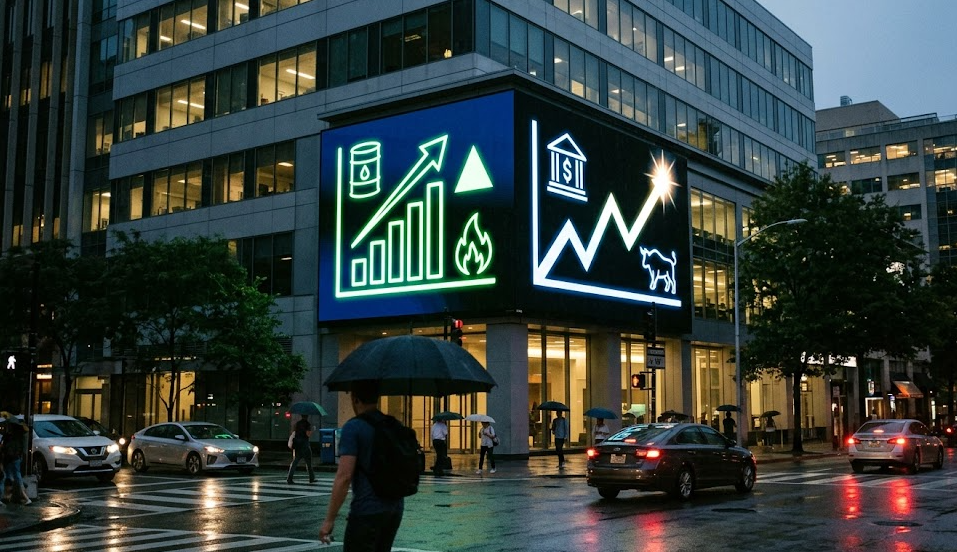
The world is at war in the Persian Gulf. Oil is trading above $104 a barrel. Inflation is at a two-year high. And yet the S&P 500 just closed at an all-time record. Welcome to the strangest stock market in a generation — where a global energy crisis and a Wall Street bull run are
The world is at war in the Persian Gulf. Oil is trading above $104 a barrel. Inflation is at a two-year high. And yet the S&P 500 just closed at an all-time record. Welcome to the strangest stock market in a generation — where a global energy crisis and a Wall Street bull run are somehow happening at the same time.
On May 11, 2026, the S&P 500 closed at 7,412.84 — a fresh all-time high — even as Brent crude surged nearly 3% to $104.21 per barrel after President Donald Trump declared that the US-Iran ceasefire was on “life support” and called Tehran’s latest peace counter-proposal “TOTALLY UNACCEPTABLE.” West Texas Intermediate crude settled at $98.07, likewise gaining nearly 3% in a single session. The Nasdaq Composite edged up 0.10% to a record 26,274.13, and the Dow Jones Industrial Average added 107 points, or 0.2%.
Two forces that logic says should not coexist are running in parallel — and understanding why tells the story of where the US economy and US stock market news are actually headed.
Why Stocks Are Rising While Oil Burns
The answer lies in earnings — and in investor psychology about the war’s end.
More than four out of every five S&P 500 companies that have reported Q1 2026 results have beaten profit expectations. The index is on track to deliver earnings growth of nearly 28% — the strongest since Q4 2021. Technology stocks, led by a chipmaker rally that pushed the Nasdaq to records, have powered the headline numbers higher even as the broader market breadth tells a more cautious story: on Monday, most S&P 500 stocks fell even as the index itself rose — a classic sign of narrow, fragile leadership.
The rally has also been fuelled by repeated waves of Iran deal optimism. Every time peace talks advance — every leaked detail of the 14-point memorandum of understanding being negotiated by Trump envoys Steve Witkoff and Jared Kushner — markets surge. When the S&P 500 first crossed 7,300 two weeks ago, it came on the same day reports emerged that the US and Iran were “closing in on a one-page memo” to end the war. The index gained 1.46% that session alone.
The calculation investors are making is simple, if risky: the war ends, oil falls back toward $70–75, inflation retreats, the Fed resumes its rate-cut path, and equities rip higher. Prediction markets and Wall Street strategists have already assigned a strong probability to an Iran peace deal before summer — and stocks are, in part, pricing in that outcome today.
Oil’s Uncomfortable Reality
But oil is telling a different story. Brent crude has surged from roughly $72 per barrel before the war began on February 28 to a wartime peak of $126 in late April — a near 75% spike in under ten weeks. Gasoline prices in the United States have risen approximately 45% since the conflict began, with diesel up over 48%. The average US pump price has crossed $4 per gallon for the first time since 2022.
The energy shock has fed directly into the inflation data. The annual US inflation rate jumped to 3.3% in March — up from 2.4% in February — its highest level since May 2024, driven overwhelmingly by energy costs: gasoline up 18.9% year-on-year, fuel oil up 44.2%. The OECD now forecasts full-year 2026 US inflation at 4.2% — sharply above the Fed’s 2% target and nearly double earlier projections.
The 10-year Treasury yield has climbed to nearly 4.40% as bond traders price out all expectations of Federal Reserve rate cuts this year. With outgoing Fed Chair Jerome Powell’s term expiring on May 15 and his nominated successor Kevin Warsh set for Senate confirmation, the central bank enters a period of transition at precisely the moment its rate path faces maximum uncertainty.
The Week That Could Move Everything
Wall Street is now watching two events that could resolve the contradiction between surging oil and record stocks — or blow it wide open.
The first is Tuesday’s April CPI report. Consensus forecasts call for headline inflation of 3.7% year-on-year and core inflation of 2.7%. A hotter-than-expected print would crush rate-cut hopes, send Treasury yields higher, and likely end the six-week US stock market winning streak in a single session. A softer number would give the rally fresh legs.
The second is the Trump-Xi summit in Beijing on May 14–15. With Iran still reviewing the US peace proposal — and Trump having just declared the ceasefire “on life support” — the summit has become the next real inflection point for energy markets. If Trump can leverage Xi’s influence over Tehran into Iranian concessions on the nuclear deal, oil could fall sharply and the peace-deal rally investors have been pricing in could finally materialise in full. If talks collapse, the military option returns to the table, oil spikes higher, and the peculiar coexistence of $104 crude and record equity highs becomes suddenly, violently, unsustainable.
For now, the US stock market is holding its nerve — surfing a wave of corporate earnings strength while one eye watches the Persian Gulf. The question is not whether the two can coexist indefinitely. The question is which one breaks first.
Market Analysis
A quick snapshot of market trends, customer behavior, and competitor movements.