Jerusalem / Beijing / Washington — Standing before cameras with the controlled fury that has become his signature posture in the Iran-Israel war, Prime Minister Benjamin Netanyahu delivered a statement on Sunday that simultaneously complicated ongoing US-Iran diplomatic negotiations, directly accused China of enabling Iranian missile capability, and drew a bright, unambiguous line around what
Jerusalem / Beijing / Washington — Standing before cameras with the controlled fury that has become his signature posture in the Iran-Israel war, Prime Minister Benjamin Netanyahu delivered a statement on Sunday that simultaneously complicated ongoing US-Iran diplomatic negotiations, directly accused China of enabling Iranian missile capability, and drew a bright, unambiguous line around what Israel will accept as the definition of a genuine resolution to the Iranian nuclear threat. The fight, Netanyahu declared, is “not ended” until Iran’s enriched uranium is physically removed from Iranian territory — a standard that places Israel considerably to the right of even the most hawkish positions currently circulating in Washington’s diplomatic framework.
The statement landed like a stone in still water, sending ripples outward in every direction simultaneously.
What Netanyahu Said — Word for Word
Netanyahu’s precise language was deliberate and carefully constructed. “The campaign against Iran’s nuclear program is not ended — it cannot be ended — until every gram of enriched uranium is removed from Iranian soil,” he stated, adding that any agreement that leaves uranium inside Iran under monitoring arrangements is “a guarantee of future catastrophe dressed as present diplomacy.”
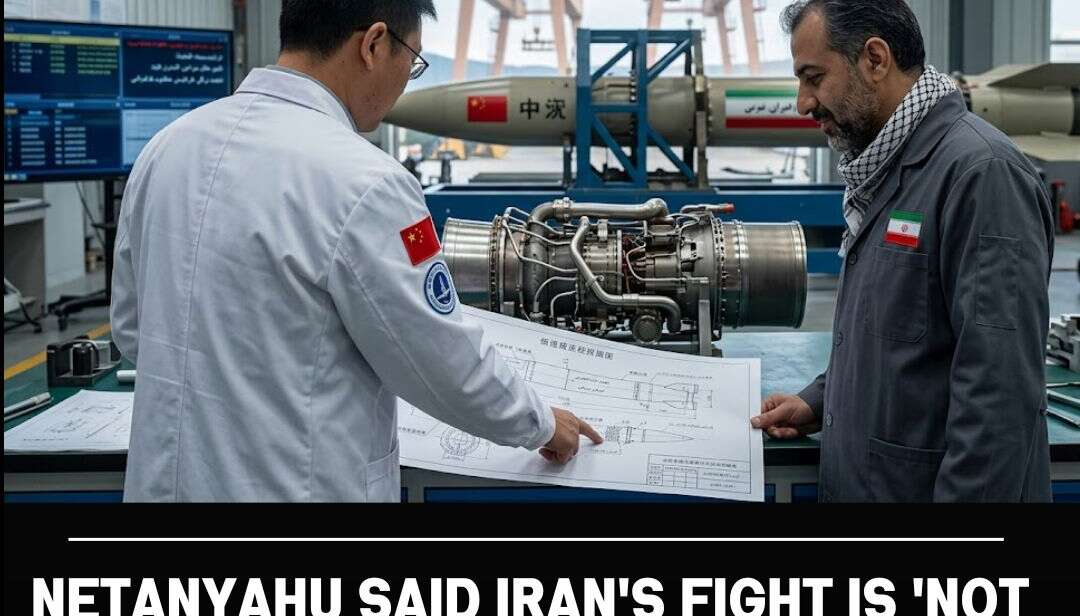
He then pivoted to a claim that drew immediate international attention: that China had provided material assistance to Iran’s ballistic missile program — supplying components, technical expertise, and manufacturing support that had meaningfully accelerated Tehran’s ability to produce and deploy the precision-guided munitions that have featured prominently in the Iran-Israel war’s most dangerous exchanges.
“China knows what it has done,” Netanyahu said, with the quiet directness that his communications team has learned generates more international attention than theatrical anger. “The world should know it too.”
The Uranium Standard: Why It Matters
Netanyahu’s insistence that Iran’s uranium must be physically removed — rather than capped, monitored, or diluted in place — is not a new Israeli position. It has been Jerusalem’s stated preference since the earliest days of the nuclear negotiations. What is new is the context in which he is restating it: a moment when US-Iran diplomatic engagement has reached its most advanced stage in years, and when the specific question of what happens to Iran’s existing enriched uranium stockpile is the central unresolved technical issue in the negotiation.
The current American proposal, as understood by sources familiar with its contents, envisions a cap on enrichment levels combined with enhanced IAEA monitoring and potential third-party custody arrangements — including the Russian proposal for transferring uranium to Moscow’s custody. None of these frameworks require the complete removal of all Iranian uranium from Iranian territory as a precondition for agreement.
Netanyahu’s standard, taken literally, would make any currently conceivable deal unacceptable to Israel — a position that, if maintained, puts Jerusalem and Washington on a collision course at the precise moment their coordination is most strategically essential.
The question analysts are urgently debating is whether Netanyahu’s uranium removal standard is a genuine red line or a negotiating position — a public marker designed to pull the eventual agreement’s terms in a more demanding direction without actually committing Israel to blocking any deal that falls short of the maximum.
Those who know Netanyahu’s negotiating history suggest the answer is almost certainly the latter. He has established maximalist public positions before — on Palestinian statehood, on settlement construction, on military operations — that have subsequently been modulated when the operational or diplomatic calculus shifted. His uranium standard may be doing the same work here: anchoring the public debate at a point that gives Jerusalem significant leverage over the final agreement’s terms without foreclosing the possibility of endorsing a framework that achieves most of what Israel needs.
The China Accusation: Explosive and Carefully Timed
Netanyahu’s claim that China assisted Iran’s ballistic missile program is, if substantiated, among the most geopolitically significant accusations an Israeli prime minister has made in years — and its timing, coinciding with the moment Beijing is projecting a stability-seeking posture toward Washington ahead of a crucial Trump visit, is almost certainly not coincidental.
Israeli intelligence has long maintained extensive files on Chinese technology transfers to Iranian missile programs — transfers that have been documented in various forms in Western intelligence assessments and UN Panel of Experts reports over many years. What those assessments have typically stopped short of is attributing Chinese assistance to direct state policy rather than corporate or intermediary behaviour that Beijing could plausibly claim occurred without official sanction.
Netanyahu’s statement does not make that distinction. By attributing the assistance to China without qualification — “China knows what it has done” — he is implicitly holding the Chinese state responsible at the highest level and demanding that Beijing be incorporated into the international accountability framework around Iran’s weapons program.
The timing serves multiple Israeli strategic objectives simultaneously. It complicates the US-China stability dialogue by injecting a specific, serious accusation that Washington cannot entirely ignore — particularly given the domestic political salience of China as a strategic threat. It pressures Beijing to choose between its Iranian relationship and its desire for a stable engagement with Washington. And it signals to Trump’s negotiating team that any US-Iran deal which does not address Chinese technology transfers to Iranian missile programs will face sustained Israeli opposition.
Beijing’s Response: Firm Denial, Calibrated Anger
China’s foreign ministry responded to Netanyahu’s accusation with the structured indignation that Beijing deploys when it believes a denial must be forceful enough to be internationally credible without being so inflammatory as to escalate the exchange beyond manageable limits.
“China firmly opposes the proliferation of weapons of mass destruction and their delivery systems,” the foreign ministry statement read. “Israel’s accusations are baseless, irresponsible, and motivated by political objectives that have nothing to do with regional stability. China urges relevant parties to exercise restraint.”
The phrase “motivated by political objectives” is significant. Beijing is not merely denying the accusation. It is characterising it as deliberate political manipulation — a framing designed to inoculate Chinese audiences and international partners against treating Netanyahu’s claim as credible intelligence rather than propaganda.
What China did not do is provide a specific technical rebuttal of the components or transfers Netanyahu’s accusation implies. That absence of specificity in Beijing’s denial will be noted by intelligence analysts as potentially meaningful.
Washington Caught Between Allies and Objectives
For the Trump administration, Netanyahu’s dual statement — on uranium removal and Chinese missile assistance — has created a diplomatic environment of acute complexity.
On uranium, Washington must now manage the gap between its own negotiating framework and Israel’s public standard without appearing to either abandon its ally’s security concerns or allow Jerusalem to veto a diplomatic process that American officials have invested significant political capital in pursuing. The administration’s response — careful acknowledgment of Israel’s concerns combined with firm assertion that the United States will “pursue an agreement that addresses the full scope of Iran’s nuclear threat” — reflects a team threading a very narrow needle.
On China, the accusation arrives at the worst possible moment for the administration’s Beijing engagement strategy. Having just received positive signals from Chinese officials ahead of Trump’s crucial visit, Washington now faces pressure from its closest Middle Eastern ally to confront Beijing on Iranian missile assistance — a confrontation that would significantly damage the diplomatic atmosphere that both sides have been carefully cultivating.
Senior administration officials have privately expressed frustration with Netanyahu’s timing, according to sources familiar with internal discussions. Publicly, the State Department has said it takes “all credible intelligence about technology transfers to Iran’s weapons programs seriously” — language that neither validates nor dismisses the Israeli claim while preserving the administration’s ability to address it through quieter diplomatic channels.
The Broader Implication: What Israel Will and Will Not Accept
Netanyahu’s statement ultimately serves as the clearest articulation yet of Israel’s bottom line in the Iran-Israel war’s diplomatic endgame. Jerusalem will not accept a deal that leaves enriched uranium in Iran. Jerusalem will not accept a deal that ignores Chinese enablement of Iranian missile capability. And Jerusalem reserves the right to act militarily against any arrangement it judges insufficient — a reservation that no Israeli prime minister has ever formally surrendered and that Netanyahu has made the operational centrepiece of his entire strategic posture.
Whether that bottom line is compatible with an agreement that Iran can politically accept is the question that the next phase of diplomacy must answer.
The fight, Netanyahu insists, is not ended. Looking at the distance between Jerusalem’s standard and Tehran’s tolerance, it is difficult to argue with him.
Market Analysis
A quick snapshot of market trends, customer behavior, and competitor movements.