
Share This Article
The US war with Iran has sent ripples far beyond the Persian Gulf reaching even the turquoise waters of the Indian Ocean, where one of the world’s smallest nations has found itself at the centre of a surprisingly sharp diplomatic incident. The United States has moved to repair fraying ties with the Maldives after Muizzu delivered a blunt condemnation of the American war with Iran, cancelled a high-level meeting with a US envoy, and publicly declared that his nation would not serve American military interests in any form.
Washington’s response was swift, deliberate, and calibrated a phone call, a request for clarification, and a careful statement that left the door open without endorsing Muizzu’s more incendiary remarks.
What Muizzu Said and Why Washington Took Notice
Maldives President Mohamed Muizzu made headlines in March 2026 when he publicly condemned the US and Israel for their attacks on Iran, issuing a formal government statement that described the strikes as violations of international law and sovereign integrity. But it was one particular remark that Iran should target US military sites and facilities in the Middle East that triggered the most alarm in Washington.
The statement was striking for a nation of fewer than 600,000 people that formally celebrated 60 years of diplomatic relations with the United States in 2026. Muizzu went further still, declaring that Maldivian territory, airspace, and facilities would not be made available for any military purpose connected to the Iran-Israel war. “The Maldives will not be used in any way, in any capacity,” he stated. The country backed the targeting of military sites while stressing no harm should come to civilians a position that drew sharp attention in Western capitals.
Here are Some Related Blogs to Read
- NATO chief calls US strikes on Iran “absolutely necessary”
- Will gold rally as US-Iran tensions escalate
- Oil jumped but the market stayed calm
- 5 takeaways from Tuesday’s 2026 primaries
- US tariff system reset across 60 economies
- Trump tariffs Section 122 surcharge expires
- Trump had deliberately paused Hormuz operations to force Iran into a deal.
- JD Vance claims Hegseth has been misleading Trump on the Iran war.
- Iran has been digging out hidden missile stockpiles after rejecting Trump’s peace offer.
The Maldives government also issued a formal condemnation of both the US-Israeli attacks on Iran and Iran’s retaliatory missile strikes on Gulf nations a studied attempt at balance that nonetheless left Washington uneasy about where Malé’s loyalties truly lie.
The Snub: A Cancelled Meeting With US Envoy Sergio Gor
The diplomatic chill had already been felt weeks earlier. On March 23, 2026, a scheduled meeting between President Muizzu and US Special Envoy Sergio Gor Trump’s designated South Asia envoy was cancelled at the last minute by the Maldivian side. No official explanation was offered. The cancellation, widely noted by regional analysts, became the clearest visible sign that Muizzu’s government was deliberately cool-shouldering Washington at a moment when the US war with Iran was consuming global attention and inflaming Muslim-majority public opinion worldwide.
Gor, who has been active across South Asia seeking to shore up American relationships in the region, subsequently moved on to Nepal and other stops but the Maldives snub remained a visible diplomatic sore point.
US Outreach: The Phone Call That Followed
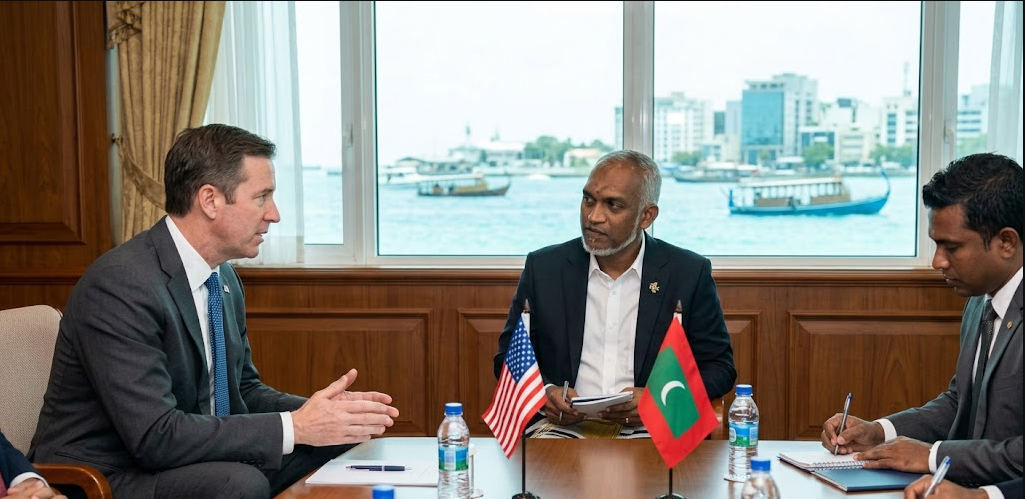
Washington did not let the rupture fester. The US Bureau of South and Central Asian Affairs arranged a phone call in which Trump’s Special Envoy Sergio Gor and Deputy Assistant Secretary of State Bethany Morrison spoke directly with Maldivian Foreign Minister Iruthisham Adam.
The purpose was explicit: the United States sought clarification on Muizzu’s remarks, particularly the suggestion that Iran should target American military installations. The Foreign Minister, placed in the delicate position of walking back her president’s words without publicly contradicting him, offered what diplomats would call a “clarification” stopping short of a retraction.
In its public statement, the US Bureau of South and Central Asian Affairs said: “On the call, the Foreign Minister helped clarify recent statements by the Maldivian President. The Minister reiterated that the President of Maldives wanted a positive relationship. We look forward to future engagements.”
The language was measured, forward-looking, and conspicuously non-committal Washington choosing to preserve the relationship while making clear the call had been necessary.
Muizzu’s Broader Pivot: Toward the Islamic World
The Iran war episode is not an isolated incident. It reflects a calculated, consistent repositioning of Maldivian foreign policy under Maldives President Mohamed Muizzu, who came to power in 2023 on a platform that included greater autonomy from traditional Western partners and a closer embrace of the Muslim world.
In early 2026, Muizzu publicly declared his government would “prioritise relations with Islamic states,” sharpening ties with Saudi Arabia, the UAE, Qatar, and other Gulf Cooperation Council nations. The Iran war has given him a geopolitical moment to publicly demonstrate that realignment — even at the cost of friction with Washington. The Maldives also praised Pakistan’s role in facilitating Iran-US dialogue, a further signal of where Malé is choosing to plant its diplomatic flag.
A Nation Economically Trapped by the Same War It Condemns
The deepest irony in the Maldives’ position is economic. Even as Muizzu condemns the US war with Iran, the Maldivian economy is being quietly devastated by it. Tourism which accounts for more than 60% of the country’s foreign exchange earnings saw cancellations surge by 23.4% in the first week of March 2026 alone, as the Iran war unsettled global travel markets.
The island nation imports approximately $443.6 million worth of diesel annually nearly all for electricity generation and with oil prices exceeding $100 per barrel since the conflict began, the Maldives faces additional monthly foreign currency outflows exceeding $6 million. Usable foreign exchange reserves stand at below one month of imports. External debt repayments exceed $1.5 billion in 2026 alone.
The Maldives Policy Think Tank has described it bluntly: the nation faces a “perfect storm” of vulnerabilities geographically exposed, fiscally fragile, and now diplomatically adrift between a superpower it relies on and a religious identity it is increasingly choosing to lead with.
What Happens Next
For now, Washington appears willing to accept the Foreign Minister’s “clarification” as sufficient to keep the bilateral relationship functional. But analysts note that Muizzu’s domestic political calculations appealing to a Muslim-majority electorate inflamed by images of the Iran war are unlikely to change regardless of what his foreign minister says on a diplomatic phone call.
The question facing Malé is how long a nation of its size and economic fragility can afford to antagonise Washington while simultaneously depending on global stability and American-underwritten security for its very survival.

Oil & Energy Markets
A look at crude price swings, OPEC supply moves, and how energy markets react to geopolitical shocks.

Geopolitics & Conflict
Breaking down how wars, ceasefires, and diplomatic deals ripple through global trade and security.
US Foreign Policy
Coverage of Trump administration negotiations, sanctions, and strategic decisions shaping world events.
Economy & Inflation
Tracking how commodity prices, gas costs, and supply chains affect everyday consumers.